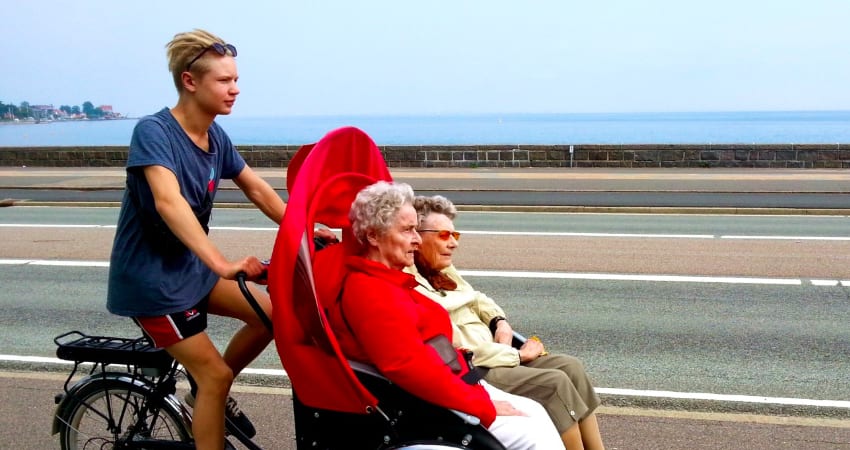
Bicycling is a fun hobby for all ages, and for many older people it’s a part of their cherished childhood.
But just because people get older, and their mobility may get limited, it doesn’t mean they have to give up the things that give them joy.
Even something as simple as riding a bike, having the wind blow through their hair and taking in the views.
It was from this that Ole Kassow created the Cycling Without Age movement.
Ole wanted to help the elderly get back on their bicycles, but he had to find a solution to their limited mobility.
The answer was a trishaw – which is essential a bicycle with a two seater bench attached to the front. And from there he started offering free bike rides to the local nursing home residents.
The movement has grown since it’s humble beginnings in 2012, and is now done in more than 33 different countries around the world.
Currently there are more than 300 chapters around the world that offer Cycling Without Age with over 1,300 trishaws.
More than 10,000 pilots ensure that the elderly get out of their nursing homes, out on the bikes to enjoy the fresh air and the community around them. They give them the right to wind in their hair.
Cycling Without Age have five core principle that go beyond offering free bike rides, and could be applied to any hobby or aspect of aged care;
Life does not end when you turn 75. Life unfolds at all ages, young and old, and can be thrilling, fun, sad, beautiful and meaningful. Cycling Without Age is about letting people age in a positive context – fully aware of the opportunities that lie ahead when interacting in their local community.
Cycling Without Age is based on generosity and kindness. It starts with the obvious generous act of taking one or two elderly or less-abled people out on a bike ride. It’s a simple act that everyone can do. Being generous in everyday life, to the elders who have been an integral part of our society is a way of giving back to them.
In the hustle of everyday life, slowness allows you to sense the environment, to be present in the moment and it allows people you meet along the way to be curious and gain knowledge because you make time to stop and talk.
Elderly people have so many stories that will be forgotten if we don’t reach out and listen to them. We tell stories, we listen to stories on the bike and we also document the stories when we share them via word of mouth or on social media. Storytelling is a way to connecting with each other at a deeper personal level.
Cycling Without Age is about creating a multitude of new relationships: between generations, among the elderly, between pilots and passengers, nursing homes employees and family members. Relationships build trust, happiness and quality of life. Through creating strong bond with older people, it allows them to feel connected and reduces the chance of them feeling socially isolated – something that can be common for many older people.
What do you have to say? Comment, share and like below.


