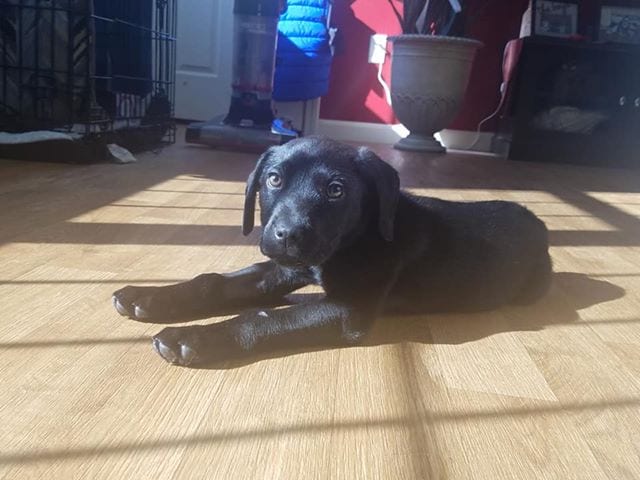
Animals that find themselves living in rescue shelters are often viewed as having something wrong with them, but enduring a lifetime of mistreatment or health complications should not be viewed as imperfection.
At this very moment, millions of animals from around the globe sit patiently awaiting the arrival of a savior who has the compassion and ability to meet their needs, and every now and then, there is a match that is so perfect that it seems as though the owner and their four-legged friend were destined to be together.
Emerson is black labrador-mix who was rescued from a foster-based animal rescue shelter in US state of Maine.
At only six-weeks-old, Emerson began suffering from seizures and an infection called canine parvovirus, and it was soon realised that this beautiful young pup was also deaf.
After enduring such a tough start to his young life, the staff at the animal rescue facility, NFR Maine, set out on their quest to find an owner who was willing to adapt to meet the needs of Emerson.
But never in their wildest dreams would they imagine that destiny would come knocking so quickly.
After posting about Emerson on Facebook, the team at NFR Maine received an inquiry from a 31-year-old man by the name of Nick Abbot who believed that he had the ability to build a special bond with Emerson.
And as fate would have it, Nick Abbot also happened to be deaf.
Within a day the team had processed Nick’s application to adopt Emerson, and it was clear from the outset that these two were meant for each other.
When Nick and his mother first met Emerson, the young puppy ran straight up to Nick and sat directly at his feet and the bond was instantaneous.
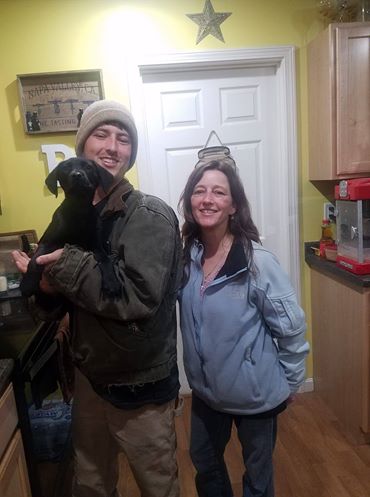
In an interview with the famed American talk show, Good Morning America, Nick’s mother revealed that her son has even taught Emerson sign language.
“So far, he’s taught Emerson to sit, lie down, and come by signing,” said Rochelle Abbot
If Nick reaches up and shakes his ear lobe, Emerson will bark—it’s so cute,” said Richelle, adding that they were “meant for each other.”
Nick’s mother believes the bond between her son and Emerson is nothing short of amazing, revealing that whenever the pair are together – Emerson is always looking for a way to sit or lean on Nick.
Nick and Emerson currently have a joint Instagram account that has captured the hearts and minds of over 22,000 followers, and the pair also have a children’s book called “I Picked Him: The Nick and Emerson Story.”
Proceeds from their book will be used to help animal rescue programs and shelters as well as charities for the hearing impaired and disabled.
There is an age-old belief that dog owners begin to resemble their pets over a long period of time, but Nick and Emerson are proof that the love that lives inside us is what brings animals and humans together in the first place.


