



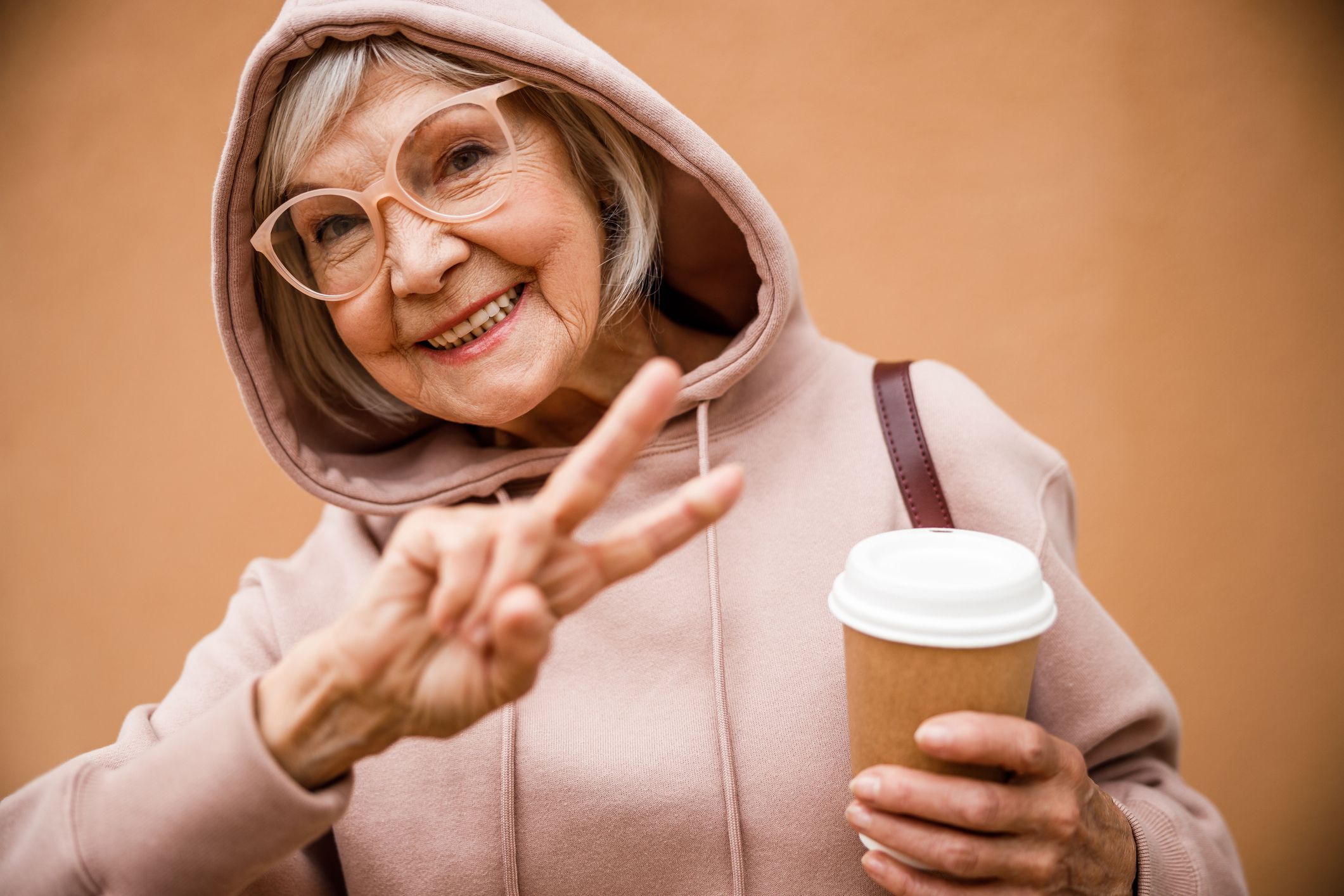
“Honestly, I can’t wait to have grandkids and spoil them — but I don’t want to be called ‘Granny’” (overheard on the No. 96 tram in Melbourne)
“I love it. It’s not the word that needs to change, it’s our culture” (Deborah, proud granny)
What’s wrong with “granny”?
From its debut in the early 1600s, “granny” has been more than an affectionate term for grandma — and a cursory glance at its history tells a depressingly familiar story.
First, the instability and decline of words associated with women. “Granny” joins a long list of words, particularly for older women, that that have acquired negative meanings — spinsters were originally spinners; sluts were untidy people; slags and shrews were rogues; scolds were poets; bimbos were men, and so on. Many started life referring to men, but quickly narrowed to female application — and with this sexual specification came further decline.
Right from the start, grannies were also people engaged in trivial (often self-serving) chatter; in other words, grannies were gossips, tell-tales and nosy parkers. In the 1700s, more negative meanings piled on — grannies became fussy, indecisive or unenterprising persons, and in many places stupid as well.
The online crowdsourced Urban Dictionary now has a flourishing of additional disparaging senses for “granny” that have yet to make it into more mainstream collections.
In sport, grannies refer to those who perform poorly, or they’re a kind of dead leg injury (which leaves you “hobbling around like an old granny for the rest of the day”).
“Don’t be a granny”!
Tellingly, the negative uses of granny have never been restricted to women — one 19th-century dictionary defines “granny” as “a simpleton: used of both sexes”. It’s another telling asymmetry in our lexicon. Terms for women are insulting when used of men (“Dad, don’t be such a granny”), but terms designating men when used of women have little or no affront. If you were to call a women a grampa or an old man, there’s really no abuse — it just seems odd.

Shutterstock
Unflattering “granny” compounds are plentiful in English: a “granny knot” is one that’s inexpertly tied, while “granny gear” is an extremely low first gear. New ones are arriving all the time: “granny weed” is low-quality marijuana that is old or dried out; “granny shot” is said of a basketballer with little skill; “granny mode” in video games is a slower speed than normal, “granny pants” (like other “granny-like” items) are naff “old lady” styles (in the fashion world, the phrase ‘not your granny’s’ describes edgy or trendy clothes — not fashion choices made or worn by grandmothers). The Oxford English Dictionary gives 29 “granny” compounds, but provides not a single compound with “grandpa”, “grampa” or “gramps”.
These terms for one’s grandfather have also been remarkably stable over time. This dictionary gives a single definition: “One’s grandfather. Also used as a familiar form of address to one’s grandfather or to an elderly man”. Even Urban Dictionary, not known for its politeness, has little in the way of slangy senses for “grandpa” or “gramps” — the closest are playful entries referring to older men or grandfathers. You might compare “codger” or “geezer” — sure, they’re not exactly flattering, but they don’t pack anywhere near same punch as do “crone”, “hag”, “battle-axe”, “old bat”, “old bag” and so on.
Granny goodness and greedy granny
Current films, comics and games reveal another way words for women evolve. To set the scene, consider the fate of “witch”, now a slur for older women. Originally, witches could be male sorcerers, but when used of women they became something very nasty — witches were females who had dealings with the devil. Our jokey image of witches these days can’t capture the potency of this word in early times, but it has never completely shed its connotations of evil. We still retain abusive epithets like “(old) witch” and also expressions like “witches’ cauldron” to describe sinister situations. And now here’s granny in the very same cauldron.
Granny Goodness is one of the most well-known evil grannies in entertainment. Known for her cruelty and manipulation, this super villain hides under a façade of grandmotherly affection. Granny is a survival video game where the main antagonist, Granny, is a hideously sadistic serial killer who locks people in her house and taunts them for days before brutally killing them.
Then there’s Granny Rags, a mad, decrepit old woman whose vulnerable and destitute appearance conceals a very dark nature underneath. Of course, there are sometimes dark older male figures too, but they’re not explicitly grandfathers (for example, Emperor Palpatine in Star Wars or Dr Wily, an older, mad scientist who creates robotic menaces to achieve world domination). And they’re not in the same league as those decrepit, old, malicious women — the “witches” of pop culture.
And now there’s the Greedy Granny toy for the little ones. The aim is to steal from this grasping grandma and get away with it.
Words make worlds
Words are declarations of social attitudes and belief systems. Through the way we speak, the words we use and our interactions, the language reveals and reinforces psychological and social roles — status, power dynamics and relationships. Here is some context for grannies:
• older women are the lowest income earning family group
• 34% of single older women live in poverty
• 60% of older women leave paid work with no super and women with super have 28% less than men
• 60% of older women rely entirely on the old age pension
• 40% increase in homelessness for older women
• older women are more likely to experience workplace discrimination
• 23% of women aged 60 years+ have experienced intimate partner violence.
Don a granny cardy
Negative senses of expressions have a saliency that will dominate and eventually expel other senses. This transformation has a name: Gresham’s Law of Semantic Change (“bad meanings drive out good”).
So what can be done to help drag “granny” out of this semantic abyss?
Many older women are giving themselves the term and doing this playfully or as a way to reclaim power (for example the Pasta Grannies and the Granny Grommets). Reframing expressions in this way may not neutralise them, but it can make us more aware of the lurking prejudices.
And why not slip into a cardigan? September 22 marks the world’s first Cardigan Pride Festival. Australians around the country will don cardigans in a call to combat the inequalities older women face — and to show they’ve got older women’s backs (and shoulders) covered.
Kate Burridge, Professor of Linguistics, Monash University and Catherine Barrett, Director, Celebrate Ageing Ltd, La Trobe University
This article is republished from The Conversation under a Creative Commons license. Read the original article.


