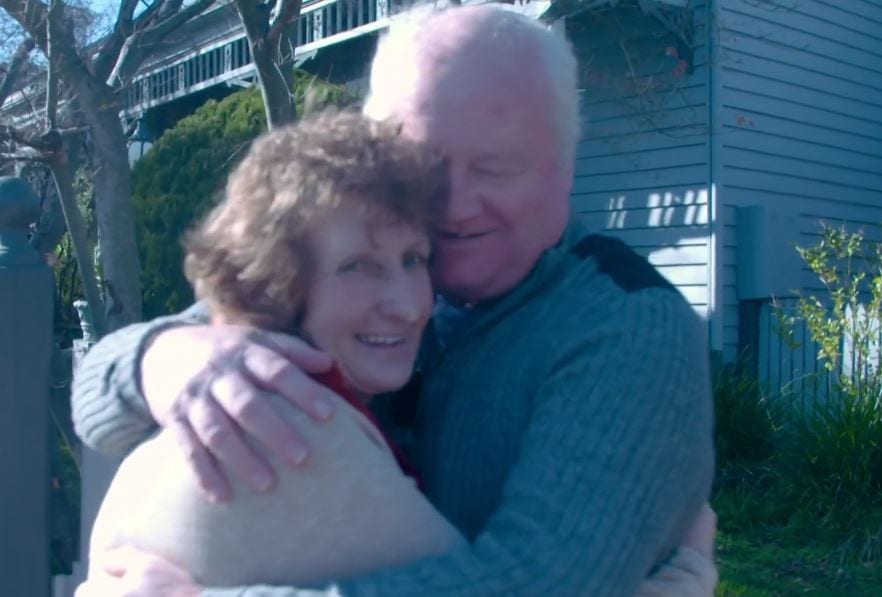
When it comes to cognitive impairing diseases like Alzheimer’s, quite often the warning signs present themselves to the ones around us long before the person displaying the symptoms comes to the realisation that there might be an issue.
After 42 years of marriage, it’s safe to say that on some level you may actually know more about your partner than they know about themselves, and this is why 60-year-old Kathy Barnbrook became suspicious when she noticed a number of changes in her beloved husband Kelven.
“The first thing that I saw was a real change in mood,” said Kathy.
“Kelven is a really passive person by nature, and up until about four years ago he never argued with me about anything, but all of a sudden he became more argumentative.
Initially, a number of visits to the doctors provided no insight into what Kelven was actually dealing with, as GP’s declared that changes in Kelven’s temperament were most likely the result of stress.
“The next thing I noticed was his driving. Kelven has always been one of those people that only have to drive somewhere once, and then he could practically drive home with his eyes closed.”
“He started to get lost really easily while driving, and then he started forgetting other things.”
Unconvinced by the initial diagnosis, Kathy continued to seek out medical advice until a doctor diagnosed Kelvin as having Alzheimer’s disease in 2017.
“After 42 years of marriage, you just know. It was almost a relief to get a proper diagnosis after so long.”
After Kelven’s diagnosis, Kathy sought out a variety of information on Alzheimer’s treatments and implemented a number of dietary changes in the hope that they produce positive results.
Kathy had heard about the positive health benefits of consuming spices like turmeric, curcumin and even chilli, and began incorporating them into Kelven’s diet in the hopes of slowing the progression of her husband’s disease.
“It was a real struggle to feed him, to be honest. Some days he wanted to eat and other days he didn’t want to eat. His taste buds have changed a lot. He loves the chilli though, and he has it with just about every meal.”
As Kathy’s research continued, she stumbled upon a product called Souvenaid®. She then spoke to her doctor about it upon their next visit and decided to give it a go.
Souvenaid is a food for special medical purposes that nutritionally supports memory loss in early Alzheimer’s disease. It contains a unique combination of nutrients, which supports the growth of connections within the brain, known as synapses.
One of the main issues that Kelven was experiencing with his Alzheimer’s was feeling ‘fuzzy’ in the mind, which is a symptom that is often referred to as ‘brain fog,’ but according to Kathy, this problem has actually regressed since Kelven began using the product.
“It stopped the fuzzy head, and that was one of the complaints that he had from day one, along with forgetting things and all the rest of it. He might still feel fuzzy every now and then, but it doesn’t happen anywhere near as much as it used to.”

“It seems to have really added a bit more quality to Kelven’s life, and I mean, he is only 61 years old, losing any quality of life at that age is really distressing. We are happy that something has actually had a positive effect.”
While there is currently no cure for Alzheimer’s disease, there are a number of available products that can reduce the symptoms of Alzheimer’s and improve the quality of life for some people.
“The doctor actually told us that he is at the same point in terms of cognitive ability as he was 6 months ago, and to be honest, right now, he is actually fixing a burst pipe in the backyard.”
“I know a lot of people struggle to find things that work when it comes to Alzheimer’s, but we are just happy that Kelven has really responded well to this. We give him his Souvenaid and try to keep him busy, and it has had a really positive effect on his quality of life.”
Souvenaid® is a food for special medical purposes for the dietary management of early
Alzheimer’s disease and must be used under medical supervision
This article is not intended as medical advice and is merely information – not advice. If readers need medical advice, they should consult a doctor or other appropriate medical professional.



Kathy that’s wonderful news. Always good to keep a look out for new stuff. I will pass this info on,
I know you would have investigated everything for him to make him feel better. I was listening yesterday to a health summit on Dementia and they said taking Non flush niacin, (niacinamide ) B12 (methyl) plus oils like fish was the most important thing.
this is my grandfather wtf