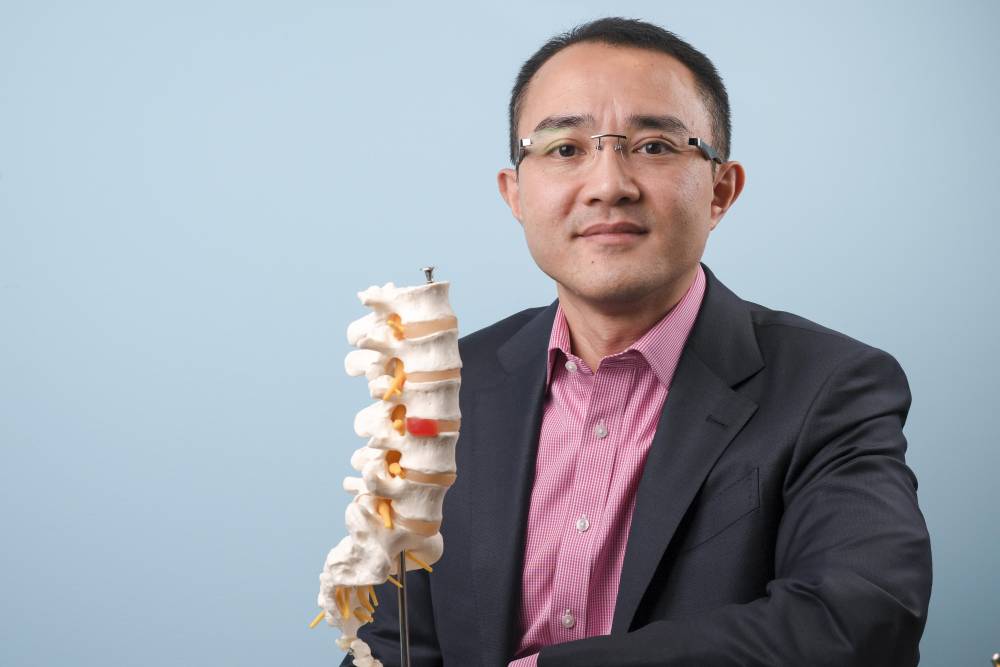
Dr Michael Wong, an experienced Neurosurgeon and Spinal Surgeon, had no idea his life would be turned upside down on what was supposed to be a normal day at work.
In 2014, his life changed when he arrived for work at the Western Hospital in Footscray and was stabbed 14 times in his arms, chest, abdomen and forehead by a mentally ill patient in a frenzied attack. Horrified staff and patients ran to his assistance and he was immediately rushed to surgery.
From this attack, he suffered life-threatening injuries. Multiple teams of surgeons including two colorectal surgeons, two cardio-thoracic surgeons, a spinal surgeon and three plastic surgeons were operating for 10 hours to save his life. Dr Wong bled profusely from a deep wound to his back, piercing one of his lungs. He lost his entire blood supply during surgery, which resulted in the partial removal of the injured lung to stem the bleeding.
When stabilised, Dr Wong was transferred to the Royal Melbourne Hospital. He had intensive treatment for many days in hospital before returning home to spend six weeks with both arms and hands in splints, followed by months of painful physiotherapy rehabilitation exercises to regain all movements in his arms and hands.
The near death experience has had a huge impact on Dr Wong’s life and changed him personally and professionally. The biggest significance of this experience is that he has become a more compassionate doctor after experiencing treatment and recovery from a patient’s perspective.
“Following my attack a few years ago, I have transformed the way I work to ensure that patients receive not only the best level of medical care, but also the best level of compassionate care so that they have a positive journey when dealing with their medical issues,” says Dr Wong.
“I have personally experienced what it feels like to be in a lot of physical pain and needing to undergo many months of physiotherapy rehabilitation. The attack has given me a much deeper understanding of what patients go through when they face significant physical setbacks and life events, and what it means to deliver the compassion and empathy that people need, not just the medical treatment.”
Since his incident, Dr Wong has improved the way his practice operates to ensure that patients benefit from the medical system and encourages other medical professionals to do the same.
“Doctors need to take the time to hear a patients’ needs, concerns and past medical history before providing a thorough assessment. Sometimes significant details can be overlooked due to time, but seeing and caring for a patient as a human should always be the first priority.”
In terms of treating neck and back pain, Dr Wong says, “It is important to find out the source of the problem and ensure each individual patient is given the right solution and long-term treatment, not just a ‘Band-Aid’ solution to temporarily fix their pain.”
Embracing a holistic approach in pain management, Dr Wong strongly supports physiotherapy and hydrotherapy combined with other resources like meditation and cognitive based therapy to optimise recovery to normal life.
After experiencing this shocking incident, Dr Wong sees the importance of promoting increased hospital security to protect the healthcare workforce.
It is with great sadness for Dr Wong and his family to see another family suffer and lose their beloved husband and father, the Late Dr Patrick Pritzwald-Stegmann, to hospital violence.
“I want to use my experience to make sure that hospital security is not overlooked in an era of tight health budgets. Entrances for hospital staff, restricted access to wards and regular security patrols of public areas are some of the measures needed to prevent repeat attacks. An increased security presence in hospitals will deter violence and increase dialogue between hospital staff and administrators.”


