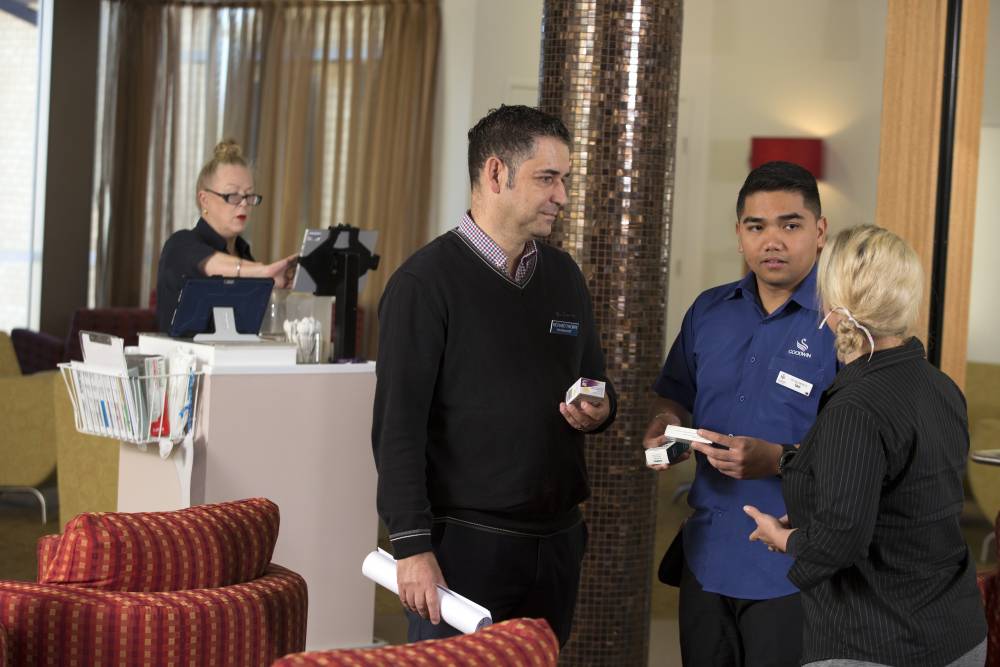
A pharmacists’ peak body has described Goodwin’s residential care pharmacist role a best-practice example, as aged care consumers share feedback on its first year in action.
Aged care consumers shared positive experiences of Australia’s first embedded residential care pharmacist at the launch of the Pharmaceutical Society of Australia’s annual Medicine Safety: Aged Care report.
Medicine Safety: Aged Care calls for medicine safety to be a national priority, and for investment towards pharmacists becoming fixtures in collaborative health care teams for aged care recipients.
The report was launched at Parliament House, Canberra on 26 February.
Goodwin Aged Care Services, an ACT not-for-profit, employed Australia’s first embedded pharmacist in December 2018, following a feasibility trial and research project with University of Canberra.
‘In my opinion, every care facility should have a pharmacist like ours’, Goodwin resident Jean Fry told the audience of Society members and parliamentarians.
Over 95% of people living in aged care facilities have at least one problem with their medicines detected at the time of a medicines review, the report says. And one fifth of aged care residents are on antipsychotics, with more than half of those using the medicine for too long.
Goodwin reports the number of residents taking benzodiazepines across all three sites has reduced by 48% since February 2019.
‘Traditionally, pharmacists would visit facilities to do medication reviews and they may not return to any specific facility for two to three months,’ said Goodwin pharmacist Richard Thorpe.
‘They don’t get the chance to build up relationships with facilities’ staff and the residents as I am able to do.
‘As we age, our responsiveness to medication changes as well, so it’s important to check in with people regularly to ensure they’re responding to medications as they should, and be able to respond promptly and appropriately when needed.’ Richard said.
Case conferencing with the whole team, including pharmacist, ‘gave me confidence that I could make an informed decision and both understand and agree to the changes proposed,’ said Peter Heaume, son of former Goodwin residents and speaker at the report launch event.
‘I have formed a view that the value of pharmacists comes from their knowledge of the, for want of a better term, mechanics of drugs,’ said Peter. ‘Drug treatment is a balancing act aimed at providing the best quality of life achievable. Pharmacists can play an important role in that, working with doctors to identify the best combination of drugs for each patient.’
Associate Professor Chris Freeman, National President of the Pharmaceutical Society of Australia said, ‘Now is the time to do more for residents of aged care in Australia. To provide a safe environment that minimises medicine harm and maximises the role of pharmacists as the stewards of medicine safety’.
Embedding pharmacists with aged care facility teams is one of ten recommendations from the Pharmaceutical Society. They also recommend renumeration for pharmacists to participate in case conferencing, and to engage in the cycle of care through follow-up medication reviews and removing the cap on medication reviews.
‘The clinical, operational and economic evidence from Goodwin’s experience will be useful to inform funding models for pharmacists to be placed within the clinical teams in residential care facilities,’ said Goodwin chief executive, Sue Levy.
‘We continue to learn and develop but the results have exceeded our expectations and we are pleased to see the issue on the national agenda.’
You can find the report on the Pharmaceutical Society of Australia’s website.


