The COVID-19 pandemic has presented a challenging time for the whole of society.
Businesses are closing and staff are being made redundant, as we make both personal and economic sacrifices to ‘flatten the curve’ and support our primary healthcare workers and the public health system.
It’s more than that though, it’s also to support those who are most at risk, our sick and elderly.
We are now seeing aged care providers shut their doors. Some are following the government’s new recommendations on visitor contact and others are locking down completely.

Resident’s usual activities are being cancelled or modified, as homes try to adhere to the strict social-distancing guidelines. It’s likely that in the near future as the virus continues to spread, that more homes will be affected, and these rules will tighten even further. If we use our overseas friends as a guide, at some point residents will inadvertently be isolated to their rooms for extended periods.
The priority for every home is, of course, to protect the older people in their care; a sentiment echoed by the CEO of Aged and Community Services Australia (ACSA), Patricia Sparrow, at a recent Older Person’s Advocacy Network (OPAN) webinar. We need to take an equally proactive approach to preventing the risks associated with inactivity and isolation.
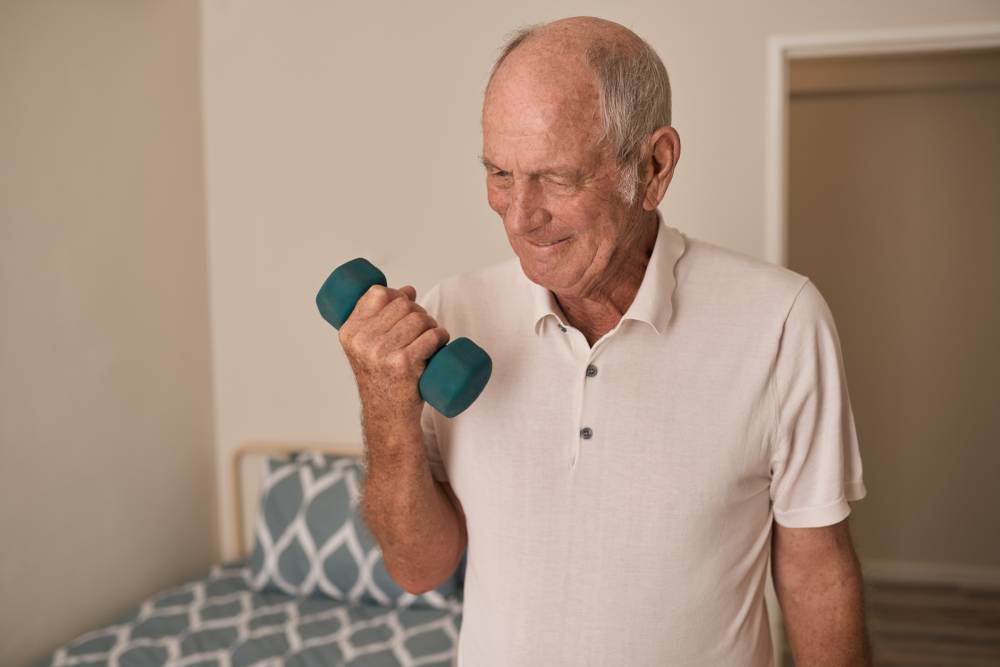
Aged care homes now see the value of daily exercise. This is usually promoted through group exercise programs, walking groups or games related activities. Many residents also receive individual exercise programs as allied health staff distance themselves from traditional pain management service models. These programs not only hold physical benefits, but also contribute to better social and psychological outcomes.
With Covid-19 restrictions, this could all change.
We know from hospital-based studies that inactivity results in a reduced functional capacity of multiple body systems, especially the musculoskeletal system. Furthermore, it causes numerous physiological adaptations in all organ systems, often with negative consequences.
Total inactivity has been shown to result in as high as a 20% decrease in muscle strength per week; in a 3-5 week period complete immobilisation can lead to a 50% decrease in strength, with the postural muscles being most effected.
On top of this, reduced movement increases the risk of contracture development, disuse osteoporosis, decreases in cardiovascular health, pressure injuries, gastrointestinal problems, increased incontinence, cognitive decline and major psychosocial complications.
So, how can we avoid all of these complications of inactivity?
The commute to the dining area and exercise programs are often the only opportunities residents have for physical activity throughout the day. As residents become increasingly isolated, we’re going to need to find more opportunities.
Most homes will continue to have access to their allied health professionals, who are always a great resource for creative exercise ideas. However, it’s likely that their time will become increasingly occupied by referrals and additional tasks. At this point, carers will become the people best placed to assist residents to stay active.
Some simple ideas to increase resident activity levels during isolation include:
Guide Healthcare has also created the ‘Get Up Guide’, a free and simple training program for carers which will give them ideas and different exercises to encourage residents to get up and move each day. The training is delivered through short videos, which can be shown during staff handovers or in the break-room. Each video comes with a summary handout sheet, which covers the daily exercises and has a log where residents can record their efforts. The program also includes a weekly live exercise session with a Guide Healthcare physiotherapist through zoom.com. And weekly exercise challenges to create some fun, help to build some community connection and generate a purpose for exercising.

We hope that through this program we can help to tackle some of the physical, social and psychological effects of isolation and reduced activity. Access to the videos and exercises is free, and you can join in specially designed Zoom exercise classes every Thursday.
For more information and to gain access to these free resources for your staff and residents, send an email to simon@guidehealthcare.com.au.
Image: Goodboy Picture Company, iStock.





