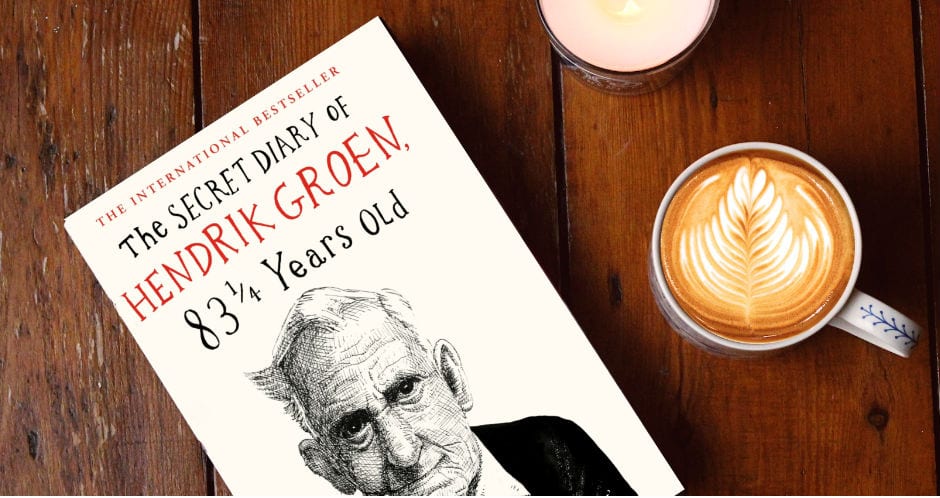
With my interest in ageing issues, I couldn’t resist a book with the title The Secret Diary Of Hendrik Groen, 83¼ Years Old. And, having now read it, I’m so glad I didn’t (resist it, that is).
I have to admit that it did take me a little way in to be totally captivated by the remarkable Mr Groen and his resolve to keep a daily diary of his life in a retirement home. But perseverance paid off, and this is not only a fascinating read, but a highly illuminating one for those of us who are interested in how old people might be cared for if they need some level of residential aged care – which is something that should concern us all.
The background to this book is also fascinating: it started as a series of pieces in a Dutch magazine, purporting to be extracts from the diary of an old resident living in a retirement home, and recording the ups and downs of his life there, as well as of his friends, enemies, and assorted staff. The pieces, which managed to combine humour with a dour realism, came to the attention of the Publishing House Meulenhoff, and the ensuing book has become a runaway best seller, with over 60,000 copies sold in the Netherlands, and the rights being sold to 25 countries as well as to Dutch television.
The intriguing element of Henri Groen (a nom de plume) is whether he is writing a diary from real life, or as a fictional character. For me, the latter is the more likely possibility, but if so, it is clearly written by someone who has a deep understanding of life in his purported circumstances. And there is, too, the mystery of whether it is being written by someone who is actually ageing, or by a younger person who has developed a deep understanding of the sorts of declines in capacity that Groen is documenting.
Wherever the truths lie, we are fortunate to now be able to find out about his life for ourselves, as the English language translation was published this year, to deservedly enthusiastic reviews. I have to admit that at the beginning of the book I was sort of wondering how it was going to work, as a record of someone living in fairly restricted circumstances. But I can assure you that it’s worth persevering as a brave view of a person striving to make to most of those circumstances, and the sorts of relationships that can be formed to help give continuing meaning in old age.
In addition, however, it doesn’t downplay the very real difficulties of keeping one’s spirits up in an institutional setting over which one has very little control, and in which – over time – there is also the challenge of coping with the variety of problems of an ageing body and mind, both one’s own, and of those fellow residents to whom one feels close.
As I got deeper into his life, the similarities to One Flew Over the Cuckoo’s Nest struck me, as they did a fellow reader, Charlotte Heathcote, who reviewed this book in the British Express. In her words, it could also be read as “another comi-tragedy concerning the tyranny of institutions of the unwanted.”
While the Director, Mrs Stelwagon, is not the power-crazed Nurse Rached, in her own way she too casts a shadow on the lives of the residents in her care. Another reviewer, Paul Bailey of the Literary Review, pointed out that Groen “doesn’t turn her into a convenient monster, but depicts her – as she goes about her steely business – as an ambitious woman determined to maintain the rules with which she has been entrusted by the management. She has no imagination and therefore no compassion.”
At the same time, the book has many delightfully humorous episodes, several of them engineered by Groen in his aim of making the most of his present, and including the setting up – with a coterie of likeminded friends – of The-Old-But-Not-Dead Club, whose Number One rule is that “The goal of the club is to increase the enjoyment of advanced age by arranging outings.” These outings turn out to be very different to the sorts arranged by their “carers”.
And, as Heathcote summed it up, despite the high points, “The Secret Diary is a devastating dissection of the care-for-the-elderly business.” Meulenhoff publisher Paloma van Dijck would agree with that, telling Publishers Weekly that she believed that “much of the title’s success is owed to word-of-mouth….[because] the book’s subject matter is striking a chord with a diverse population. ‘We think that the topic [Groen] is writing about is a very important one nowadays. The way we treat the elderly in our society says a lot about the values a country holds high.’”
As our population ages in Australia, many of us have had direct or indirect experiences of assisted care living, and know the standards are very variable. We understand the pressures that these often short-staffed institutions are working under, and the importance of working towards giving a high value to a high standard of compassionate and informed care.
The Secret Diary deserves to be widely read for its illuminating insights, with the capacity of these insights to contribute to the raising of awareness in both potential consumers and the providers of such institutions, of the need to work towards making such standards the norm, rather than a matter of luck. In its way, therefore, this book has the potential to reinforce the aspirations of the Aged Care Report Card.
And it’s good news that there are more insights to come, from a follow-up volume of the diary which is now in press, and called As Long As There Is Life – The Second Secret Diary Of Hendrik Groen – 85 Years Old.
Anne Ring ©2016


