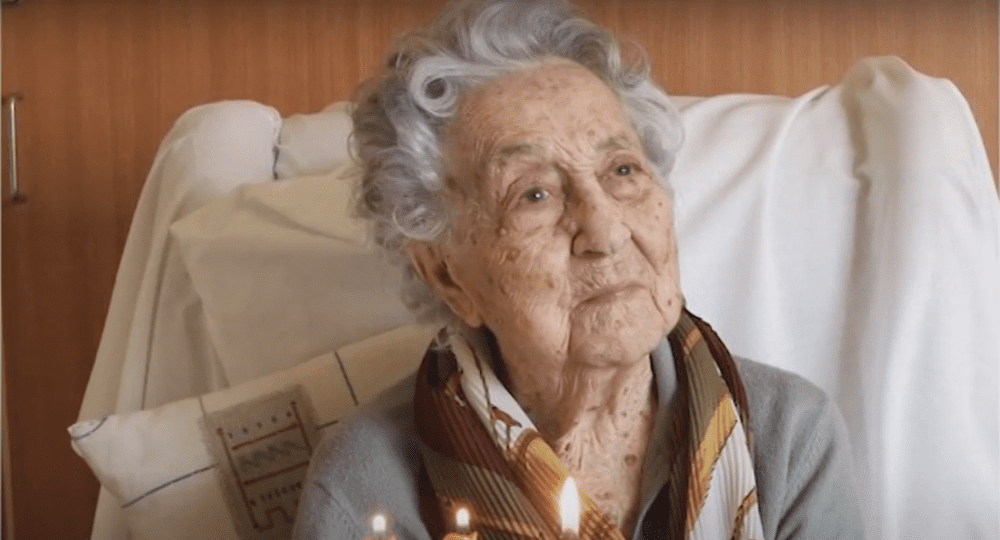
A 113-year-old woman, who is believed to be the oldest living person in Spain, has told staff at the care home where she lives she is “fine” after recovering from COVID-19.
In a video taken at the Santa Maria del Tura care home in Olot, in northern Spain’s Catalonia region, Maria Branyas told the director of the home she is only suffering some “minor annoyances” that “anyone can have”.
Ms Branyas was born in San Francisco in the United States on 4 March 1907. Her father was from northern Spain and worked as a journalist in the US. The family moved to Spain on a boat during World War I, when Ms Branyas was a young child.
Ms Branyas had three children, and remembers both world wars and the Spanish Civil War. She lived through the Spanish flu pandemic of 1918-19, which killed 50 million people world-wide.
Regional television TV3 broadcast images of the centenarian once she had recovered from the illness, showing her saying staff had been “very kind, very attentive”.
Her daughter, Rosa Moret, told the station her mother was “in shape, wanting to talk, to explain, to reflect, she has become herself again.”
📽 | Maria Branyas, who at 113 is Catalonia and Spain’s most senior citizen, has overcome Covid-19 having experienced only “mild” symptoms and becoming quite possibly the world’s oldest person to survive the disease.
📝 | Find out more: https://t.co/xsK6u6047v pic.twitter.com/nqxt0Jjqd2
— Catalan News (@catalannews) May 12, 2020
On 1 April, Ms Branyas’ care home revealed it had recorded 17 coronavirus-related deaths among its elderly residents.
Due to the outbreak, only one worker wearing full protective equipment at all times had been able to care for Ms Branyas. But the highly infectious nature of the disease meant the centenarian still contracted the deadly virus.
Ms Branyas confined to her room, alone, for weeks, but fortunately only developed mild symptoms.
Ms Moret told the Catalan News Agency the family was extremely worried only a few weeks ago.
Though she was not able to see her mother in person, Ms Moret spoke to her every day and said she remained “calm and optimistic”.
Maria Branyas, 113, said, “I won’t be able to help you…. But believe me, you need a new order.” https://t.co/TsfMAhmv9V
— HuffPost Politics (@HuffPostPol) May 13, 2020
A spokeswoman for the Santa Maria del Tura residence, where Ms Branyas has lived for 18 years, told AFP, “She survived the disease and is doing fine.”
“She feels good now, she took a test last week and the result was negative,” the spokeswoman said.
Spain has recorded nearly 27,000 COVID-19 deaths so far, making it one of the world’s worst-affected countries.
Older people are particularly vulnerable to COVID-19, and it is believed that around one-third of all European deaths may have been in ‘care homes’, the European equivalent of our aged care facilities.
Spain has been in a state of emergency since 14 March, but as infection and death rates begin to decline, the nation is beginning to lift strict lockdown measures in some areas.
Restrictions are not currently being lifted in Olot, where Ms Branyas lives.
In March, Ms Branyas received global media attention when she turned 113. Maria Rosa said her mother remains humble despite her newfound fame, and says “being healthy” is the secret to her renowned longevity.
Image: MariaBanyas112 Twitter.


