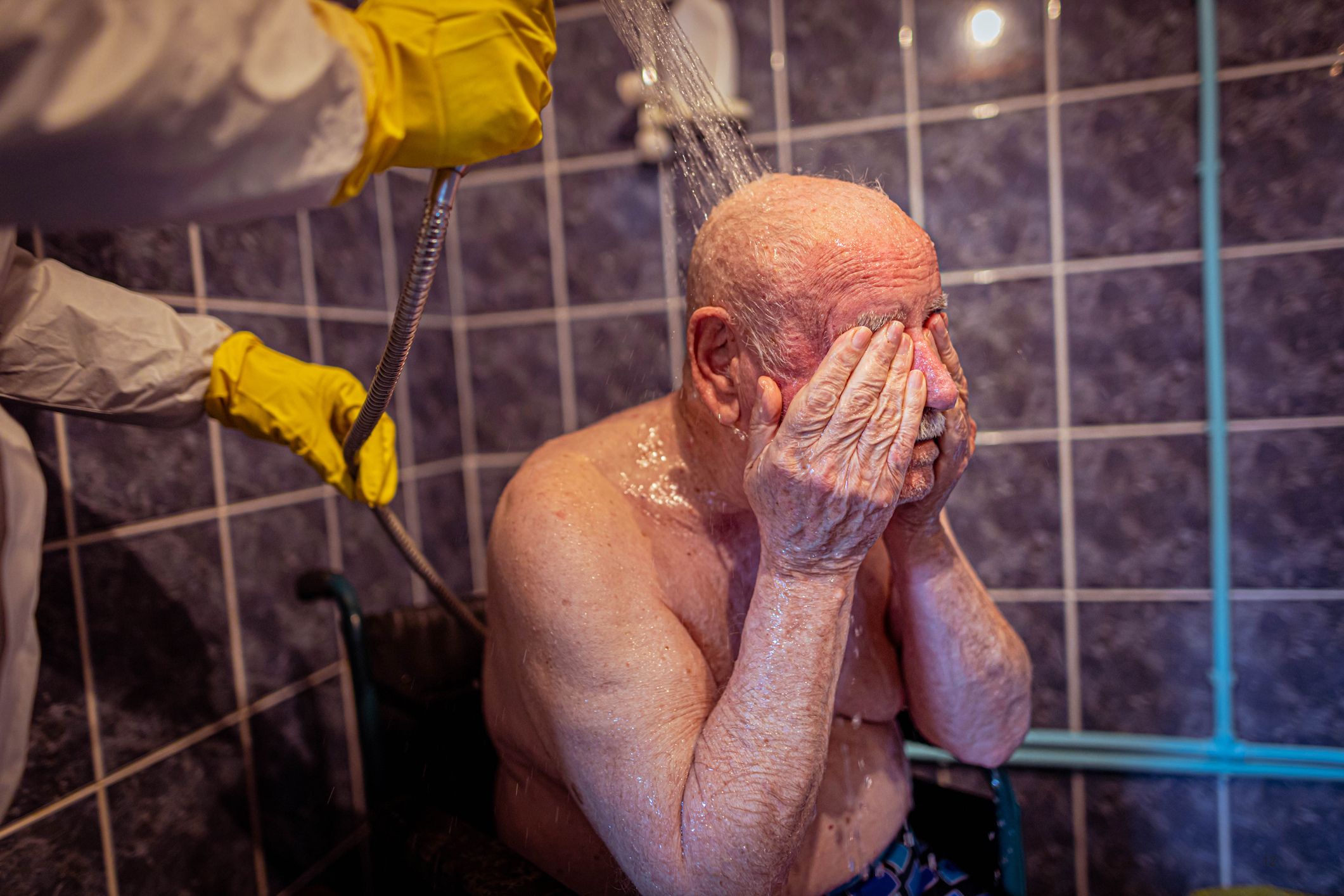
A single shower. A $200 bill.
That is the reality one family says they are facing under Australia’s aged care system, as providers transition from Home Care Packages to the new Support at Home program.
The post, shared in the 17,000 member Facebook group Aged Care At Home Forum Australia, has struck a nerve with home care workers, care partners and older Australians across the country.
The woman’s mother is on a Level 4 Home Care Package, historically the highest level of support under the old system. She requires assistance with showering. The visit takes about an hour. But the provider charges a two hour minimum engagement, resulting in a $200 deduction from her package for each shower.
The family says the result is simple. Funds disappear faster. Other supports get squeezed. Dignity gets compromised.
And they are not alone.
Many commenters pointed to the SCHADS Award, the industrial agreement that sets minimum employment conditions for social and community services workers. Under that award, employees generally must be paid for a minimum two hour shift.
Providers argue that this is not optional. If a worker is rostered for a single short visit and there are no other clients immediately before or after, the employer must still pay them for two hours.
But here is where it gets murky.
Numerous frontline workers in the comments stated that they are rostered for full day shifts and visit multiple clients for 30, 45 or 60 minute services. Clients, they say, are billed only for the actual time delivered.
One worker wrote that she regularly completes eight or nine visits in a ten hour day, including 15 minute medication prompts and 30 minute showers. Another said their organisation charges in 15 minute increments. Others reported 30 minute minimums.
Which raises the uncomfortable question: when a client is billed two hours for a one hour service, where exactly is the extra money going?
Providers insist it covers award compliance, travel time, rostering gaps and business sustainability. Critics argue it is a blunt policy that shifts business risk onto frail older Australians.
Since November, the aged care landscape has been shifting to the new Support at Home model. Instead of four Home Care Package levels, there are now eight classifications. Level 8 is the highest under the new framework.
There is also a stronger move towards co contributions based on income and assets. Under Support at Home, many participants are required to pay a percentage of the service cost, meaning the higher the provider’s charge, the higher the out of pocket contribution.
Several commenters said they are already paying hundreds per month out of pocket. One woman said she paid $221 for her mother’s weekly services despite being on a Level 4 equivalent package. Another described paying $224 while personally showering her wheelchair bound husband five times a week because the maths no longer made sense.
The government argues the reforms are about sustainability and fairness, particularly ensuring wealthier retirees contribute more. But families on the ground say the transition has created confusion, reduced purchasing power and higher visible prices.
One commenter summed it up bluntly: “The new era of aged care is user pays.”
Beyond the two hour minimum debate, the thread exposed wider frustration about provider costs.
Claims included:
$1,500 charged for a five minute assessment about a tilt chair
Administration fees running into tens of thousands per year
Cleaning rates of $134 per hour through some council linked providers
Workers paid around $30 to $35 per hour while clients are charged $100 to $112 or more
Some of these figures vary by state and provider, and not all are independently verified. But the perception problem is undeniable.
When families see a support worker earning around $34 per hour and the provider charging $100 plus, trust erodes quickly.
The government caps care management and package management fees under aged care legislation, but under Support at Home the pricing structures are changing again. Greater transparency has been promised, including clearer unit pricing. Whether that delivers real downward pressure on costs remains to be seen.
A large portion of commenters advised self management. Platforms such as Mable and other brokerage models allow families to directly engage independent support workers, often at $50 to $80 per hour plus platform fees.
Supporters say it delivers better value, continuity and flexibility. Critics warn it can create inconsistency, administrative burden and workforce instability.
There is also the uncomfortable reality that not every 87 year old with arthritis has an adult child capable of navigating contracts, compliance and payroll.
As one worker noted, having industry knowledge makes the system “marginally less confusing”. That is hardly reassuring.
At the centre of this debate is a structural question.
If industrial law requires a two-hour minimum shift, should the financial risk of rostering inefficiencies sit with:
The provider
The worker
Or the older person receiving care
Many providers say they cannot operate at a loss. Advocates argue that billing two hours for one hour of delivered care effectively drains publicly funded packages and reduces frontline support.
In practical terms, families are being told to “use the other hour”. Get the worker to vacuum. Hang out washing. Make breakfast.
That may work in some cases. But it does not address the principle at stake.
A shower is not a luxury. It is basic personal care.
When a Level 4 package worth over $60,000 per year under the old system cannot comfortably absorb regular one hour showers without funding pressure, something is misaligned.
Australia’s aged care system has already been through a Royal Commission that exposed neglect, underfunding and structural failure. Billions have been injected since.
Yet here we are debating whether an elderly woman can afford a shower from her own package.
Some commenters urged families to complain to the Aged Care Quality and Safety Commission. Others recommended contacting MPs or contributing to the Senate inquiry into Support at Home. A few defended providers, warning that without viable business models there will be no services at all.
All of those perspectives can be true at once.
But this much is clear. When older Australians and their families look at a $200 charge for a one hour shower and feel ripped off, confidence in the system collapses.
Support at Home was meant to simplify, strengthen and future proof aged care. Instead, for many, it has amplified anxiety about value, transparency and fairness.
Aged care is not just another service industry. It is the final safety net for people who have paid taxes for decades.
If that net now comes with a $200 minimum for a shower, it is reasonable to ask whether we have lost sight of what the system is supposed to be for.



Personal hygiene is a clinical activity and covers a number of clinical assessments-skin integrity, thermoregulation, joint mobility/dexterity, cognitive awareness to name a few and why it was not included in clinical section totally confuses and frustrates me.
The two hour minimum shift is the providers responsibility and many providers have been innovative enough to link shifts together, be they 15, 30, 45 min or 1hr duration.
No SAH recipient should have to be penalised due to a provider unable to link a support workers shifts to adhere to the SCHADS Award requirements.
That is unethical and gouging!!
Where is OPAN, ACQSC, CoE, COTA- aren’t they suppose to be protecting the most vulnerable and be the voices to govt?
This is absolutely appalling and un Australian!!
Btw the image accompanying the post is not representative of how experienced support workers assist with personal hygiene.
They don’t need to dress themselves up as though they are in a cattle yard.
Dignity and respect for one of the most important and personal procedures ALWAYS
Cheryl, I totally agree with what you have said but did you notice that the client is still wearing,what looks like the lower part of his pyjams. This can surely not be a real photo!!!. If it is a fabricated photo then this sort of thing just aids to people’s stress. Surely HelloCare is better than this.
Cheryl, It has just been pointed out to me that the client is not sitting on a bathing chair but an ordinary wheelchair. Also any train nurse would give the client a face washer to hold over their eyes whilst hair is being washed.
It’s not an image that is representative or reflective of hygiene practice and has been used inappropriately.
Not sure of the purpose apart from catching our attention to all that is incorrect which I’m sure was not the intent, it was the narrative we need to read, absorb and process.
The issues raised need to be forwarded to the Independent Aged Care Commissioner.
Yes, you could use the extra hour sometimes, but not every day, after you have had a shower. And paying the carer for two hours does not mean that the client pays for a non-existent service. If the carer must be paid for two hours, then that would be $34 + $34, and would be billed to the client at a percentage of 100 + 34. This is just one more aged care rort that certain providers have managed to swing. I thought I had seen them all, to date, but apparently not.
Every time the government moves to a user pay private provider model they tell us the tax payer that it will drive prices down? Can someone please tell me where this has occurred? My power prices are going up, my gas prices are going up and so is my water bill.
Age care should be government run, no need to make a profit, everyone can work together to make sure people get the services they need.
I need to follow this up with our provider but when you speak of what a worker gets paid to provide a service and what the provider charges the client NSW health i think takes the cake! My husband was on a level 4 package old scheme. He had district nurses visit 3x per week to attend dressings which cost approximately $1200 per month! Enter the SAH program the cost escalated to $2600 I queried this and was told that his package could not sustain this cost. I must add that NSW health never provided a itemised account. It was only because the provider challenged the increase that we learned the truth of the charges . I contacted the aged care and quality complaints commission who advised that their charge was $186 per hour which was within their ability to charge range. The nurse is probably on about $40 per hour .. I seriously think that this new SAH program will be the next NDIS with clients being ripped off as we were! We now use a nurse for 2 days through the provider at $100 per hour and I do the 3rd day myself
I can shower, dress and make up a clean bed in 10 minutes! I know some aged care facilities have staff that go out to care for people in their home. They are still on the same rate of pay as the rest of the staff who have wards of 17 and 2 staff showering ,dressing, med com, cleaning, Making beds, taking them out, cooking. Now all this could be done by hiring more AINs that like the idea of getting out of their usual settings. Same pay rate as facility AINs. Even sleep overs should get the same rate of pay as the night shift workers, who work in facilities for the elderly. This is the only way to have homecare that is affordable. Cut out all the businesses that hire too many admin. Cit out the overpaid carers as well and go private. OK they would need to hire more staff. So what? They still get subsidized by the government and OK staff need to be compensated for using their own car. Then you still have some elderly who can afford to pay a bit more. But it should be cheaper to have care in your own home than residing in an aged care facility! Maybe 3 staff can rotate for one house from each facility. There are so many aged care facilities in every suburb for God sake. We should be utilizing the aged care facilities and outsourcing staff!! No electricity bills for facilities to pay. No laundry as the AIN can wash in the client’s own home. Food shopping at the expense of the client. Some can work nights for the same rate of pay you would get in facilities as long as there is somewhere to sit comfortably. Get rid of all the administration and the outsourcing of aged care and stay with facilities. OK . Surely it can be worked out.we need to cut the prices and wages of admin and these cowboys who profit from the taxpayers and the elderly. Think outside the square.
Shower, dress and make a bed in 10 minutes!!
You wouldn’t get away with that on my watch!!
Showering does not need to be a dunk and get wet procedure, enable the resident to do as much as they can themselves, assessing all areas of functionality, ensure hair combed, dressed in a manner that suits the resident and is appropriate, dentures in, hearing aides in and checked, glasses on or within reach and leaving resident comfortable is the priority .
The remainder of your commentary is already insitu ie personal support workers within the community, working as independent workers or under a platform such as Mable or Hire Up to name two or under the umbrella of the provider.
Yes i know the feeling, i went from level 3 to level 4 and am grand fathered. I was having 4 half hour showers a week and asked when i was assesed for level 4 if i could have 1hour showers and was told yes. I have COPD, Stenosis of the spine and very bad arthritis. My provider told me i would get more services when i went up to level 4, but i have lost services and still only get half hour showers per week. I am incontinent so you can understand why i need the showers, i don’t go out anymore and am on depreshion medication. These so called new rules are taking away our dignity as well as our quality of life.
The whole process of aged care payments needs to be more uniform, so that we can utilise the small pension that we are afforded in our old age, for our portion of the user pays – co-contribution of fees, then we pull back on using the care.
Be it help with the vacuum and mop, or anything else. If this rises to $200 for us, it will simply not be happening. We don’t have that sort of money; we are already juggling our funds around to pay our bills.
We don’t have anyone in our family to look after us, the paperwork is confusing, and if you ask for someone to come and explain something, we are told that will cost money for admin. So, when it comes to a point that I need to pay $200 for a shower or pay for my electricity, or medicines, then I will be doing without the shower. That simple. (yes, I know, stinky old people!)
And on a final point, this maze of providers, everywhere you look, a car with logos stating that they are dealing with NDIS and Aged Care. A different person every time to come to your home, your personal space, no longer feels personal, it feels like an invasion of privacy.
Then, we are meant to pay, whoever it is, for the privilege of being here. There is no uniformity, to the charges, we simply need to give over our banking details and pay the bills and accept without complaint.
Back to what I said earlier, if it means a shower or my meds or lights, then I will skip the shower and have a “bird bath” instead. Even if I really do need a proper wash.
I agree this is disgusting to expect people to contribute that are on a pension most are going without, items such as food( not eating regular meal maybe only once a day), not being able to buy gifts for their families, going without heating or cooling.
Another concern is when people live in rented properties and the package pages for upgrades to keep that older citizen at home, once completed they are then told to vacate the premises. I believe that there should be a system going by percentage that is a person is asked to vacate the premises within the 1st year of completion the home owner should be required to pay back the amount by 100% decreasing each year the person is able to stay in the home. This is an unjustified situation for the renter
I think that the whole aged care system has failed seniors badly and caused so much anxiety which they don’t need or want this at their age,it’s a disgrace that the current Government has caused the problem making age care into an intolerable mess.
Obviously the stay at home idea has created a money pot for providers who have popped up all over the place. Whether it is childcare, NDIS, or Aged Care Homes some people are making a lot of money. I have no idea of the “packages” that are available, or how the system works. I am 89 and just hope that I never get to the stage where I will need to know. It all sounds disastrous .