Key points:
Gone are the days of video games just being for young people.
As technology and care models advance, more health professionals are realising the role it can play when it comes to incentivising older people to stay healthy, active and improve their balance at home.
One of the big areas of health and well-being preservation for this demographic revolves around movement and exercise – namely to prevent the risk of falls. With a steadily ageing population, scalable and effective fall prevention strategies are needed to address the growing impact of falls in the community.
With this in mind, a new research trial from Neuroscience Research Australia (NeuRA) has found that at-home gamified step exercises were effective in fall prevention for people over the age of 65 over 12 months, even reducing falls by 26% when compared to a control group.
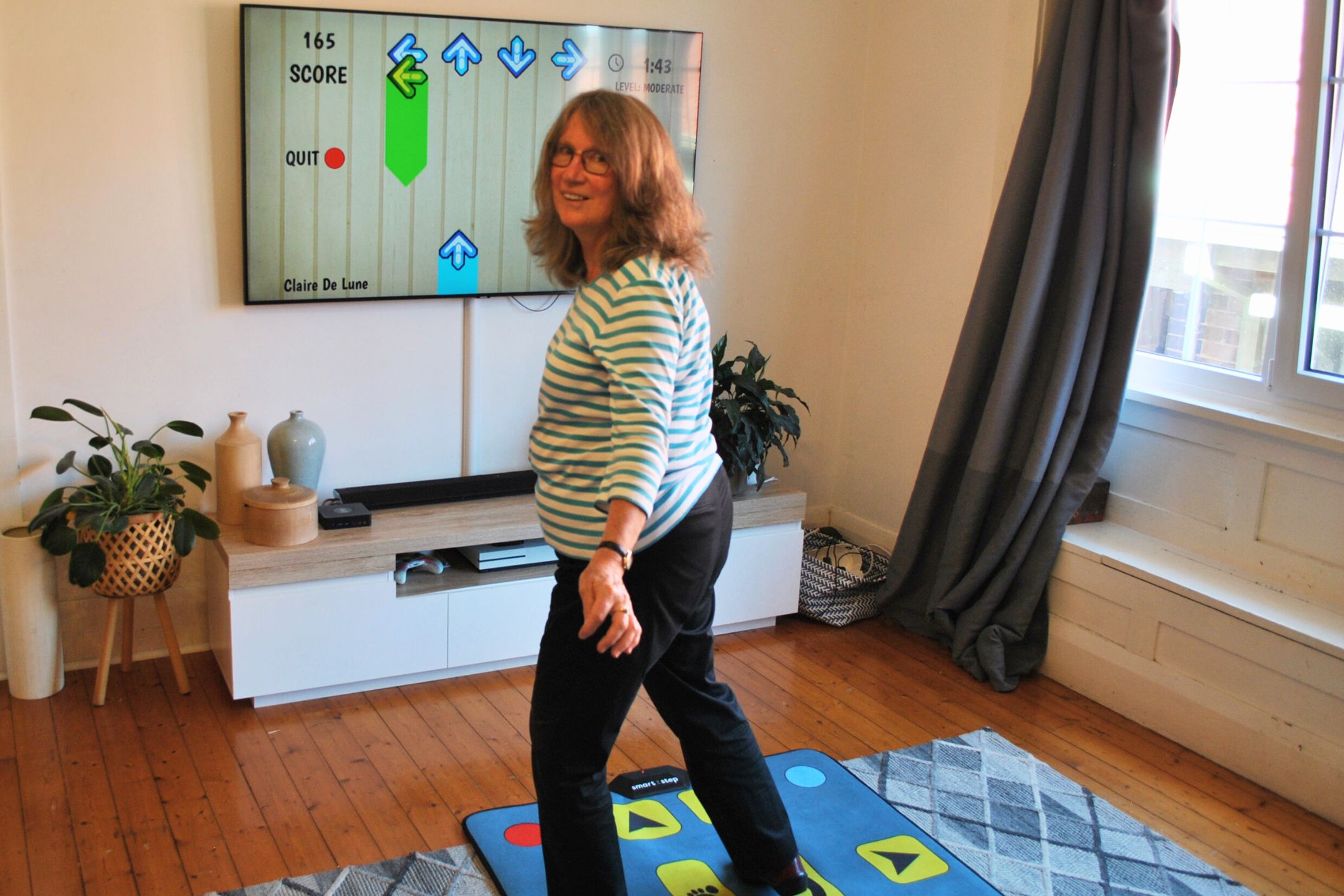
Trial participants – who were over 65 and living in the community – were asked to do exercise games through the researchers’ smart±step “exergame” system for 120 minutes per week for 12 months.
Similarly, University of South Australia (UniSA) researchers recently used Virtual Reality (VR) systems to construct a cycling exercise in a bid to help patients with chronic pain move and engage with exercise while being distracted from pain.
There are physical and mental benefits to gamified exercises.
Smart±step exergames are offered at home with no assistance from a therapist. It involves stepping on a mat, which acts as a controller that is also connected to a television screen. Once a game of choice is selected it requires the person to step on target panels on the mat, just like one would with a game controller.
These games require quick movement and thinking to keep up with the games.
This method keeps older people’s bodies agile and resilient but their brains too.
Lead author of the trial and Senior Research Scientist at NeuRA and UNSW Sydney, Doctor Daina Sturnieks, said the best evidence for fall prevention in the community is balance-challenging exercises like those promoted through smart±step games, but these exercises aren’t often engaging enough to stick with.
“People get addicted to games because they are fun and they become motivated to beat their high score and just get lost in the game. These exergames require people to think quickly, unlike traditional exercise programs where you just go through the movements.”
Participants Bev and Bill, a couple in their 70s said while they were relatively fit, their balance needed some work and the exergames helped strengthen their legs and improve their balance.
They said, “The games were varied and extremely motivating. I think we also benefited from the competition between us.”
Another participant, Helena, said the game brought out her competitive nature as it offered rewards and incentives to move.
“I felt I was playing a computer game as opposed to doing an exercise program,” she said and a follow-up falls assessment showed her risk had reduced.
To be added to a waitlist to purchase smart±step, email smartstep@neura.edu.au



I am 74yr old male, DVA Gold card veteran with some balance problems and am interested in the smart+ step exercise programme.
Loved reading about the innovative approach to exercising for older people! As someone who works in healthcare, it’s clear to me that gamification can be a powerful tool for improving physical and mental well-being. I’ll definitely be sharing this article with my colleagues and patients. Well done!
I am very interested in having access to the smart step programme.