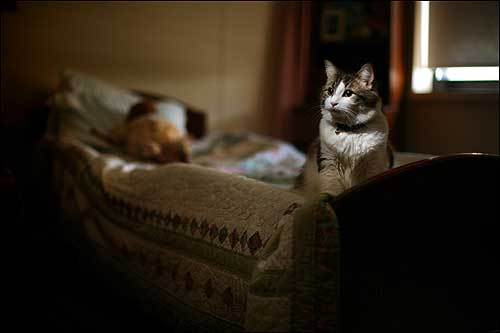
Death rarely comes as a surprise in aged care, many of the staff are used to it by now, however, it can still be quite a shock for the families and other loved ones.
If there were a way to predict the death before the last few moments, it may give the family – as well as staff – time to comfort the resident and receive closure themselves.
In something that sounds more fiction than fact, it’s been found that some cats are able to predict death.
Somehow these cats are able to sense something that the staff cannot see, something that is beyond the nurses and carers’ training and skills.
Cats, like other animals, are very intuitive, and their eyesight and sense of smell are more acute than humans.
Because cats rely primarily on body language to communicate with one another, they must be attuned to biological and behavioural changes in the other animals around them.
Research would suggest that the cats are able to smell the chemical changes that begin to occur just a mere hours before a person passes away.
What if these cats could be utilised as a part of the “care service” in aged or palliative care? Or if researchers could use find a way to harness the cat’s skill to create technology that could help predict imminent death.
By no means are these cats trained to sense or behave in such a way. And it should be noted that not all cats can “predict death”.
The most famous case of this is seen in Oscar the cat – a cat that no one wanted to see in their room, because he could predict who was going to die next.
Oscar has been living in Steere House Nursing and Rehabilitation Center in Providence, Rhode Island since 2005.
Staff found that as he would roam around the pet friendly facility, he would end up napping next to terminally ill residents that would later die within the next few hours.
The staff at the facility believed that Oscar would nap near them in an attempt to comfort them in their last moments. And if he was sent out of the room, he would either sit by the door purring, or scratch at it to be let back in.
“I first heard about him from the nurses on the unit,” says Dr David M. Dosa, a geriatrician who cares for the elderly at the nursing home.
“It came to light that he was spending time with patients as they were becoming terminal.”
Dr Dosa would go on to have his essay about Oscar published in The New England Journal of Medicine.
Oscar’s presence has been a comfort to many family members, as well as help alert the staff to let family members know that their loved one may be nearing death.
Oscar has been so accurate, that by 2018 he’d predicted approximately 100 resident’s deaths.
What do you have to say? Comment, share and like below.





I have noticed that when I am feeling unwell, my cat will be more attentive. I would personally like a cat to be comforting me when I am dying.
Me too!
My mum was in a rest home for the elderly in Pahiatua, New Zealand. Mum was never a cat person so when I was contacted to say mum only had a few days of life as we know it, I was surprised to find the rest home cat would not leave her room. After I chased it out a couple of times due to the fact mum nor me were cat people – it kept coming back.
It was a slow hard time for my mum – and when she finally moved on, I was blinded with tears – opened her bedroom door and virtually slipped over the cat!, waiting by the door.
I have never seen anything like it in my life – utterly shocked me. Beautiful cat knew more than us.
I often wonder if the cat is still there at the rest home and how it actually works – this sensory thing. Miss my mum dearly so very much.
I am adding this to see if still active. My mother in law, whom I stay with several days a week, is in slow decline. She recently had to be hospitalized and is in a nursing home. During that stay she also has been in hospital a couple days. At the time of the second hospitalization, I had a friendly stray cat start hanging at our duplex. Over the last few weeks, he only shows when I am home (my DIL lives next door and he is not there when he can’t come in the side I share with MIL).
Yesterday he ran up as before I could even turn car off, and even though we have our dog with us this week, pushed into house and he has been insistent on trying to get into MIL room. No issues with our dog (very cat friendly anyway), but I thought it strange that a stray cat would be that fearless and yet docile around a strange dog.
The whole death scent thing makes sense as even though we have cleaned, there is obviously scents remaining from MIL and her room would be where it is strongest. He will sit for maybe 5 minutes, then gets up and wanders the entire duplex looking and sniffing. I am convinced he may be one of the “cat angels” now. BTW- I told her about him and she wants to know if he is in apt. all day long.