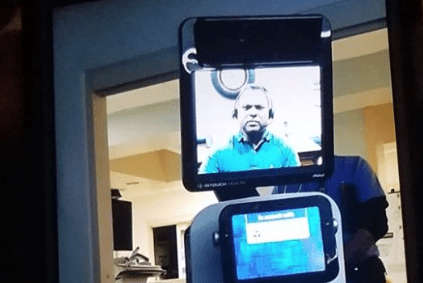
A 78 year old man was informed by a hospital robot that he was going to die within days, due to problems with his lungs.
The elderly patient, Ernest Quintana, was delivered the prognosis by a doctor who appeared on the screen of a hospital robot.
According to a friend of Mr Quintana’s daughter, the doctor told the man he had “no lungs left” and the only option left for him was comfort care. The doctor advised Mr Quintana to remove the mask he was wearing to help him breathe, and that he should be placed on a morphine drip until he died.
The friend shared an image of the robot on Facebook. “This is not the way to show value and compassion to a patient,” she wrote.
A robot doctor may be okay in some situations, the friend wrote, but not to tell a man he is going to die.
Sadly, Mr Quintana passed away the day after the robot doctor’s diagnosis.
AMA President, Dr Tony Bartone, told HelloCare that video conferencing works best when patients already know the doctor.
“Patients must always be treated with respect and dignity, and they and their families must be communicated with sensitivity and compassion,” he said.
“Discussing death can be profoundly confronting and difficult for all concerned.
“The AMA has always said that video calls and teleconferencing work best when the patient knows the doctor well. Teleconferencing is an aid – it can help busy people, and those in remote places – but it can never replace face-to-face consultations.”
A spokesperson from the hospital where the incident took place was apologetic, and said the hospital will be reviewing its procedures around the use of video links.
Michelle Gaskill-Hames RN, Senior Vice President and Area Manager of Kaiser Permanente, said in a statement, “We are deeply sorry for falling short of the Quintana family’s expectations.”
“The story being reported over the past 24 hours about a “robot diagnosis” is heartbreaking and shocking,” she said.
Ms Gaskill-Hames also clarified some of the details of the incident.
“It is important to understand that we do not have robots that have medical discussions with patients or deliver terminal diagnoses.
“The evening video conversation was a follow-up to earlier in-person physician visits and was not used in the delivery of the initial diagnosis,” she said.
“We discussed the diagnosis and prognosis of the case in person with the Quintana family and their loved one since he entered our hospital and our physicians and nurses were in regular, in-person communication with the patient and family about his condition.
“In order to provide an urgent evening consultation with a specialist physician, a live conversation was conducted using a video connection.
“A nurse was in the room to accompany the video conversation, as is our standard practice,” she said.
“Use of secure video conversations allows a small hospital to make additional specialists available 24/7 for patient consultation, enhancing the care provided and bringing additional consultative expertise to the bedside,” Ms Gaskill-Hames said.
However, Ms Gaskill-Hames acknowledged the incident presented an opportunity for the hospital to review its procedures around the use of video consultations.
“We will use this as an opportunity to review how to improve patient experiences with video capabilities,” she said.
For more information about Australia’s policies around ethics, end of life care and technology consultations, see:



Hmmm. The way it is all heading with our use of screens and text messaging etc to replace real human contact. Some people are so used to this way of communication, they have forgotten that humans have a presence/warmth in person that is simply not there on a screen and therefore makes interaction a little bit cold and mechanical unless you know the person well.