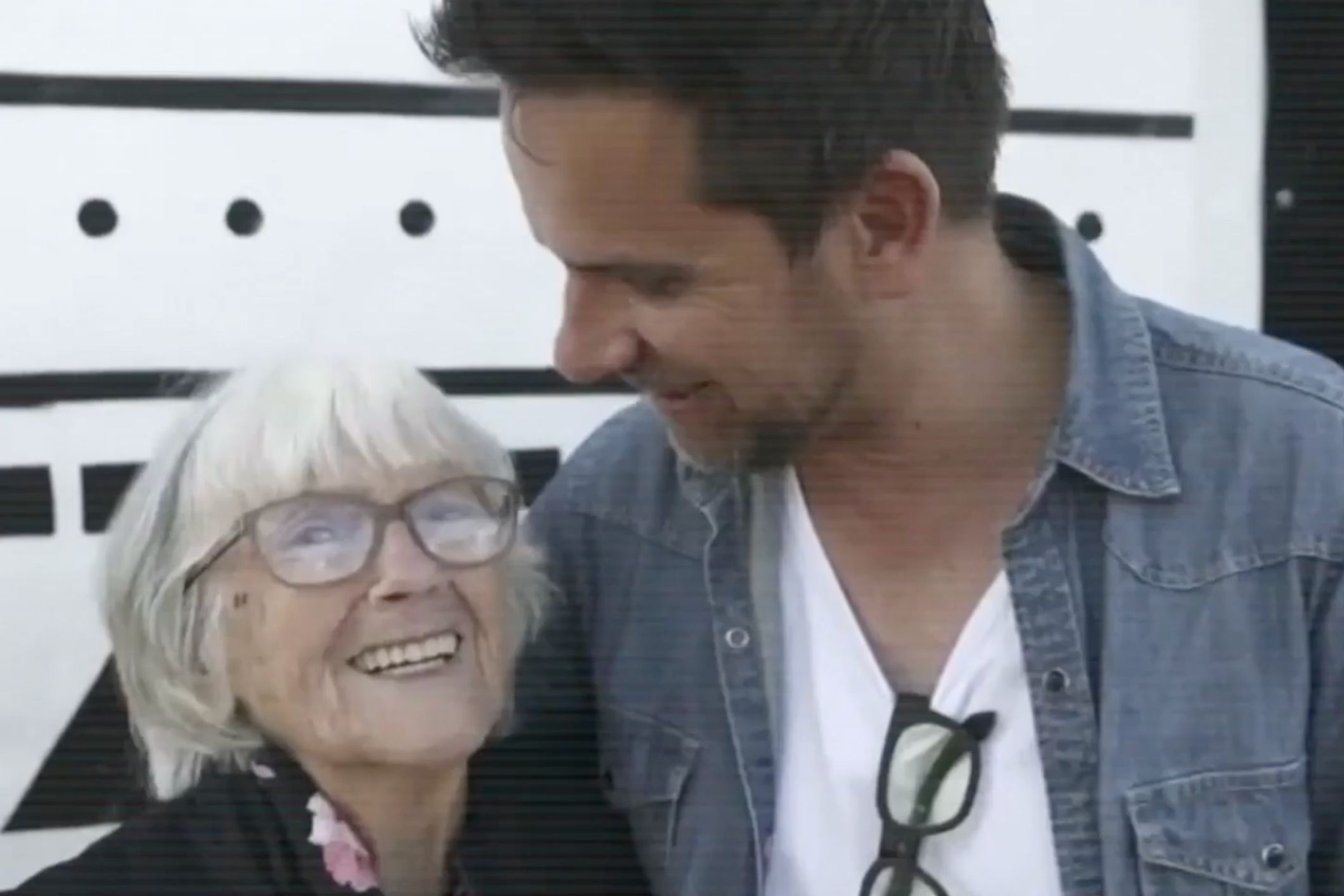
The video attracted more than 100 million views, and Jason has been interviewed around the world, including on Good Morning America and The James Cordon Show.
Now Jason has produced a feature film, a heartwarming documentary titled Everybody’s Oma, which will open at this year’s Sydney Film Festival.
Jason and his wife, Megan, appeared as part of a webinar by the Older Person’s Advocacy Network (OPAN) titled ‘Everybody’s Oma – a family’s dementia journey’ to talk about their unique caring experience. The panel also included Danielle Robertson, director of DR Care Solutions and Craig Gear, the CEO of OPAN.

Jason hopes the film will change perceptions of dementia as something bleak and sad.
He wants to tell a story of “love and hope”, and there’s also a lot of laughter.
Of course, there are also difficult times, and the film also captures the difficult side of caring for a loved one with dementia, such as when Oma no longer remembered Megan. Oma sadly died earlier this year aged 89.
Jason began documenting life with Oma during lockdown.
Creating stories about what the family were doing was a kind of “story therapy”, he said.
The films also could “unite” the family as they were all involved in making the content and then they could all watch them back together. They helped Oma remember what they had been doing each day.
When the video went viral, Jason felt a “responsibility” to tell the story well and knew it was “really important” that Oma gave her consent and was “actively involved” in the process.
“There was lots of talking every time we were filming, making sure she was aware we were doing this,” he explained.
When asked why the supermarket video was so popular, Jason replied that the “pressure cooker” environment of lockdown had many questioning relationships, careers and even identities, and a film about someone living with dementia who “battles” those issues every day resonated.
The film also injected “a breath of fresh air” and allowed viewers to “escape from [their] worries” during the pandemic, he said.
Megan and Jason knew little about dementia care before becoming full-time carers for Oma.
It took “a lot of love and a lot of patience”, Jason said. They learnt along the way.
When communication became difficult, they used a Polaroid camera to create visual prompts.
Megan learnt to speak Dutch so she could speak to Oma, who returned to her first language as the disease progressed. Actions and gestures were also more important.
Megan and Jason’s children interacted beautifully with Oma.
“They didn’t have any preconceived ideas or notions about how to treat Oma, they just treated her openly and warmly and just for who she was, which was just amazing to watch,” said Megan, tears welling in her eyes at the recollection.
Baby Evie was born in 2019, just as Oma began finding it difficult to make conversation.
“Evie broke down Oma’s walls,” Megan shared. “Oma didn’t need to speak to Evie. She could communicate just through looking at her and smiling and touching and holding. Oma got so much feedback from the little baby.”
Oma’s playful personality meant it was easy for her to have fun with the children, and taught them about creating “fun memories and beautiful times”. She also taught them about respect, compassion and resilience, it was her “gift” to the children, Megan said.
Eventually Oma had to move into residential care. Danielle Robertson helped them with the transition.
The couple were asked if they could, would they have done anything differently?
Megan said they could have identified as carers earlier.
“It was only last year we mentally told ourselves we were carers. I think we felt like Oma was part of our family, and we were looking after her, but we never really said we were carers or identified as carers.
“I think I did that a little bit too late because I’m sort of struggling now … struggling losing a bit of that identity.”
Humane lessons from an inspiring and personal conversation.
The documentary ‘Everybody’s Oma’ will screen 11-12 June 2022 at the Sydney Film Festival.





Hi, and thank you for sharing your story publicly. I have been caring for my beautiful mother (she has been living with a diagnosis of Alzheimer’s with my support for 2 years now).
I bought tickets for my sons and my “dutch” mother-in-law (who does not have Alzheimer’s) to see the film, I’m wondering if it might be too confronting for my Mum; she is strong, but quite a sensitive soul. So far though, she has accepted her diagnosis; and is determined to do everything she can (including embracing technology, attending yoga and returning to her art, in an attempt to remain stable. Her proactivity has inspired me so much.
Would you recommend the film be viewed by persons with a diagnoses or could it be too confronting?
Regards and thanks
Tralee