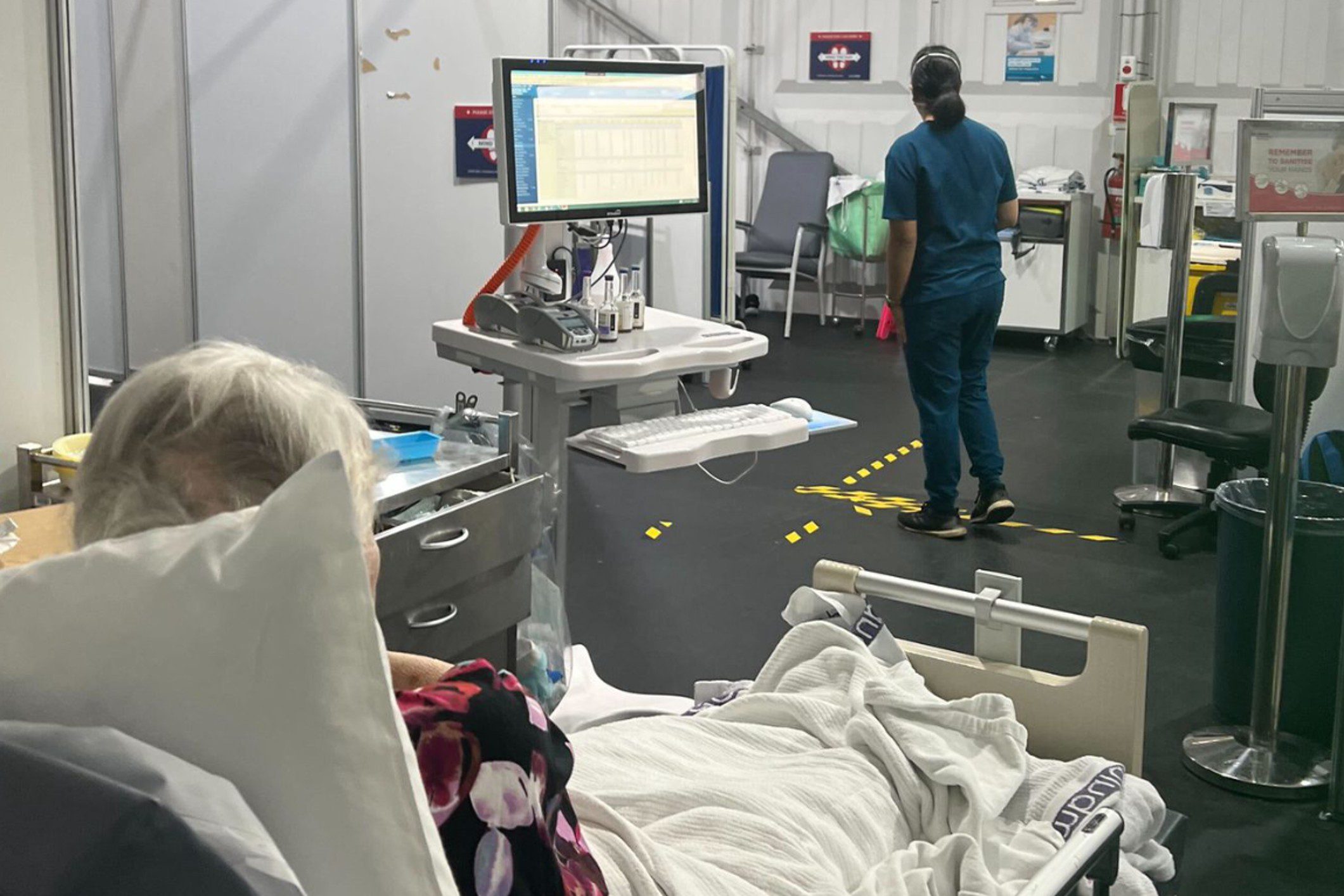
An elderly stroke patient has been forced to wait in a “Guantanamo Bay”-like makeshift tent outside a Melbourne hospital overnight.
The 83-year-old’s daughter, who wished to remain anonymous, told Nine News her mother was found slumped in a chair at her aged care facility on Wednesday night and was taken to Box Hill Hospital, Melbourne, via ambulance.
After arriving at 4 pm on Wednesday, the elderly woman waited in a corridor for three hours before being moved into a tent just outside the hospital, a situation her daughter said the paramedics likened to “Guantanamo Bay”.
The hospital suggested the 83-year-old was showing signs of a stroke, but said it had partially resolved itself.
The elderly woman currently remains in the tent, where she has been waiting for over 16 hours for a bed inside the hospital.
Her daughter said her mother was being looked after by paramedics and nurses, and had been seen twice by a doctor – who initially wanted to send her home.
“I wasn’t comfortable with that and the paramedic said they wouldn’t send her home until she gets a scan,” the daughter told Nine News.
“I had to advocate for her to get a scan and last night [Wednesday night] I pushed it again and she ended up getting one at 10 pm.”
Her daughter said the tent has heating and that hospital staff were doing their best to be accommodating, but it was still a tent.
“This is not acceptable. Don’t worry about building roads, improve our hospitals!
“We are in limbo and just waiting.”
Executive Director Clinical Operations of Eastern Health, Shannon Wight, said they were “unable to comment on any individual patient” due to confidentiality.
“While the health system is currently under a great deal of pressure, we constantly strive to deliver the best care for our community and our people are working tirelessly to provide exceptional care for all of our patients,” Ms Wight said.





