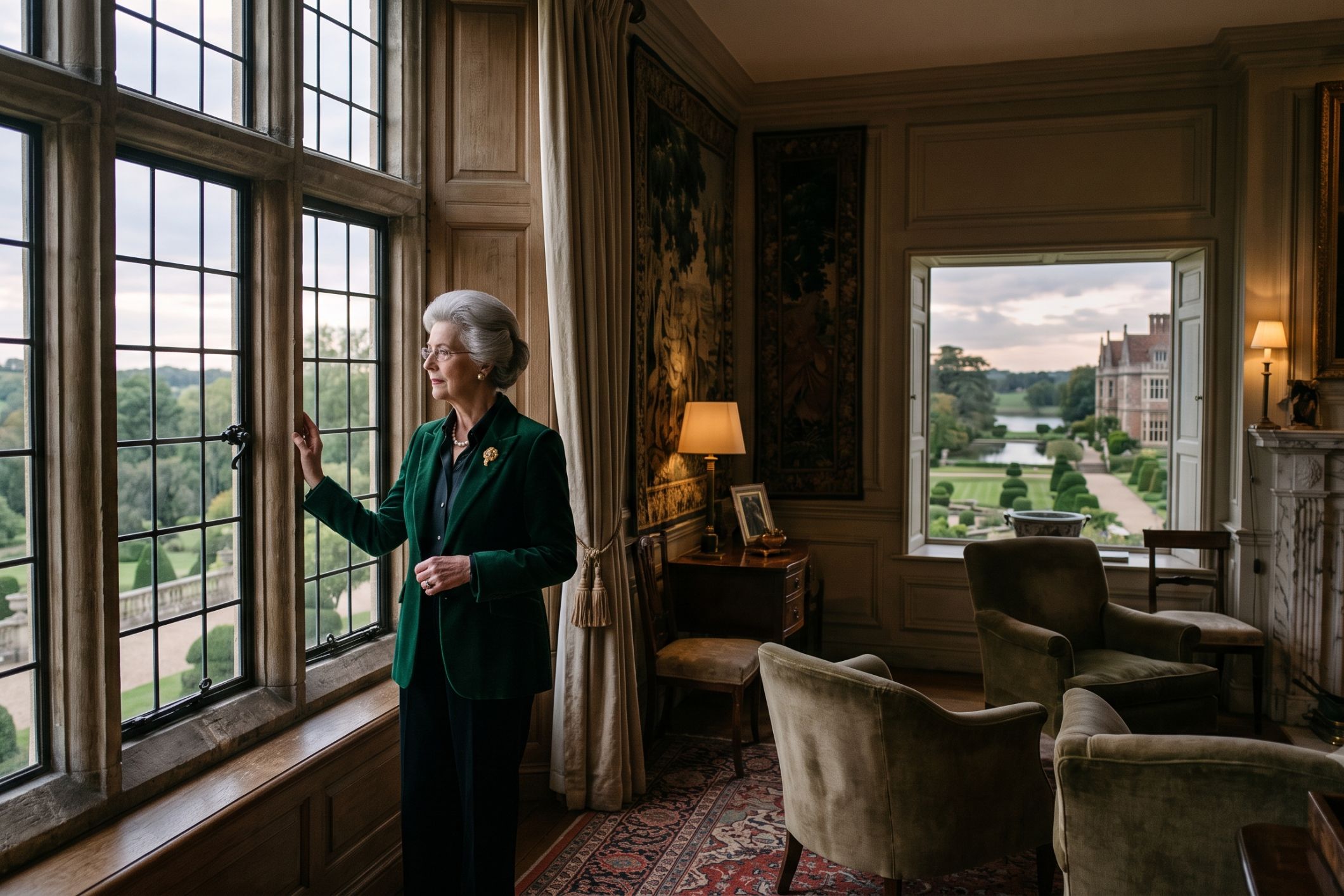
In the village of my childhood, in the middle of the English countryside, there lived an extraordinary woman named Vivian. A cherished friend of my mother, she shared a unique bond marked by the joyful coincidence that she gave birth to her youngest son, Alex, on the same day as I.
This serendipitous event forged a lasting friendship between us, as our mothers’ closeness blossomed into a deep-rooted connection for us as children.
During the challenging days that followed my unexpected arrival a full three months early, Vivian became a beacon of support for my mother, her warmth and kindness illuminating the difficult path ahead. Her presence offered solace and strength during that difficult time, reinforcing the ties that wove together our families in the tapestry of village life.
Vivian lived in the manor house, whose stone walls and aged windows stood as a solitary testament to memories past.
Ever since the tragic loss of her husband, who met a cruel fate at the hands of a hit-and-run driver, Vivian had endured the long years alone. Her husband, Gerald, only 51 at the time of his death, left behind a legacy of love and two energetic teenagers who needed to be nurtured and guided through their formative years.
Now, as she entered her early seventies, the echoes of laughter in the manor house had faded. Both sons had embarked on their own journeys, marrying and settling far away for their work, leaving Vivian with only the memories of the past.
The boys rarely visited their mother due to their busy lifestyles and their wives having other priorities, although she told me they were constantly nagging her to sell up and move into residential care. Knowing full well that it was their wives, Stacey and Amanda, who wanted to get their hands on the inheritance now rather than wait until she died, Vivian was healthy, mobile and in full control of her faculties, and determined not to move out of the home she and Gerald had built together.
She told me she was comfortably wealthy, knowing the house alone was worth four million pounds and the estate was worth in excess of seventeen million.
Although Vivian was not born into money, her family was extremely poor.
Marrying Gerald in her mid-twenties, she knew little about his profession. He told her that he was an entrepreneur dealing in stocks and bonds. All Vivian knew was that they were comfortably off, certainly by moving into the manor house, which provided status and prominence in the village.
Money was never an issue. It was not until Gerald’s death that Vivian became aware of how wealthy she really was. Gerald had adequate life insurance policies to provide for his family after he was gone.
I recall the large lounge room where trinkets, framed photographs of family and mementoes of the past adorned the room. Paintings hung on the walls, with one small yet striking Rembrandt that Gerald had bought many years earlier as an investment. That painting alone would now be worth over five million pounds.
Vivian once remarked with a wry grin that she had considered bequeathing everything to charity to spite both daughters-in-law, knowing full well they were likely to challenge the will by claiming she was of unsound mind. Nevertheless, it was just a clever ruse to keep the vultures at bay.
Vivian was well aware that her two sons loved her deeply, yet the shadow of their domineering wives loomed large over her reality. These women, driven by a relentless pursuit of wealth, with extravagant lifestyles, designer clothes and exotic holidays, often left Vivian feeling out of touch with their world. She couldn’t ignore the resentment they harboured towards her, sparked by the presence of her long-standing staff: Mildred, the devoted housekeeper who had served the family for thirty years, and Albert, the gardener who tended the grounds with a level of care that spoke of his deep-rooted affection for the property. They were constant reminders of a life the daughters-in-law sought to change.
Vivian noticed how the wives often exchanged knowing glances, their lips twisted into sly smiles whenever the conversation turned to her age. They frequently insinuated, almost too casually, that she would be better off in a nursing home, skilfully masking their eagerness to inherit her home and wealth.
Amanda and Stacey enjoyed the status of being “corporate wives” and knew they had to live up to a certain standard. Vivian, remaining in her home, was standing in the way of fully achieving this.
The thought of parting with her independence gnawed at Vivian. The idea of relinquishing her cherished surroundings felt unbearable.
Her sons, Alex and Richard, had followed in their father’s footsteps, both establishing themselves in the fast-paced world of finance. They were brokers, engaged in the mysterious and often opaque dealings of stocks and bonds. Yet Vivian remained baffled by the specifics of their careers. She only caught snippets of conversations and vague explanations about her sons being “something in the City”, which left her feeling distant from their lives. Although she knew they were successful, their constant preoccupation with work left her longing for more meaningful connections, moments where they could be a family rather than a financial unit.
Vivian found herself without the joy of grandchildren, as her daughters-in-law both insisted they were too preoccupied with their own lives to take on the demanding role of motherhood. Time was slipping through their fingers like sand, with both women now in their late thirties, caught in their extravagant lifestyles and personal pursuits. Amanda often declared that she didn’t want to risk ruining her figure, while Stacey claimed she never had the patience, dismissing the idea of noisy little ones in favour of her peace and quiet.
The last time I spent with Vivian, we sat together in her living room, the fading light casting a warm glow around us as she pondered the three distinct stages of her life: childhood, married life and widowhood. Her eyes sparkled with memories as she urged me to cherish the present, cautioning that each fleeting moment would soon become a mere whisper of the past.
To this day, Vivian remains defiant in that grand old manor house, resolutely choosing to remain within its familiar walls until her last breath, much to the frustration of her daughters-in-law, who wish she would move into residential care.



I know her thoughts. I owned and operated a Nursing Home many years ago and it was the worst possible place I could think of to end my life. I plan to spend my last days on a boat, with good luchk and management, with young ones around as crew, ready to bag me and send me over into the deep.
“Good on you, Vivian, you’re doing the right thing.” Better to give something to your ever-loyal servants than to your daughters-in-law. Maybe if you have or will have grandchildren who will show their real love and concern for you, then they deserve something.
Thanks for sharing Vivian’s story Michael. Her life seems like a throw back to a bygone era, an era of the landed gentry and country estates. It feels a bit sad to me that her boys married women who seem to be only in it for the money and lifestyle. I am sure Vivian would love to be a grandmother but that possibility seems to be slipping away. I hope she manages to live the rest of her days on her terms, living in the family estate until her final breath. The daughters-in law will get the estate soon enough, but I wish Vivian a long healthy life so they have to wait a long time. That would be the best legacy Vivian can leave them with for their money-hungry ways.
Astonishing that Vivian ending up with TWO self-centred, money-grabbing, childless daughters-in-law. How very sad but good on her for staying defiantly in her home. I just hope all (or most) or her wealth goes to charity.