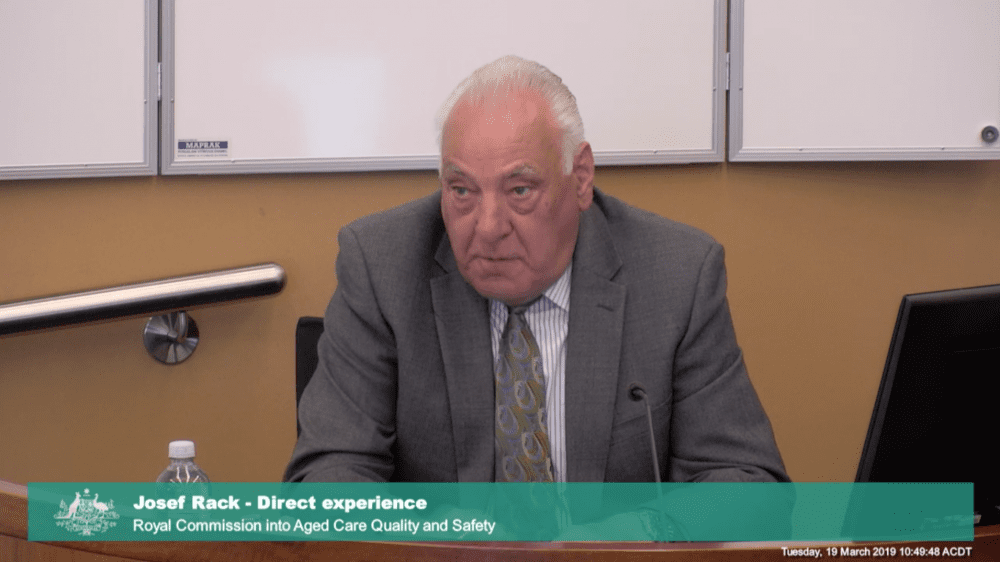
The Royal Commission’s investigation of home care continued on Tuesday, with hearings revealing confusing fee structures, high turnover of staff, and low wages and inadequate training for carers.
Josef Rack, a recipient of home care since 2010, revealed an impressive propensity for record keeping, which on Tuesday helped the royal commission shine a light on some of the shortcomings of the home care system.
First assessed for a level 2 package, he received four hours of care a week from Southern Cross Care until December 2016. For the first hour years, he was mostly cared for by the same woman.
Mr Rack revealed that over the entire seven years he received care, a registered nurse only visited him about three or four times each year, despite his paying thousands of dollars in fees.
Mr Rack estimated he received 20 hours of care from a registered nurse over the entire seven years.
After the first carer left, Mr Rack said staff turnover was high. He said staff he didn’t know would appear at the door, often without any identification they were from Southern Cross, and lacking the appropriate skills or experience.
“There’s so many different workers coming to the house without the name tag, without any identification,” he said.
There were “constant change of workers, so many really unqualified people,” Mr Rack said.
“They did not know what to do in the house. Some of them came in dressed like party girls,” he said.
Mr Rack eventually changed providers because Southern Cross’s administration fee were 50 per cent of the government funding he was receiving and because the hourly rate was high.
Mr Rack changed to Assist Care, and his care was reduced to three hours a week.
He didn’t receive any statements from the time care commenced in August 2017 until he received a spreadsheet from them halfway through 2018, though he did ask for statements earlier.
Mr Rack noticed discrepancies in the unspent funds on the spreadsheet.
Mr Rack said he was also charged for services he didn’t receive.
“There were charges in there which don’t related to the actual services that I received,” he said.
In October 2018 Mr Rack changed providers to HenderCare.
Mr Rack now sources his own providers and makes sure they have the appropriate checks, accreditation and insurance. He is still charged 10 percent of his package for administration.
Mr Rack can use his package for whatever he likes.
“I can use that for anything that I like. Tree pruning, gutter cleaning, window cleaning. As long as it is for the purpose of my personal health benefit, not for any other luxury or any other – other things,” he said.
Commissioner Briggs complimented Mr Rack for his remarkable mathematical skills and record keeping. He asked Mr Rack how other older people, whose skills may not be so powerful, would cope.
Mr Rack told the commission of his cleaner who was concerned about the care her mother was receiving.
Her mother can’t “control the invoices” and simply “pays as it comes in.”
“She has got no clue what she is paying for,” he said, noting that her daughter had also identified irregularities in the paperwork and noted that the invoices were “so complicated”.
In these situations, “You just pay. You just run out of funds and that’s it,” Mr Rack said.
Lynette Hargreaves, manager of social policy with the Municipal Association of Victoria, which represents 79 councils, spoke of the “very successful” and “cost effective” Commonwealth Home Support Program.
Ms Hargreaves is advocating for continued government support for the Program.
She said the recent changes to the system have created “uncertainty”.
A group of home support workers revealed the difficulties of their jobs “from the coalface”.
They spoke of the time restraints on doing their jobs property, low wages, the isolation of doing their job, and communication problems within providers.
Personal care worker Helen Jackson said, “We are the lone workers. We are the frontline workers of this great industry.”
“Some people have left the industry because they don’t like the isolation.”
They revealed that care recipients are charged extra for any time carers go over their allotted time.
Home support worker Anna Hansen said, “If I can, I won’t run over time. But sometimes you literally cannot help run over time. You try the best you can.”
Ms Jackson said, “You see the deterioration in some of the clients and it can be quite rapid and that 15 minutes can turn into 35 minutes and every minute you go over they get charged.”
Some care recipients “worry about being charged extra,” said Rosemary Dale, health care worker.
The home care staff said increasing wages and providing more training could help attract more workers to the home care industry.
Sally Warren, a community support worker from Perth, said, “For the work that we do, the pay doesn’t reflect that at all.”


