In 2018, the Morrison government called a Royal Commission into aged care. Over the years that followed, Australians watched adult children break down in public hearings describing parents left in soiled beds, denied pain medication, and stripped of basic dignity.
The Commission’s final report was titled Neglect. It contained 148 recommendations and a clear warning: without structural reform and dedicated funding, nothing would change.
Labor went to the 2022 election with aged care at the centre of its pitch to voters. It won. It had the mandate, the evidence, and the goodwill. On 1 November 2025, it launched a slew of reforms spearheaded by the Support at Home program and an assurance that “no one will be worse off.”
Seven months on, more than 200,000 Australians are still waiting for either an aged care assessment or the support level they have already been assessed as needing.
The average time from application to receiving care is 12 months. Providers are being turned into debt collectors. A black-box algorithm is overriding qualified clinicians with no meaningful right of appeal. The independent watchdog has resigned. A bipartisan group of more than 100 federal politicians has formed an unusual alliance to demand urgent change.
These are not teething problems. The decisions that produced this outcome were made deliberately, with full knowledge of what the outcomes would be.
The funding decision that shaped everything
The Royal Commission’s central recommendation was a hypothecated levy, modelled on Medicare, to provide a sustainable funding base for aged care.
A Flinders University study found 61 per cent of taxpayers supported higher income taxes for quality aged care. The Commissioners were explicit: without it, the system would remain chronically underfunded.
The levy was dismissed before the reform design had properly begun. According to reports from within the sector, then Aged Care Minister Anika Wells made clear to industry stakeholders during consultation meetings that advice supporting the levy was not welcome, because it could be characterised as a new tax by voters.
The government that had campaigned on the Royal Commission’s findings had quietly shelved its most important recommendation before the ink was dry.
Without a levy, savings had to come from somewhere. They came from older Australians, through contribution fees now deterring people from accessing care they are entitled to, and from a funding model that shifts financial risk onto providers never equipped to absorb it.
Professor Kathy Eagar, who designed the AN-ACC funding model and advised the Royal Commission, put it plainly: “The new Support at Home program is based on all the worst features of the NDIS applied to aged care. It’s an NDIS for old people, except they have to pay a lot of money for it.”
Her warnings, and those of others across the sector, were delivered loudly in the months before November 2025. The government proceeded regardless.
What the system looks like in practice
Linda Nicholson coordinates care for some of Queensland’s most geographically isolated seniors through 4 Island Aged Care on the Southern Moreton Bay Islands. Her account of the past seven months covers most of the system’s failures in one conversation.
Under Support at Home, full pensioners are charged a 17.5 per cent contribution fee. Many are declining services as a result, skipping shower visits or forgoing cleaning, not because they do not need the help, but because the fee sits on top of a pension that does not stretch.
Some self-funded retirees, meanwhile, are being charged 1 or 6 per cent. Nobody in the sector has satisfactorily explained that inversion.
The government moved to remove co-contributions for personal care services such as showering in the 2026 budget, committing $1 billion to fully subsidise these services. It was a meaningful reversal driven by sustained public and political pressure.
But the same budget removed the additional private health insurance rebate for Australians over 65. A visible problem was fixed; something else was quietly taken away. The pattern has become familiar.
The responsibility for collecting unpaid fees has fallen entirely onto providers. “We are now debt collectors for this money,” Nicholson says. “And when that debt grows, we have to say: care is going to be affected if the debt is not paid.”
She has hired a full-time staff member who spends the majority of her time on budget tracking and debt management rather than care coordination. One client has accumulated $900 in incorrectly calculated contribution fees and must travel from the islands to a Services Australia office on the Gold Coast in person to resolve the error. The provider carries the debt in the meantime.
On assessments, Nicholson describes a client in her eighties, living alone with no family, who was a Level 3 package holder clearly needing an upgrade. An assessor attended with an advocate. Both agreed the evidence pointed to Level 7. The Integrated Assessment Tool disagreed and declined the upgrade.
The formal route for disputing that outcome is a letter sent by post. No email address is provided.
The tool has drawn criticism across the sector since before the program launched. It prohibits clinical overrides and offers no transparency about how it reaches its decisions. Since November, one provider has reported its assessment rejection rate jumping from near zero to 38 per cent.
People with dementia and complex conditions are being assigned lower support levels than their treating clinicians recommend. Multiple Senate submissions have compared the approach to Robodebt, and the bipartisan group of more than 100 politicians is specifically demanding that human clinical oversight be reinstated.
Barry Tiernan is a Vietnam veteran with PTSD who has spent 50 years caring for his wife Mary, known as Jo, who lives with Lewy Body Dementia.
Under the previous system, a Level 4 package supplemented by the Dementia and Cognition Supplement provided roughly $71,000 a year, enough to keep Jo at home with ten to twelve hours of external carer support each week. Under Support at Home, Mary was assessed at Level 7.
The dementia supplement, worth approximately $7,330 a year, is being phased out, leaving Barry facing a projected annual shortfall of up to $13,000 and the loss of roughly 100 hours of carer support. The $15,000 assistive technology cap is consumed almost entirely by a hospital bed and pressure mattress. Barry and Jo live in a rental, so ceiling hoists are not an option regardless of what the funding allows.
Barry told HelloCare that the weight of navigating Support at Home had pushed him to a place that serving in Vietnam did not, and that he had contemplated taking his own life – something that he hadn’t considered before reforms came into effect.
For Australians like Peter Willcocks, who contracted polio at age four in 1950, the failures of Support at Home sit on top of a structural injustice the reforms did not touch. The NDIS excludes anyone who turns 65 before applying, regardless of whether their disability is lifelong.
Willcocks, now 75, receives nine to ten hours of support per week through a Home Care Package, far short of what the NDIS would provide. His contribution costs under Support at Home are expected to double. The Royal Commission addressed this inequity. It has not been acted upon.
Natalie Siegel-Brown, the inaugural Inspector-General of Aged Care, announced that she will resign on 31 July, less than two years into a term running to 2029. Her office’s review of My Aged Care found older Australians were still struggling to navigate the system.
Her submission to the Senate inquiry called for the $15,000 home modifications cap to be independently reviewed, the 16-week end-of-life funding limit to be removed, and block funding retained for thin markets and First Nations communities. The government’s response to those recommendations has been limited.
“No wonder she resigned,” wrote one provider.
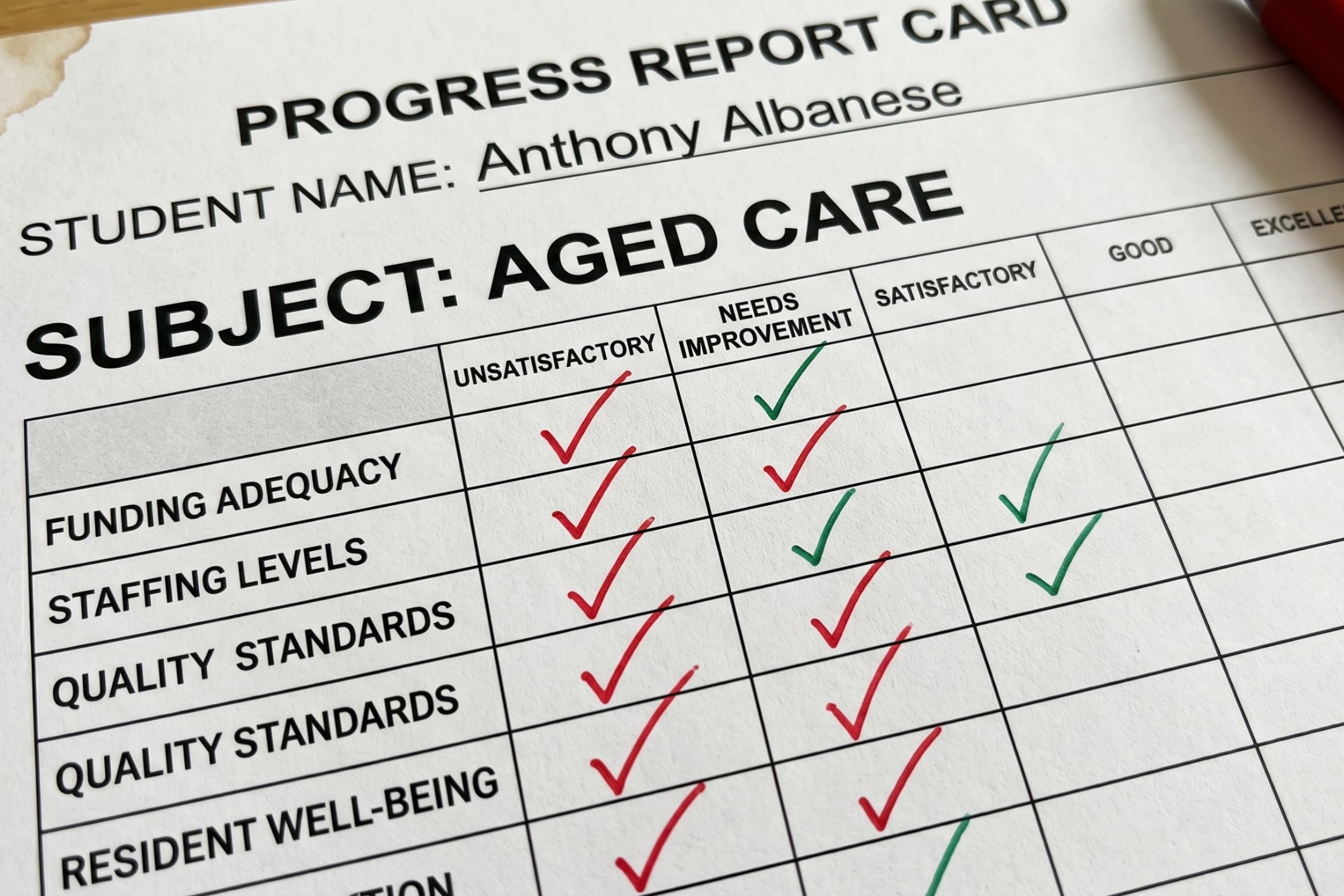
Report card: Labor’s reforms vs the Royal Commission’s findings
| Royal Commission priority area | Seven-month assessment | Grade |
|---|---|---|
| Timeliness of access to care | 200,000 still waiting. Average wait from application to care is 12 months. Government target of 3 months not due until July 2027. | F |
| Affordability and contribution fees | Full pensioners faced 17.5% contributions for basic personal care from day one. Reversed under pressure in May 2026, but the over-65 private health rebate was removed in the same budget. | F |
| Assessment quality and human oversight | Algorithm overriding clinicians with no transparency and no meaningful appeal. One provider’s rejection rate jumped to 38%. Compared in Senate submissions to Robodebt. | F |
| Support for carers | Nothing substantive in the reform package. Unpaid carers save the government an estimated $80bn per year and are compensated at roughly $3.50 per hour. | F |
| Dementia and complex needs | Dementia supplement being phased out. Rigid funding levels fail to reflect high-need, variable conditions. Some specialist dementia units announced in 2026 budget. | F |
| Assistive technology and home modifications | $15,000 cap exhausted by basic equipment. Three-month approval delays common. Renters unable to access key modifications regardless of funding. | D |
| Provider sustainability | Providers collecting debts they cannot recover, absorbing IT costs, and operating under a 50% cut to care management fees while compliance requirements have increased. | D |
| End-of-life pathway | 16-week funding cap creating ethical problems in practice. Some refinements flagged in 2026 budget, details pending. | D+ |
| Package numbers and rollout | 61,500 of 83,000 new packages released by March 2026. Wait times falling from a high baseline. The one area of measurable forward movement. | C- |
| Transparency and parliamentary accountability | Two Senate inquiries running. Cross-party pressure producing some responses. Wait time data published on a Sunday night before Senate Estimates. Inspector-General resigned. | C- |
| Overall | Seven months post-implementation | F |
The 2026 budget committed $3.7 billion to aged care and the personal care reversal is a genuine improvement, but the core structural problem has not been addressed. A system designed without the funding mechanism the Royal Commission said it needed will not be fixed by announcements made under political pressure.
The Royal Commission was called in 2018. It heard testimony that left the country confronted with what it had allowed to happen to its oldest citizens. A government campaigned on those findings, won an election, and then discarded the one recommendation that would have made genuine reform possible, because it polled badly.
Every person who lives long enough will need what older Australians are currently being denied. That is not a niche concern. It is a universal one. Fixing it requires a government willing to spend political capital now for benefits that accrue over decades. That government has not yet arrived.
If you or someone you know is struggling, Lifeline is available 24 hours a day on 13 11 14.



This is a repeat of the history of neglect by this Government…making claims for improvements, having a Commission which is incapable of taking serious actions against non-compliance by providers, where the interests of an ageing population are sacrificed for commercial interests and operations.
When things get too tough for the Government they reshuffle portfolios and in the guise of expediency and supported by false advertising, ignore many of the findings of the Royal Commission
Did you read the article? This is not an issue of providers sacrificing care for commercial profit. It is an issue of insufficient funding to effectively provide even basic care requirements in people’s homes. Without sufficient funding the providers will lose so much money they have to exit the care industry and then there will be even less care available.
We raised concerns with government about the flaws in the proposed reforms, yet key information—including pricing details—was not made available before the legislation was passed. Decisions of enormous consequence were made without Australians having access to the full picture.
The assessment tool was trialled and found to have significant shortcomings. Stakeholders were repeatedly assured that assessors would be able to exercise professional judgement and override the system where necessary. However, many of the concerns identified during testing remain evident in practice.
Few would argue that additional funding for aged care is not needed. The levy was presented as a necessary contribution to support a sustainable aged care system. The real issue is not the principle of funding aged care, but the way reforms have been designed and implemented.
Today, many older Australians are bearing the consequences of policy failures, flawed implementation, and decisions made without adequate transparency. Equally concerning is the role of advocacy organisations that receive government funding while claiming to represent older people. Effective advocacy requires independence. When an organisation is accountable to both government and the people it is meant to represent, there is always a risk that the voices of older Australians become secondary to maintaining government relationships.
Senior Australians deserve better. They deserve transparency, accountability, and advocacy that is prepared to challenge government when policies are not working as intended.
I have found an email address for My Aged Care. I am asking for a review of my assessment as my level remained as it was. The address is found on their website.
As my provider, along with all other providers, has lost a huge chunk of their income with the 10% rule they are forced into raising fees. Therefore the funding does not go as far as it did with HCP. So are we no worse off ? I think not.
One has to laugh at the “No worse off” comment.At 17.5 % on the Services my wife and i are afforded relates to $120.00 per fortnight from a $905.00 pension.We were told we were grandfathered after being approved for care in December 2021,they (The Bureaucrats) are so good at the smoking mirrors routine and can keep a straight face when telling lies.They know at our age we are slowly dieing so its not an issue for them, so sad, Advance Australia Where?
.
Here is my bit:
I am a “grandfathered” Level 3 because of arthritis. My hands are painful and not particularly interested in cooperating with me these days, but I do appreciate the assistance that is available.
I receive household help for 2 hours a fortnight, gardening for 2 hours a fortnight, a taxi card, a personal alarm in case I decide to test gravity, a bathroom mat, and a shower handrail.
I also had physiotherapy for an hour a week, but I have stopped that. Frankly, I know the exercises by heart and do not require ongoing supervision. I may be old, but I am not a slow learner.
I am also entitled to order prepared meals. On paper, that sounds wonderful. In reality, I much prefer my own cooking, however difficult at times, because I like to know exactly what is going into my food and, more importantly, what is not. After 87 years, I have developed fairly strong opinions about what I will and will not eat.
The thought of a freezer full of mystery meals does not exactly fill me with excitement. I suspect some of them contain ingredients that I would not voluntarily invite into my kitchen.
My main complaint is the astonishing waste of funds. The bathroom mat supplied reportedly cost $124. Surely I could have bought one at Bunnings for about $50 and still had enough left over for coffee and a vanilla slice. And the shower handrail? OVERPRICED (but yes, necessary)
And don’t get me started on occupational therapy charges. Apparently, someone needs to be paid a substantial amount to tell me what I need in my own house. I have lived in one for more than 80 years. By now, I have a fairly good idea of how they work.
My other major beef is the lack of supplier choice. The provider decides which businesses I can use and that is the end of the discussion. No ifs, no buts, no room for common sense. Apparently, consumer-directed care does not always involve much direction from the consumer.
I sometimes wonder how much money could be saved if older people were trusted to make a few sensible decisions for themselves. We may have arthritis, hearing aids, walking sticks and the occasional afternoon nap, but many of us are still perfectly capable of deciding where to buy a bathroom mat.
I am genuinely grateful for the support I receive. The household help, gardening assistance, taxi card, safety equipment and other services all help me remain independent, safe and continue living in my own home.
However, there are times when it feels as though the system spends more money administering help than actually providing it. A little more flexibility, a little more trust, and a little more common sense could go a long way toward making aged care both more effective and more economical.