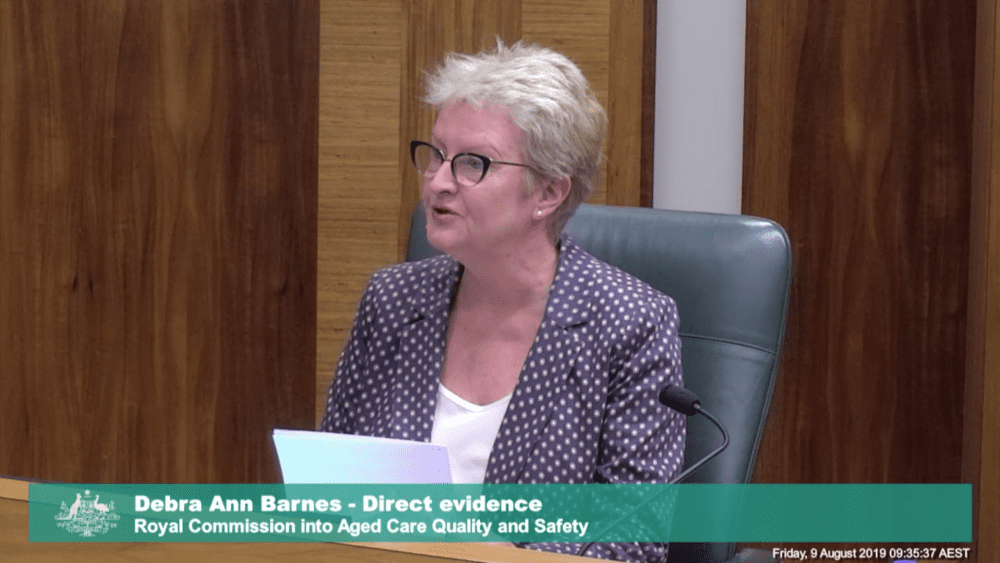
The daughter of a 90-year-old woman who died after her pressure wounds became infected has told the royal commission her mother did not receive the care she needed while living in residential aged care.
Debra Barnes told the royal commission of the “shocking experiences” her mother had to endure when in care.
Ms Barne’s mother was a university lecturer and school headmistress. She was one of five children, and had four children of her own. On her 90th birthday, she celebrated with 38 family members around her. During her retirement, she travelled widely, researched her family history, learned to quilt and played cards.
After a fall in December 2017, Ms Barne’s mother moved into residential aged care, eventually moving into the high care section.
Ms Barnes acknowledged she was a fierce advocate for her mother’s needs. “I would say I was the most annoying brilliant advocate daughter that I could be,” she said.
“As I was present several times a week, I was able to observe the way the facility staff handled Mum’ s needs, and I often provided formal and informal feedback.”
Feedback was mainly provided through a paper-based system, but sometimes also informally through conversations with staff, and also through an online system.
None of these systems helped Ms Barnes solve the problems she was experiencing with her mother’s care.
Of the 50 to 60 times Ms Barnes did share feedback, she only received acknowledgement of her comments in about 25 per cent of cases, and even then she was only told informally.
Ms Barnes was concerned she was not being kept properly informed of her mother’s care.
Ms Barne’s mother has a standing booking to have her hair done twice a week. However, on a number of occasions she missed her appointments.
“I witnessed the difference it made when Mum had had her hair done,” Ms Barnes said. “People would stop and comment on how lovely Mum looked and Mum would respond or smile.”
It appeared that staff weren’t informed about her mother’s booking, and when the hairdresser tried to find out where her client was, her calls weren’t answered.
More critically, Ms Barnes was horrified to discover she had not been told her mother had developed pressure wounds on her buttocks in January 2018.
“It felt like I was not being told or given updates unless I proactively asked for them,” Ms Barnes told the royal commission.
In May 2018, after going to hospital for a UTI, Ms Barnes stressed to care staff the importance that her mother drink regularly. However, there were frequently no cups available for her to use, and staff did not regularly offer her a drink.
“It was up to Mum as to what she did or did not drink,” a staff member told her.
These experiences left Ms Barnes feeling “incredibly confused and frustrated”.
A clinical nurse education told Ms Barnes she “could be intimidating and that perhaps staff didn’t feel comfortable approaching me with problems or information.”
On 2 August, Ms Barnes’ mother was taken to hospital when should could not be woken. Her blood sugar levels were too high for the hospital monitor to read. She also had a UTI.
Ms Barnes’ mother passed away in the palliative care unit of the hospital on 9 August 2018.
“I was saddened and frustrated with the communication I had with the facility in Mum’ s last six months of life. At several different stages, I felt like my voice was not being heard and that I was powerless. I did not know who else I could talk to about my concerns. The facility did not tell me about any external complaint services that I could access,” Ms Barnes told the royal commision.
As her mother’s power of attorney, Ms Barnes believed that she had a responsibility to ensure her mother received the best care possible.
“I wanted to be kept informed and involved with decisions and any developments about Mum’s care,” she said.
However, after her mother died, Ms Barnes said she “was left with an overwhelming and absolutely certain feeling that she didn’t get the care that she should have received.”
The outcome of a complaint to the then Aged Care Complaints Commission, now the Aged Care Quality and Safety Commission, was unsatisfactory, in Ms Barnes’ view.
“I do not understand how the complaint could have been resolved without there being an acknowledgement of what actually happened to Mum, and who was accountable for it,” she said.
Commissioner Tracey acknowledged that Ms Barnes had been through a “shocking experiences”.
Outside the royal commission, Ms Barnes and her brothers told the media they believe their mother’s death could have been prevented if she had received proper care.





I truly identify with the lack of care Ms Barnes went through with her mother. I have experienced many of the same issues with the lack of care my husband receives. I like Ms Barnes, is a strong advocate, being at nursing care 6 days a week. Back in May 2019 my husband went into “septic shock” due to a “UTI”. He survived but was severely critical! The nursing home called an ambulance, we had to wait 35 minutes, rather than calling 911. They never held the RN accountable for her lack of action! I had many meetings, nothing was ever done, that is our medical system, even in Southern Ca. Sad!