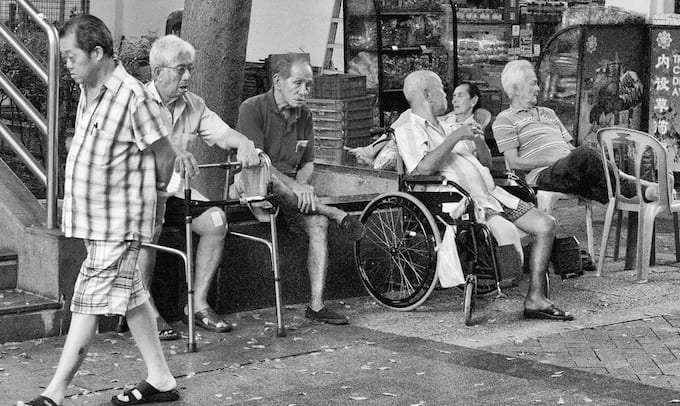
Older people often have a lot of free time on their hands – they may be no longer working, their children are all grown up and their social circles are dwindling as time goes on.
And it’s been generalised in the past that older people are a “burden” on society, and that they have little to offer. But that is simply not true.
Social isolation can be a serious issues for older people who spend have a lot of time on their own, and it can actually be detrimental for their health.
It’s been said that keeping busy, social and occupied can help a person’s physical and mental health – and in China they’ve found a special way to utilise their ageing population.
In Beijing, they will be deploying their own “granny” civilian force, later this week.
China, in particular, have a skewed ratio of older people compared to the younger population after because of nearly 40 years of the one-child policy, which only got revoked in 2013.
The volunteers will wear red armbands and caps, and are usually dispatched in large numbers during periods of heightened security, particularly during sensitive political gatherings.
On Sunday, a woman died and 12 others were injured when a man went on a knife rampage in a busy city shopping centre.
To increase public safety, 700,000 Chinese seniors will patrol the streets as security volunteers.
The timing of this latest batch of “granny” civilian force come with Chinese New Year celebrations beginning this Friday.
The elderly volunteers are said to help police with “safety inspections”, checking passengers and their belongings at railway stations and road junctions.
Others may patrol residential areas to monitor safety hazards and security issues, or identify illegal activity in the community, such as unlicensed street vending.
“Many of the volunteers are retired people aged from 50 to 70 years old,” state media previously reported.
The volunteers, who are tasked with working in different regions, belong to groups which are named after the local districts. Some examples include “Xicheng Aunties”, “Yongshan Persuaders” and the “Chaoyang Masses”.
One volunteer, who works in Chaoyang, said that that she often spends about six hours a day monitoring residential compounds.
“I feel like I am doing a public service and it is nice that I get to know all my neighbours,” the elderly volunteers told The Daily Telegraph.
This is rather telling when compared to the older people who feel as though they have nothing to contribute or offer.
Though Australia may not adopt a scheme of older people patrolling the streets for safety inspections, there are plenty of potential way that older people can help support the community. One example is helping with childcare.
How can Australia, as a society, utilise our elderly more?
What do you have to say? Comment, share and like below.


