The royal commission heard about the benefits of ‘multipurpose service’ providers in small country towns on Wednesday, and examined proposals for several ways to improve the delivery of aged care services in rural and remote areas.
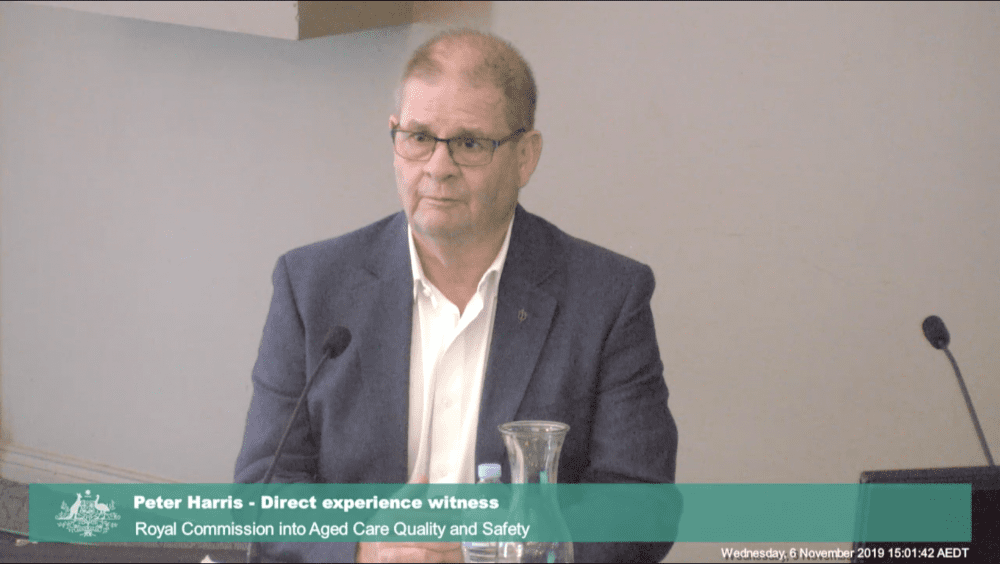
Peter Harris, whose wife Beth is living with young onset dementia, told the commission the multi-purpose service (MPS) in Nyngan, where he lives, has given him and his wife their lives back.
“We are so lucky to have the MPS at Nyngan because it’s a community-involved organisation,” he said.
With established ties to the community, both Mr and Ms Harris have strong links to staff who work at the MPS.
“The nurses can look after Beth for eight hours a day and do it well, and they can go home, where I envisaged I could do this for 24 hours a day, seven days a week and it just was not going to happen,” he said.
Mr Harris said he wanted to speak to the commissioners because he believes carers do not receive the recognition they deserve.
“I think carers are underrated and we underrate ourselves,” he said.
He also wanted to make the point that the community support he and Ms Harris have received has turned their situation around.
“Our story’s a sad story, but it’s also a very good story, and it’s a good story because of the caring community we live in, because of the MPS system we have, and because of the people who work in that system.”
On Wednesday, counsel assisting the royal commission Peter Gray QC, also asked Marget Denton, chief operating officer of WA Country Health Service, about the accuracy of data on My Aged Care in regional centres.
“We have some evidence that I will be raising with the Commonwealth later that if you search My Aged Care for home care package service providers in Kellerberrin (in regional Western Australia), you actually get quite a list of providers and they include providers who aren’t located in any of the towns in the wheat belt area.
“They include some as far afield with addresses in Victoria,” Mr Gray observed.
The revelation comes only days after the release of the royal commissions’ interim report, in which witnesses describes My Aged Care as “pretty useless” and “horrible”.
One witness said she suspected My Aged Care was a waste of money and said it offered little in the way of assistance.
Julian Krieg, a former teacher and resident of York in Western Australia, told the commission palliative care nurses visit patients on remote properties and after that they have face-to-face contact by Facetime, which is available at any time.
“So they (care recipients) can get 24 hour contact anytime,” he said. “It’s helped keep people supported.”
“It’s based on your relationship that you set up in the first place. It’s not just something out of the blue,” he noted.
Mr Gray put forward several proposals for improving aged care services in regional centres.
Though the commission has made it clear it will not be making recommendations until it releases its final report in a year’s time, it is not shying away from floating ideas either for implementation now, as in the interim report, or for general discussion, as were Wednesday’s proposals.
Mr Gray suggested that the government conduct use “block” grants for MPS providers or “pooling” of home care packages, and suggested MPS services could be expanded upon in areas with “thin” aged care markets.
“There could be a system of block grants through a competitive tender process, location by location, to address the issues of thin markets in those locations and scale diseconomies in those locations,” Mr Gray explained.
Mr Gray also suggested the government could offer rural and regional scholarship to attract nursing and aged care staff to regional and remote areas. In a similar vein, HECS debts could be waived for students who committed to working in regional towns. The commission also heard of successful programs in which residents already living in regional towns are trained to become aged care or healthcare workers.
Mr Gray spoke of building “linkages” between aged care providers and training organisation or TAFEs in the regions.
Another suggestion aired on Wednesday was that the government could establish a grants program to rebuild or refurbish older MPSs to ensure infrastructure is suitable for aged care, including dementia care.
Mr Gray proposed an independent pricing authority could be established to cost services in regional areas and provide subsidies where needed. He suggested the Independent Hospitals Pricing Authority could provide a framework for such an authority, a model suggested by the Productivity Commission in 2011.
Government-appointed managers could be used to ensure “continuity of service” when rural or regional aged care providers are struggling to meet compliance standards.
“Emergency” funding could also be directed to regional operations when a service’s financial viability comes under threat, Mr Gray suggested.
Mr Gray noted that the Department of Health is projecting demand for aged care services in remote and regional areas to increase 41 per cent over the next decade.
Wednesday was the final day of the Mudgee hearings. The next hearings will be in Hobart, Tasmania, on 11-15 November 2019.


