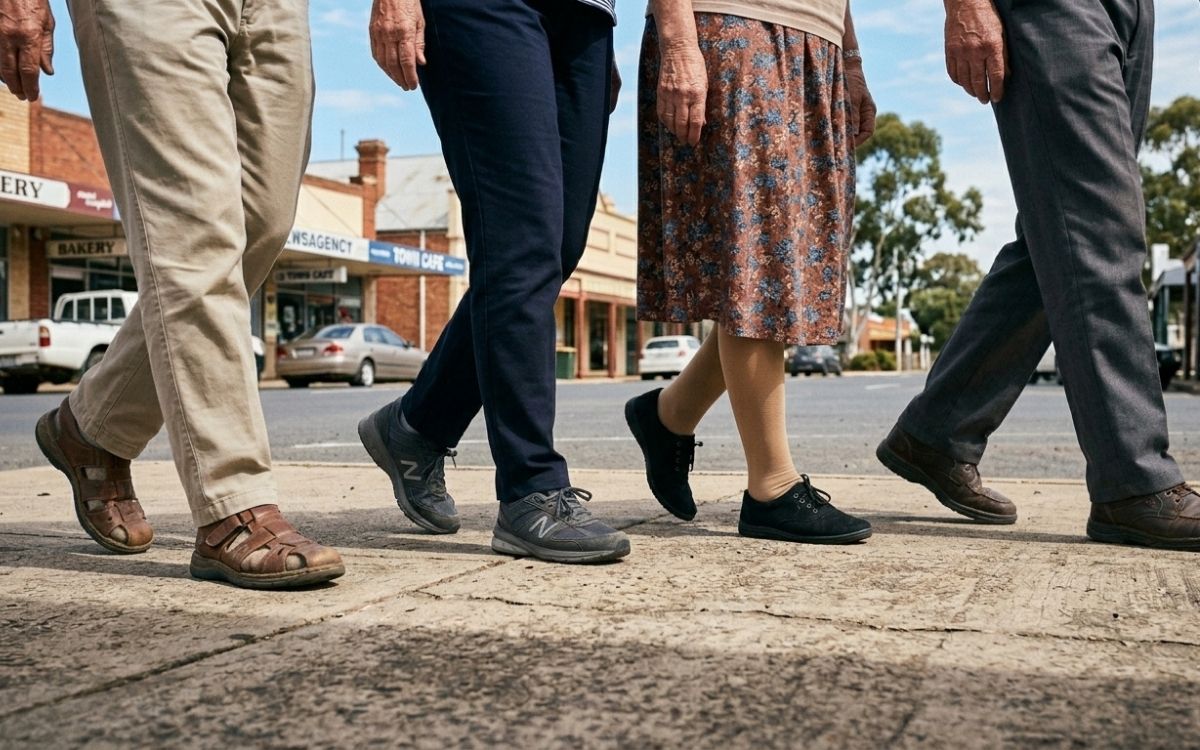
When an older person slows down, we tend to accept it.
They’re ageing. It’s expected. It’s inevitable.
But what if part of that decline has less to do with age, and more to do with the street outside their home?
New Australian research suggests the environments people live in may be quietly shaping how well they age. A study examining communities across Tasmania found that people living in more walkable neighbourhoods spent significantly more time being physically active. In some cases, that difference added up to more than an extra hour of walking each week .
That’s not a small change. Over time, it can influence everything from physical health to independence and overall wellbeing.
It also challenges a long-held assumption. We often treat decline as something that simply comes with age, but the reality may be more complex. The environment around someone can either support their daily life or gradually limit it.
This isn’t about structured exercise or motivation. It’s about what happens when everyday movement becomes harder to sustain.
If there’s nowhere nearby to walk to, if streets feel unsafe or disconnected, or if getting out requires planning and transport, people naturally begin to move less. It’s rarely a conscious decision. It’s a gradual shift.
A few fewer walks each week. Fewer reasons to leave the house. More time spent sitting.
Over time, that pattern builds. What begins as convenience becomes routine, and routine starts to look like decline.
Families often focus on care when needs become more visible. The conversation turns to services, support and whether more help is required.
But independence is shaped earlier than that.
It depends on whether someone can still move through their environment with ease, access places that matter to them, and stay connected without relying on others. Walkable environments support that. Less walkable ones gradually erode it.
What can look like increasing care need is sometimes the result of an environment that no longer supports everyday life.
The research found this relationship is even stronger in regional areas .
That matters, because older Australians living outside major cities are already more likely to experience chronic health conditions and lower levels of physical activity. They also tend to have fewer nearby services and limited transport options.
In these settings, the immediate environment carries more weight. If there are no accessible destinations within walking distance, staying active becomes significantly harder.
The result is not just reduced movement, but a gradual narrowing of daily life.
Walkable environments don’t just support movement. They support connection.
They make it easier for people to get out, see others, and remain part of their community. Without that, isolation can build slowly in the background.
For older people, that loss of connection can be just as significant as physical decline, shaping confidence, mental health and overall quality of life.
Much of the conversation around ageing has focused on improving care. Better services, stronger systems and more responsive support.
All of that matters.
But this research points to something more fundamental. Ageing well is also shaped by whether the environment around someone supports how they live each day, not just how they are cared for when things go wrong.
It’s a factor that often sits outside the care system, yet has a direct impact on when and how that system is needed.
For families, this doesn’t replace the need to think about care, but it does broaden the lens.
Alongside questions about services and support, it’s worth considering what everyday life will actually look like.
Can they leave the house easily?
Are there places nearby they can walk to?
Will they be able to stay connected without relying on someone else for every outing?
Because sometimes, the trajectory of ageing isn’t defined by a single moment or decision.
It’s shaped, slowly and quietly, by the environment people live in every day.


