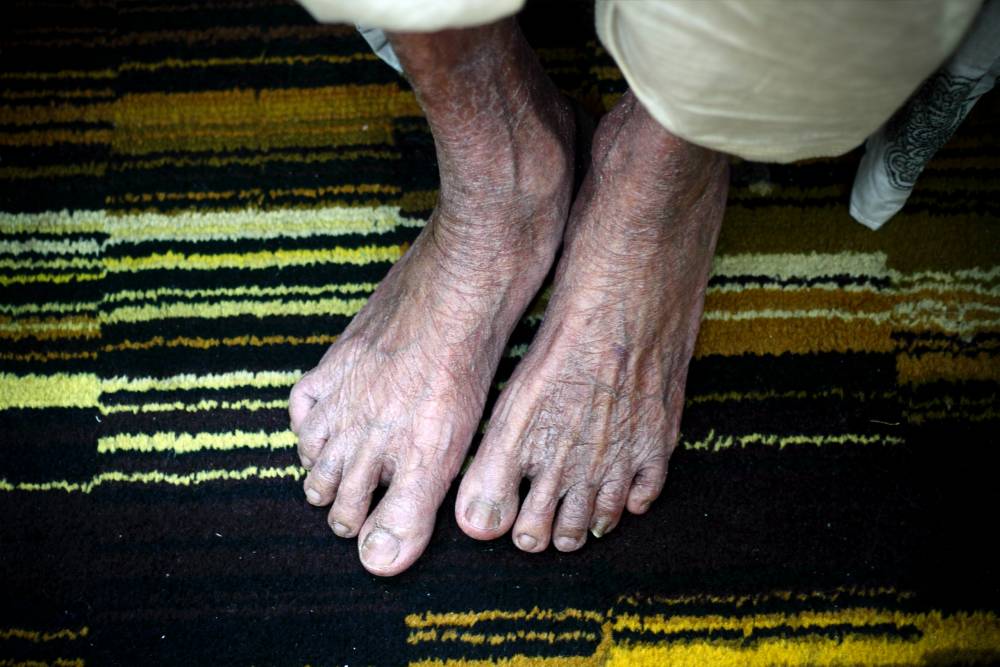
The long-held recommendation that older people should wear supportive shoes could be turned on its head by new research into whether – or not – walking barefoot can reduce the risk of falls among older people.
Susan Antcliff, a researcher with the University of Canberra, told HelloCare her journey to study the link between going barefoot and falls among older people began with her own personal experience.
“About 10 years ago I started having pain in my knee and my hip when I was running,” she said.
It was suggested to her to try running barefoot, which she did, and she found it helped. She also tried to walk barefoot as much as possible.
Ms Antcliff, who worked as an actuary for 20 years, also began visiting Calvary Older Persons Mental Health Unit with her therapy dog, golden retriever Sascha.
“I saw all these older people in clumpy shoes. Their feet couldn’t work properly, and it made me start thinking about how much they’re no longer sensing what’s going on (with their feet) and how that might relate to falling over.”
Ms Antcliff said when children learn to walk they engage all the muscles in their feet, and she could see older people losing the strength and sensation that comes from going barefoot.
Now, with a team of physiotherapists at the University of Canberra, she is testing the theory scientifically.
“One of the risk factors of falls is having impaired proprioception (the awareness of where the body is in space),” Ms Antcliff told HelloCare.
“We know that proprioception comes from receptors in our skin and muscles, and what shoes do is reduce the sensation you’re getting through your skin and it doesn’t encourage you to use your muscles.
“Maybe if we had feet that are stronger and more sensitive, that might do a better job than shoes,” she said.
But Gustavo Duque, Professor and Chair of Medicine – Western Health at the University of Melbourne, told HelloCare that going barefoot doesn’t prevent falls and that older people should wear shoes to lower the risk of falls.
“Several studies have shown that it (going barefoot) increases falls risk,” he said.
“The current recommendation is wearing well-fitting, low-heeled shoes with slip-resistant soles. But these recommendations vary from culture to culture,” he said.
A 2010 study published in Footwear Science, concluded that “older people going barefoot, wearing only socks, or wearing slippers may be at considerably increased risk for falls in their homes”.
The paper said data from several studies on the topic are “consistent” in this conclusion.
“We suggest that advice about wearing shoes whenever possible be included in fall prevention programs,” the study concludes, adding that more research is needed on the design of the most appropriate footwear for older people to prevent falls.
Ms Antcliff is looking for people to take part in the study.
Suitable candidates should be aged 65 or older, and she is particularly interested in working with people who have fallen in the last five years. Candidates must not have peripheral neuropathy.
The study will span 12 months and will be broken into two parts. During the first nine months, the researchers will monitor the candidates on various tasks.
After the nine month mark, they will begin a randomised control trial. Candidates will be broken into three groups – one will be a control group, one will do yoga, which is known to be beneficial in preventing falls, and the third group will do barefoot walking exercises.
The purpose of the trial will be to see if the barefoot exercises reduce the risk of falling as much as or more than yoga.
Ms Antcliff said the candidates won’t be asked to do anything too demanding. All activities will be tailored to older people, and the progression with the barefoot walking and yoga will be responsive to how the people are going.
To sign up for the study, contact Ms Antcliff at 0460 402 184 or send an email to Susan.Antcliff@canberra.edu.au.
We’ll keep our readers informed about the outcomes of the University of Canberra study.


