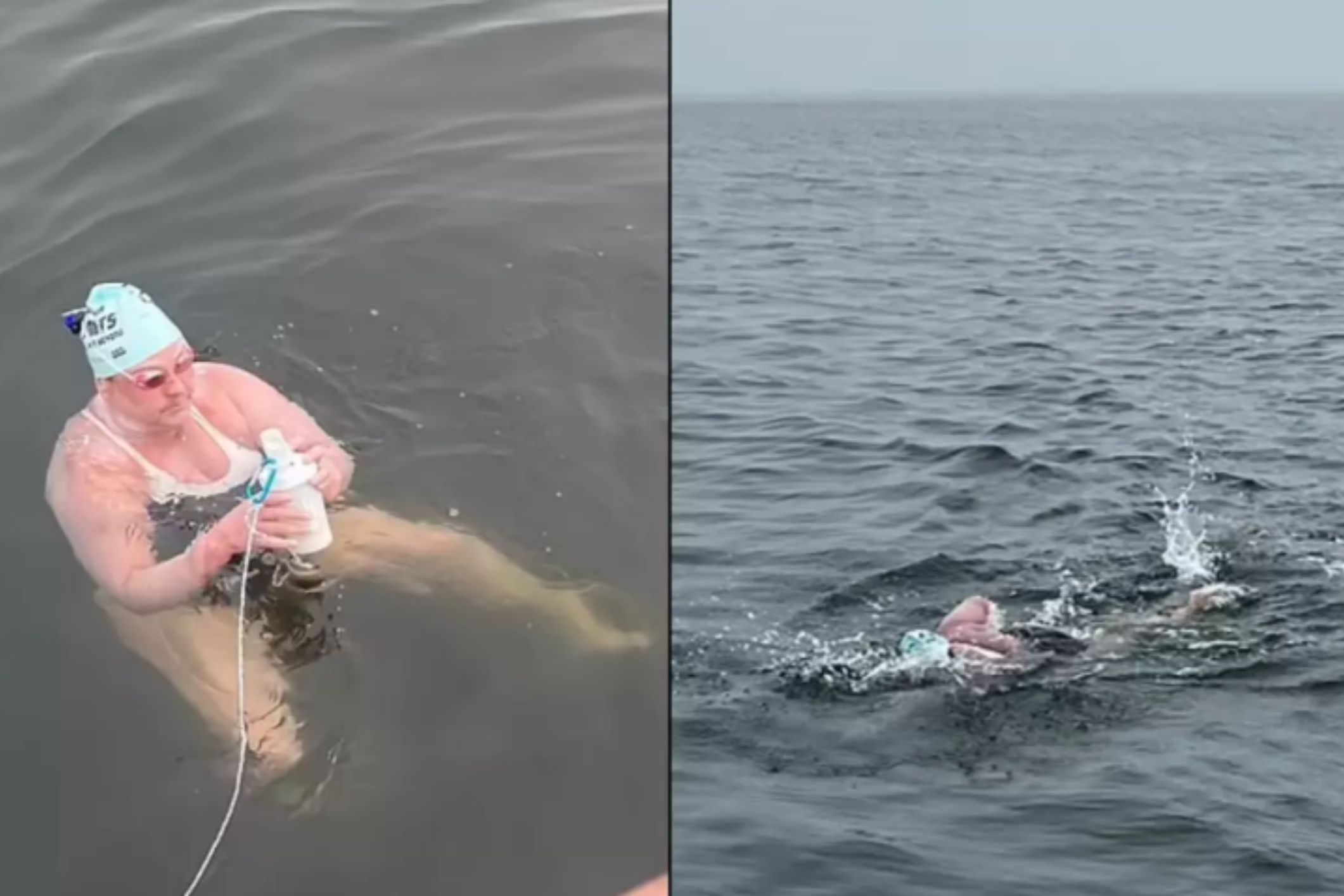
A 55-year-old grandmother has made history by becoming the first person to swim nearly 50 kilometers through waters known for great white sharks.
On 11 May, Amy Appelhans Gubser embarked on this remarkable feat, starting from a boat beneath the Golden Gate Bridge in San Francisco, USA. She spent the next 17 hours swimming the 29.7 miles to the Farallon Islands, located off the west coast of the USA.
According to the San Francisco Chronicle, Gubser is only the sixth swimmer to accomplish this challenge and the first to swim to the islands from the mainland. This route is particularly demanding as the tides and wind often oppose the swimmer, but Gubser prevailed.
In addition to battling the elements, Gubser faced the constant threat of encountering great white sharks. Despite this, she successfully completed her swim without incident.
Gubser, a mother of two and grandmother of two, works as a nurse coordinator at UCSF Benioff Children’s Hospital. After finishing her shift, she took a short nap before beginning her swim at 3:25am local time on a Saturday morning.
Reflecting on her achievement, she said, “It was the toughest thing I have ever set out to do. I look at those islands every day from Pacifica and often joke with my husband that I could swim there. They are so captivating and eerie.”
Gubser has trained for years for this marathon swim by undertaking other cold-water challenges, including swimming from Ireland to Scotland. However, this was her longest and coldest swim. Open water marathon swimmers are not allowed to wear wetsuits, so Gubser completed the swim wearing only a swimsuit, cap, goggles, and earplugs.
“I was pretty steady for the most part, but towards the end, we encountered a strong current and the water became colder,” she explained, noting the unique difficulties of the Gulf of the Farallones swim. “My progress slowed because I was chilled to the bone. I did not expect 43 degrees (6°C). That was nuts.”
Gubser was supported by a boat and a team of swimmers who took turns joining her after the 15-mile mark. Marathon swimming rules permit a support swimmer to accompany the main swimmer for only one hour at a time, with an hour’s break before another swimmer can join.
She credited her 67-year-old stepbrother Dan Fine, who is undergoing treatment for stage four pancreatic cancer, as a source of inspiration. Another motivating factor was the knowledge that if she failed, she would have to attempt the challenge again.
Her rigorous training regimen included swimming for two hours in the dark against an incoming tide two to three days a week.



Congratulations. What an effort and she is to be commended for training and taking on such a challenge. the human body is capable of many things but to do this swim under such conditions is remarkable. A life achievement.