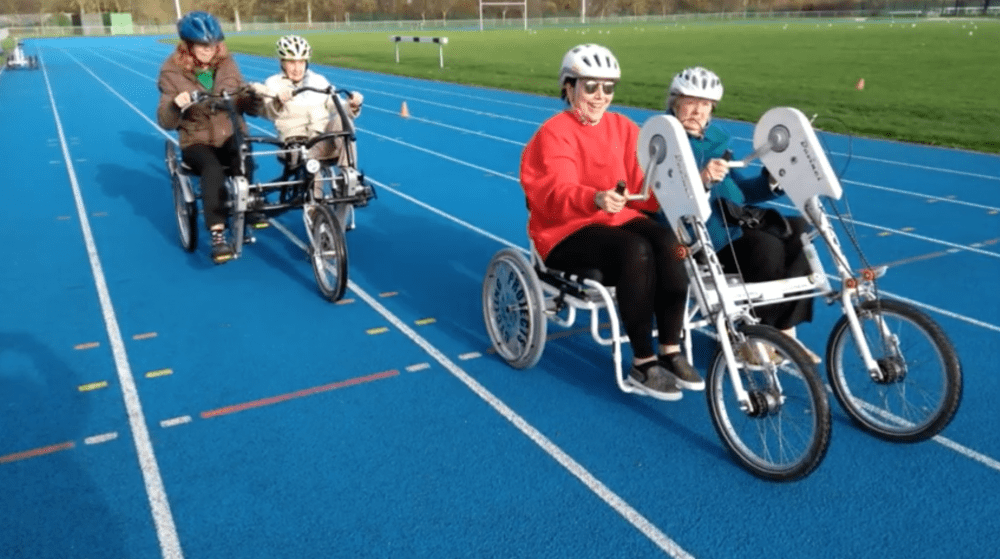
When people say ‘it’s just like riding a bike’, they’re usually referring to an activity that once learned, will always be remembered.
Scarlet House Care Home, in Gloucestershire in the United Kingdom, with the assistance of Wheels for All, has made that expression a practical reality – providing bikes for aged care residents to ride, even though some haven’t ridden for nearly a century!
“I loved it,” said resident Marion as she cruised the nursing home corridors, in a video presented by the BBC. Marion said the last time she rode a bike was 90 years ago.
“It’s great isn’t it,” she said.
“It’s been absolutely lovely,” said resident Edith. “You can go so fast,” she said. Edith hadn’t ridden a bike for “a couple of years”, she said.
“I was a little bit nervous at first, but it soon came back,” she said, proving the truth in the old adage.
“I was so pleased they asked me to go. I won’t forget that for a while,” Edith said.
People without a disability often take riding a bike for granted, Mary-Clare from Wheels for All told the BBC.
Wheels for All is a UK initiative that aims to encourage people to get involved in cycling, regardless of their age or ability, in the hope that they can develop a love of cycling. Wheels for All also run dementia-friendly cycling sessions.
For those living with disabilities, riding a bike is “extremely difficult”, Mary-Clare said.
Care organisation Care UK purchased a bike for residents (see image below), and transports it round 26 its homes with the charity bike ride support vehicle.
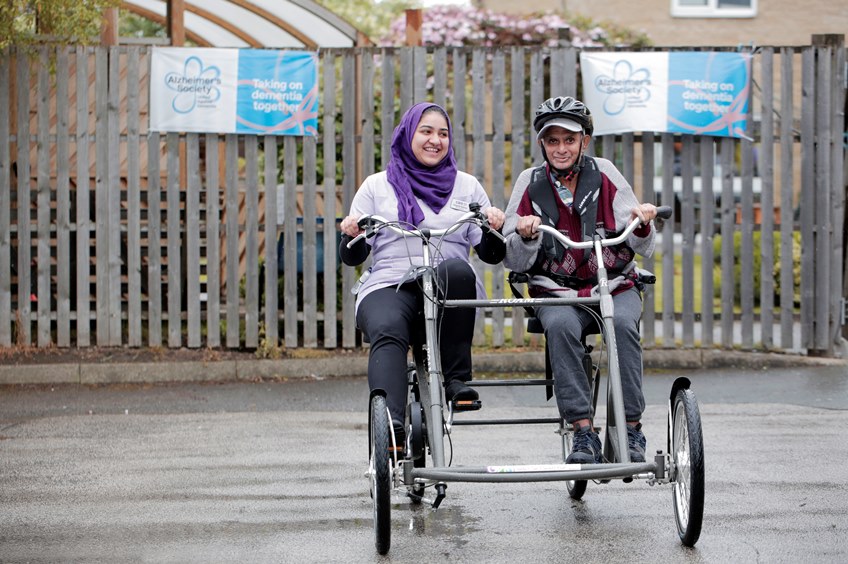
“It was a huge success,” a spokesperson for Care UK told HelloCare, “so much so that we are considering buying a couple more.
“Generally, the pedalling is done by a member of the care home team and the resident enjoys the ride (there is only one set of pedals). But sometimes, because they are stable, residents have been able to propel themselves around a safe space like a garden or car park.”
“Without these adapted bikes, [riding a bike] wouldn’t be possible,” said Mary-Clare.
“It was really great. It’s really is lovely to be able to get these people outside and onto bikes,” she said.
“And to see how much they enjoy it – residents, staff and the family, everyone benefits from it.”
Image: Cycling Project’s dementia friendly cycling session.





Waiting at a suburban bus stop I sat with an elderly Asian couple and a young girl of about 6 years,probably their granddaughter they had collected from state school.Time sped past a teenage school boy googled up the transport app and found out bus was going to be another 10 minutes arriving.No way we could help Asian couple know that.I asked child if she would explain to her grandparents bus would be coming but she said nothng and yet I knew she fully understood herself.They were quite frantic…so they phoned someone then set off walking. I felt at the time I should speak to a school staffer about teaching children that things could arise where they may need to be interpreters,but neglected to do so.