Older people, their families and taxpayers are the losers in aged care system that trusts an algorithm over expert clinical assessors.
The national Support at Home program for older people went live on 1 November 2025. It has been beset by problems ever since. The computer algorithm used to determine funding has come in for particularly strong and sustained criticism and rightly so.
Until November 2025, an older person needing a ‘Home Care Package’ to stay safely at home would be assessed by a specialist aged care clinical assessor. Following the assessment, the assessor would use the information gathered and apply their clinical judgement to approve the older person for one of four different funding levels.
This was the older person’s total annual allocation, with the older person required to make provision within their package for unforeseen events in the years ahead. This would typically include the possibility that the older person’s family carer might become unwell or that the older person might have to go to hospital and need a burst of extra support when they came home.
Aged care providers were not permitted to cross-subsidise from one person to another and, in the event of a person’s death, the unspent money would return to treasury.
To allow for each person to cover their future care costs, the previous Home Care Packages program allowed them to carry forward unspent package funding from one financial year to the next. There was no cap on how much money could be carried forward.
By the time that program ended and the new Support at Home program started in late 2025, the 293,000 people in the old program had a total unspent balance of $4.2 billion or around $14,000 per person.
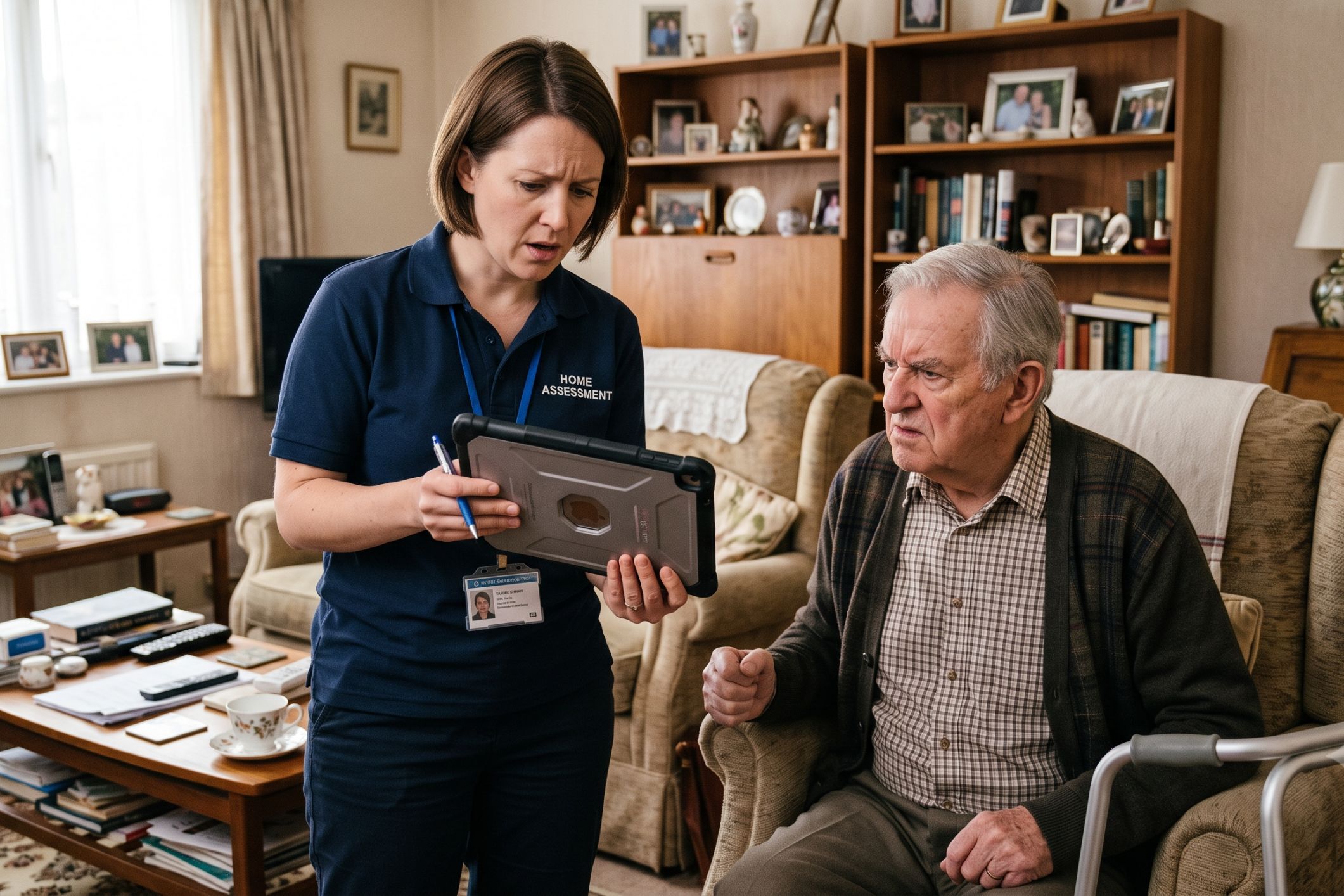
The assessment system changed with the introduction of Support at Home. Clinical assessors are now unable to make the decision about what funding the person needs to live safety at home. Instead, they enter assessment information into a computer. The Integrated Assessment Tool’s algorithm, designed by public servants, makes the decision.
From day one, assessors, aged care providers, families and older people themselves have criticised the algorithm for making determinations that are blatantly wrong. The approach using a computer algorithm has been criticised by the Inspector-General of Aged Care, the Human Rights Commissioner and the Age Discrimination Commissioner. It is now the subject of both an Ombudsman and a Senate Committee Inquiry. The Government has made a few minor concessions but these amount to little more than tinkering around the edges. They do not actually address the central problem.
Government attempts to defend the new system have fallen on deaf ears. One such occasion was on 4 June 2026 in an ABC Radio National interview. Referring to the previous Home Care Packages program, Minister Sam Rae said: And what we ended up with was an aged care system where there was essentially $4 billion of unspent funds that could have been better distributed to older people in need of care. The case for having a much improved assessment system was very clear.
More recently, Minister Rae rejected the idea of reintroducing clinical assessor decision-making and made unsubstantiated claims that to do so would potentially cost $6 billion to $11 billion and increase wait times by around five months.
In essence, the government argument is this: it cannot trust clinical assessors to decide what level of funding an older person needing Support at Home should receive because clinical assessors approve older people for more support (and therefore more funding) than they need.
This argument rests on an assumption that every cent of the $4.2 billion in unspent package funds is due to assessors allocating older people more money than they need. This is not true. Yet this is the basis for the government decision to trust an algorithm more than it trusts specialist aged care assessors.
Aged care specialists reject this outright as Canberra folklore. They have always argued that there is a legitimate case for older people receiving care at home to hold an unspent funds balance. There are multiple reasons why older Australians did not fully spend their Home Care Package funds. These reasons make perfect sense.
Delays accessing services: setting up a new package takes time (organising care plans, finding suitable workers, scheduling), so funds sat unused at the start.
Saving for a rainy day: many people chose to deny themselves services they would have benefited from, intentionally allowing funds to accumulate. They did this so they could respond to increased care needs later, such as after a hospital admission or during periods of illness. In some cases, people planned ahead for bigger costs such as home modifications, equipment or respite care.
Unavailability of, or delays in, accessing services: an older person could not spend their package funds if there were no services to access. This occurred (and continues to occur across large parts of Australia) due to shortages of services or staff. This is certainly not evidence that the services were not needed. It is evidence that required services were not available.
Fluctuating care needs: older people typically experience fluctuating health problems, and their health and support requirements also fluctuate. They sensibly use fewer services during some periods and more during others.
Not needing the full budget: in some cases the older person did not spend their allocation because they felt their needs did not require the full budget. This is the group that the Canberra folklore is based on. One of the reasons (but not the only one) for this is that there were previously only four funding levels, which was not sufficient to accurately match funding to needs. The eight levels in the new Support at Home program does not solve this because eight levels is also not sufficiently granular to match funding to needs with any accuracy. Irrespective, there is no evidence to indicate how common this was. There is evidence that this was only one of many factors and certainly not the only or even the main one.
The government reluctance to acknowledge and fix the significant problems with Support at Home (and specifically the IAT algorithm) is puzzling. Equally puzzling is how they can justify replacing clinical judgement with a computer algorithm based on anecdotes, not evidence.
Older people have the right to evidence-based aged care policy as well as evidence-based practice. The case for trusting an algorithm over expert clinical assessor judgement has not been made. Older people, their families and taxpayers are the losers.



Using the department’s argument that the start point of accessing services is the sole and most significant reason for the rest of the program’s issues of inconsistent utilisation, is akin to saying your first day of school will determine your remaining educational attainment. Assessment and utilisation are different things. Assessment is a nuanced complex process which acknowledges context and environment, conditions and their trajectory, psychology and social determinants. Professionals with complex skills and knowledge can gather this information. An algorithm can only work to boundaries of the people that built it and must always have outliers. Human conditions assessed by humans. Algorithms should be used to work out how to debeuracratise systems that develop dense and convoluted rules that delay and frustrate to the point where clients give up trying to use the funds at all as the entire system is blocked. Since SAH there are triple the issues, double the delays, and at least a third more administration costs. The algorithm is the start, the poorly trained first line communicators are next, the overly complex rules, not understood by said front liners, who give advice in opposition to the manual, the separation and lack of anticipation of equipment needs, the delayed payments to providers, the impossible demands to justify the simplest request, and…. it goes on. Good people who held the previous program up by sheer determination and hard work are now leaving exhausted.
My elderly folk are an example of allocated funds that have not been used, not because they don’t require the support, because they do not wish to receive the weekly nurse to shower for privacy and safety reasons, inviting a stranger into the home is very uncomfortable and they feel vulnerable so they decline. I could provide multiple examples of support offered in good faith and the decline of the offer – this is apparently a common conversation across Australia where support is declined as the transition from stranger to professional support requires time and patience as the support person is introduced – we would spend all of our $$ if there was an opportunity for the support person to visit intro themselves and perhaps in the following session commence gently with showering for example – very personal and private for someone who has never had this type of help throughout their life and coming into their home/sanctuary.
With the decline of services as such the responsibility then becomes the carers or family members and places strain on all…..the conversation about this is important and requires attention. The concern about safety and the focus on staying in the home is so important and yet there is a gap from living at home and the Aged Care Facility care……providing services is not transacational.
I could provide multiple examples however you are welcome to contact if required.
AI can’t facture in anomolies or be empathetic. Explains why my 74 year old neighbour can’t get any help. She’s had 15 operations on her spine is frail. She had a fall yesterday and broke her arm in 2 places. The days of fair and just have gone.