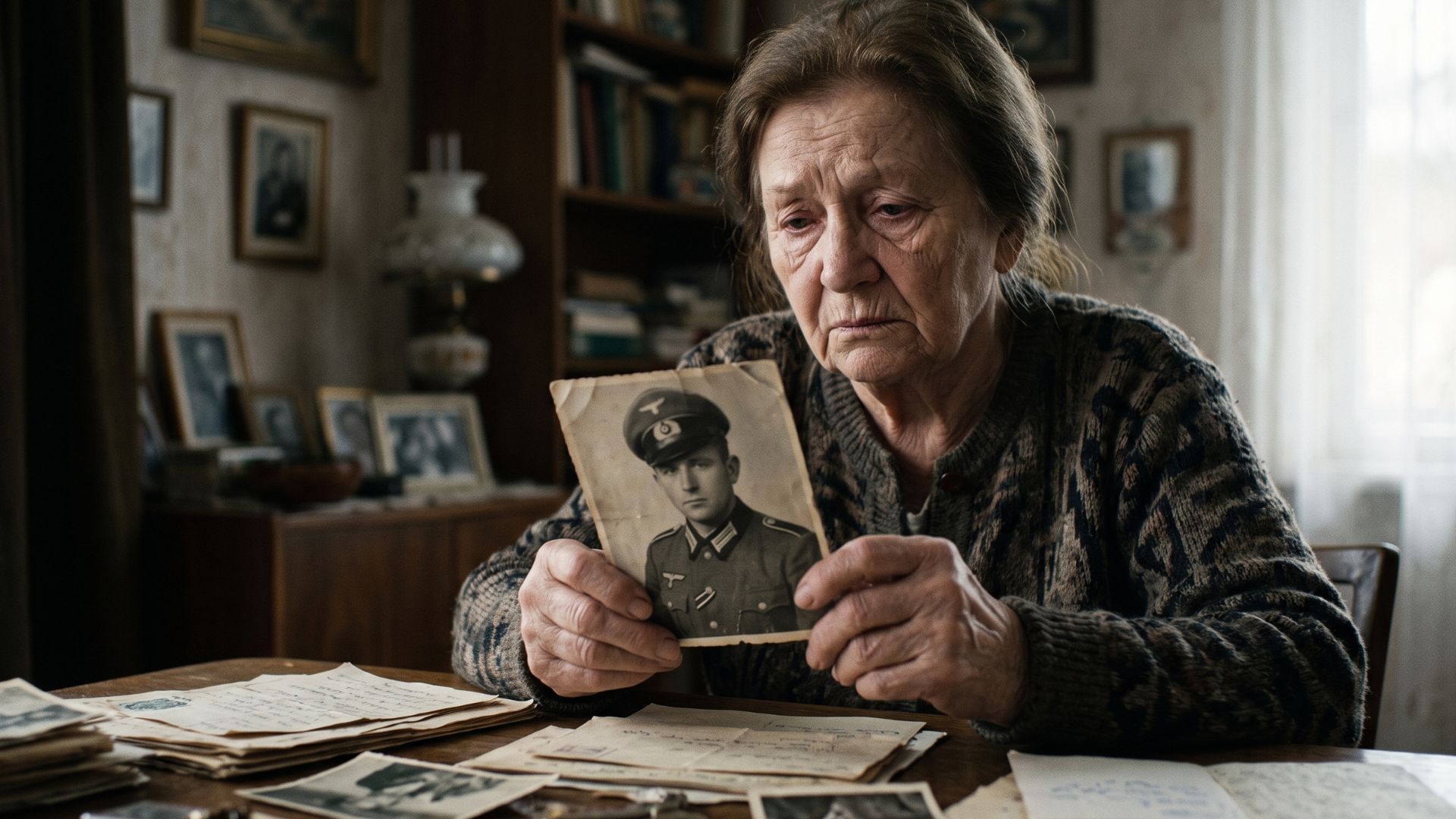
Elsa was a kind woman, a breath of fresh air during my community visits. With her German heritage woven into her demeanour, I had only scratched the surface of her story until one day she urged me to stay a bit longer, eager to open the door to her past.
In her soft voice, Elsa said how safe she felt with me, a rare sentiment that encouraged her to finally share the tale she had kept close to her heart for so long.
Born just months after the Second World War ended, she began life amid the remnants of a shattered Berlin, the youngest child of Hans and Margo, and she carried the weight of her family history with grace. Growing up alongside her two elder brothers, Gerahardt and Karl, she shared a tapestry of moments, each thread coloured by a different experience in a post-war world. As she recounted her memories, echoes of laughter and the shadows of past struggles danced in her eyes, revealing a rich narrative of resilience and love.
To escape the political turbulence in Berlin, the family moved to Munich when Elsa was just three years old.
Elsa felt they were an ordinary middle-class German household, with a home constantly filled with the inviting scent of meals prepared from scratch and closets packed with outfits for every imaginable event.
To Elsa, they were untouched by the lingering hardships of post-war Germany, enjoying a normal life.
In her memories, the family radiated happiness, with laughter and joy in their daily lives.
They spent their summer holidays by the tranquil lakes, enjoying picnics and outdoor pursuits that drew them closer.
Special occasions were marked by vibrant celebrations: birthdays filled with balloons, cakes and presents, and Christmas festivities adorned with twinkling lights, tree decorations and cherished traditions. Each moment was filled with warmth and affection, fulfilling her childhood wishes and creating a tapestry of joyful memories for years to come.
Elsa was raised in a home where the past remained a tightly kept secret. Although he served as an officer in the Third Reich, his wartime experiences remained strictly outside the sanctuary of their family life, never once mentioned.
Only when Elsa turned seventeen and secured a position at the ministry in Munich was the veil lifted. In the dimly lit archives, she stumbled upon her father’s war records, uncovering a truth that jolted her to the core: her mild-mannered father had been a serving SS officer at one of the darkest places, the notorious concentration camp of Bergen-Belsen.
After unearthing the shadowy past, deeply intertwined with the turbulent history of war, she felt an urgent need to confront her father and demand the truth.
Seated in the dimly lit room, she looked into his eyes, searching for honesty, only to find a veil of ambiguity. He evaded any direct denial or admission regarding his involvement in the atrocities committed within the grim confines of concentration camps.
Instead, he calmly said he was simply a nineteen-year-old soldier, bound to carry out his commanding officer’s orders and uphold the Führer’s directives.
Despite the distance in his tone, a stark reality emerged when he confessed that young men like him had been indoctrinated, brainwashed even, into believing that their horrific actions served a noble purpose for the Fatherland.
His words hung in the air, weighing heavily with a profound gravity, reverberating like a sombre bell tolling in the stillness. They encapsulated the deep, wrenching moral dilemmas woven into the fabric of war: the relentless struggle between personal conscience and the gnawing obligation to obey orders, leaving an unsettling sense of anguish in their wake.
Elsa looked towards her mother, her heart burdened by the unresolved mysteries surrounding her father’s time in the war.
With a deep sigh, her mother hesitated before speaking, the shadows of the past flickering across her face. She confessed that she carried a burden of guilt, pain and regret, a weight that had settled in her chest and refused to lift. Her eyes clouded over as she recalled the brief, chilling snippets of information she had gleaned about the horrors within the death camps. The thought of it made her stomach churn, a relentless nausea that surfaced day after day, a haunting reminder of a truth she wished she could forget.
Elsa had always struggled with the burden of the past, particularly the shadow cast by her father’s actions during the war. Despite the deep bond she shared with her husband Eric and their two sons, Ralph and Max, she chose not to discuss her father’s history.
She watched with bittersweet pride and sorrow as her boys idolised their grandfather, a man revered for his charm and wisdom. Elsa did not want to disrupt that adoration by revealing the uncomfortable truths that lay beneath the surface.
Her sons, passionate and outspoken, held strong feelings about the Holocaust; their disgust at how the German public was brainwashed about the atrocities committed in the name of state-sponsored propaganda was profound. They had developed a sense of moral clarity that often left Elsa feeling like a keeper of painful secrets.
She knew that speaking out would shatter the idealised image they held of their grandfather and perhaps even damage their perception of their own heritage.
Elsa also reflected on her paternal grandmother, a woman who had lived her entire life under the heavy shadow of her son’s wartime choices. Years of shame and regret had carved lines into her face, and Elsa had seen that unmistakable glint of sorrow in her eyes time and time again.
Her grandmother had carried that sorrow, passing away with the heavy knowledge of her son’s role in a dark chapter of history, a legacy of shame that was buried with her.
Elsa gave a heavy sigh as she processed the weight of this revelation. She glanced around her lounge; the walls were adorned with cherished family photographs frozen in time, alongside a collection of German memorabilia hinting at a bygone era.
A large, intricately crafted wooden cuckoo clock dominated the room, its carved figures narrating stories of nostalgia and expert artistry.
Every fifteen minutes, it chimed beautifully, its cheerful song echoing through the room. Elsa’s face softened at the sound; she shared that the cuckoo was her constant companion during moments of solitude, a joyful reminder of her roots and a connection to the Fatherland she both cherished and questioned.
Elsa knew deep down that trying to rewrite the past was futile. History stands as a fixed reality, existing for a reason and impossible to change.
Yet, she felt an urgent need for her family story to be acknowledged and preserved, not as a reflection of guilt, but as a testament to the complexity of human morality.
She wrestled with the need to make it clear that her father’s transgressions were not her own, and that his actions should not cast a shadow over her.
She believed the truth deserved to be brought into the light, rather than kept in the shadows out of fear of tainting those precious memories.
It was a difficult balance, but Elsa felt it was her duty to ensure that the lessons of the past were shared, even if it meant confronting painful realities.


