
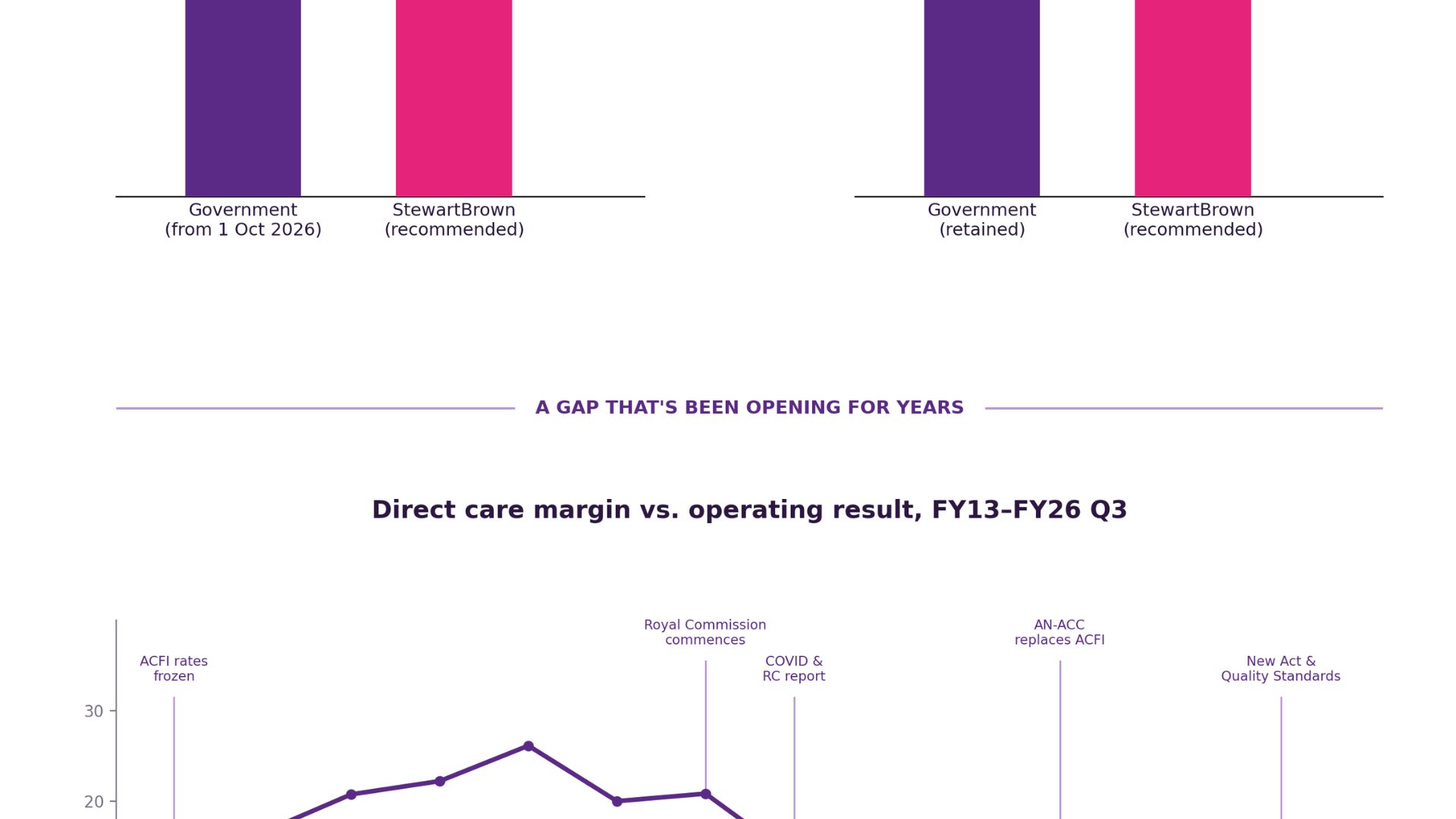
The new AN-ACC price is already falling behind the cost of delivering residential aged care, with a fresh analysis showing the figure would be $7.72 higher if more recent provider costs were used in the pricing calculation.
For a provider with hundreds of residents, the difference quickly becomes substantial. At 100 occupied places, $7.72 per resident per day equates to $772 a day, or more than $282,000 a year.
From 1 October 2026, the AN-ACC price will increase from $295.64 to $303.19 per resident per day, a rise of 2.55 per cent.
StewartBrown has taken cost data from its March 2026 financial survey and applied broadly the same cost and indexation principles used in the AN-ACC pricing process. It arrives at a price of $310.91 per resident per day. That leaves a $7.72 difference between the Government’s new price and the price produced when more recent provider costs are used.
For providers, the significance is not simply that an industry accounting firm believes the Government should pay more. The analysis demonstrates that the funding outcome changes materially when the underlying cost data is brought closer to the period in which providers are actually delivering care.
The Independent Health and Aged Care Pricing Authority (IHACPA) develops annual pricing advice for residential aged care using financial reports, cost collections, AN-ACC classifications, claims data and other information.
Its pricing framework uses cost modelling and then applies indexation to account for changes between the period covered by the cost data and the pricing year. IHACPA provides its advice to the Government, which determines and announces the final AN-ACC price.
StewartBrown’s analysis does not reject that methodology. Instead, it tests the outcome using a more recent provider cost base.
The difference is particularly clear in labour costs. StewartBrown’s March 2026 data produces a labour cost base of $264.10, compared with $254.63 in the IHACPA calculation.
After indexation, StewartBrown calculates weighted labour costs of $277.12, compared with $267.16 in the IHACPA calculation. Once the other components are included, the StewartBrown calculation produces $310.91.
The result shows how a funding price can fall behind even when indexation is being applied. If the starting cost base is behind the actual costs providers are facing, subsequent increases are being applied to a number that is already out of date.
The timing matters because provider costs have continued to rise.
StewartBrown’s March 2026 financial survey found average direct care costs, including allocated administration overheads, increased by 9.5 per cent over the nine months to March compared with FY2025.
Its survey also found 62 per cent of participating homes recorded an operating loss during the nine months to 31 March, while 35 per cent recorded an EBITDA loss. The average operating result in the March 2026 quarter was a loss of $9.16 per bed day.
Those figures cannot be attributed solely to the AN-ACC price, with providers also dealing with labour, compliance, accommodation, food and other operating costs. They do, however, provide a contemporary picture of the financial pressure facing the sector.
The broader cost environment is moving faster than the new AN-ACC increase. CPI rose 3.5 per cent in the year to June 2026 and 3.8 per cent in the year to July, while the Fair Work Commission’s 2026 national minimum wage decision increased award wages by 4.75 per cent from 1 July.
The Wage Price Index for public and private health employees, excluding bonuses, increased by 3.9 per cent over the year to June.
AN-ACC is not simply indexed to CPI or wages, so these figures cannot be used to calculate what the AN-ACC price should be. They do show the scale of the cost increases providers are absorbing while the new funding price rises by 2.55 per cent.
IHACPA says it uses the most recently available year of data from its cost collections, together with Aged Care Financial Reports and Quarterly Financial Reports, and then applies indexation to account for changes between the data collection period and the pricing year.
Its 2026–27 pricing framework says the advice was informed by the Residential Aged Care Cost Collection for 2024–25.
That approach creates an unavoidable lag between providers incurring costs and those costs appearing in the data used to set future funding. The problem is what happens when costs are rising rapidly during that period.
StewartBrown’s analysis provides a direct illustration. Its March 2026 data produces a materially higher price when put through the broad pricing methodology.
The $7.72 difference is not a theoretical complaint about future costs. It is the difference between the Government’s announced price and the figure produced using much more recent evidence of what providers were actually spending.
The same issue appears in the separate hotelling supplement.
The Government will retain the supplement at $22.15 per bed day while the methodology is reviewed. StewartBrown’s analysis puts the required amount at at least $27.96.
IHACPA previously identified a $5.81 per occupied bed day gap between everyday living costs and related revenue for homes that did not receive additional or extra service fee revenue in 2023–24.
Using its March 2026 data, StewartBrown calculates that gap at $8.52 per occupied bed day. StewartBrown argues that additional service fee revenue should not be used to compensate for a shortfall in the funding of the basic everyday costs of running a residential aged care service.
It has also called for a regional loading, pointing to larger everyday-living cost and revenue gaps among regional providers and their more limited ability to generate additional service fee revenue.
The sector does not need another analysis telling providers that their costs are rising faster than funding. They already know that. What StewartBrown’s analysis adds is a calculation showing how much difference the underlying cost data can make.
The Government’s new AN-ACC price is $303.19. Using StewartBrown’s March 2026 cost base and the broad pricing approach produces $310.91. That $7.72 daily difference is evidence of a funding system struggling to catch up with the costs it is supposed to fund.
The AN-ACC price may be updated each year, but the evidence suggests the funding is still being set against a cost base that does not fully reflect the financial reality providers are facing by the time the new price takes effect.


