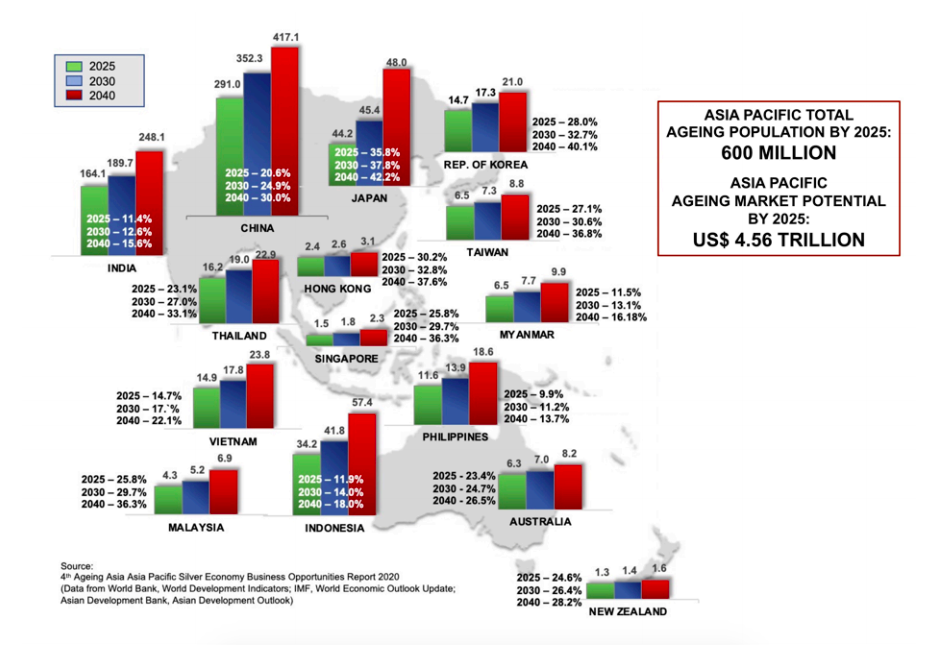
According to findings from the 4th Asia Pacific Silver Economy Business Opportunities Report 2020 edition, Asia Pacific’s ageing market value is estimated to hit US$4.56 trillion by the year 2025. This marks an increase of 43 percent from US$3.2 trillion in 2020. In line with previous editions of the Report, launched on Friday by Ageing Asia, household savings continue to be the metric to estimate the capacity of an individual to purchase goods and services outside of their daily consumption needs.
The report also released the Ageing Asia Silver Economy Index – a ranking of countries in Asia Pacific by market potential for the ageing population. Singapore ranks top in the 2020 Index with Japan catching up closely in second position from a number sixth ranking in 2015. Australia maintains third in position.
In the 2015 Index, Hong Kong SAR was in second position, but has dropped two rankings down to fourth position in the 2020 edition. Japan’s jump is largely attributed to improved household savings per capita forecasted for 2025 compared to other developed countries, a large ageing population and longer life expectancy.
Singapore’s projected ageing market value by 2025 is forecast to be US$ 72.4 billion. Japan, a super-aged country with 35.8% population aged 60 and above, is the second largest ageing market in Asia Pacific, accounts for US$884 billion and 19.3% of the ageing market potential in Asia Pacific. Australia is projected to reach US$159.1 billion by 2025.
The market outlook for the ageing market remains positive, even in the midst of the COVID-19 pandemic. The majority of industry participants surveyed believe the market will pick up and adapt to the new norm of eldercare services and ageing technologies.
“Ageing is not one homogenous market; it is an eco-system of multi-industry, niche business opportunities, that require research, experimentation, market segmentation and in-depth understanding of customer perception of product value. The next lap that will drive the future of ageing in Asia Pacific is about successfully engaging both consumers and industry”, observes Ms Janice Chia, Founder & Managing Director of Ageing Asia, Singapore.
The report covers 15 key countries identified as potential silver economy growth markets within Asia Pacific – Australia, The People’s Republic of China (known as “China”), Hong Kong SAR, India, Indonesia, Japan, Republic of Korea, Malaysia, Myanmar, New Zealand, Philippines, Singapore, Taiwan, Republic of China (known as “Taiwan”), Thailand and Vietnam.
The 4th Asia Pacific Silver Economy Business Opportunities Report 2020 edition is available from, 8th August 2020. The report launch is a part of activities held in conjunction with Ageing Asia 2020: World Ageing Festival (The hybrid edition), 2-25 November 2020.
For more information on the festival or to receive the report, visit www.ageingasia.com


