
1 January will bring significant changes to the calculation of pension entitlement. It will also bring serious changes to the way in which the former home (and any rent) will be treated.
At the moment there are two sets of rules, one for residents who entered care before 1 January 2016 and one for those who entered after.
Residents who live in aged care and pay towards their cost of accommodation by daily payment (DAP or DAC) AND rent their former home have their former home’s asset value and any rent receive exempt from the calculation of their pension. The home and the income (rent) are exempt for as long at the resident meets these criteria.
Residents who entered care prior to 1 January 2016 also have the rent exempt from the aged care means test, those who enter after 1 January 2016 have the rent included.
The house has a capped asset value of $159,631 for the aged care means test, unless a protected person lives there.
From 1 January next year, the rent will be included in the calculation of pension entitlement under the income test. The asset value will remain exempt for a maximum of 2 years regardless of whether the property is rented or not.
This all means that there will be 3 different assessment criteria based on whether the resident entered care before 1 January 2016, between 1 January 2016 and 31 December 2016 or after 1 January 2017.
Mary is pensioner with the following assets
House $850,000
The family estimated she could receive rent of $500p.w with expenses of $4,000p.a
Cash $120,000
Personal Effects $20,000
The facility Mary is moving to has a Market Price $400,000 RAD or $63.12 DAP
Mary is going to pay $50,000 from her cash towards her RAD
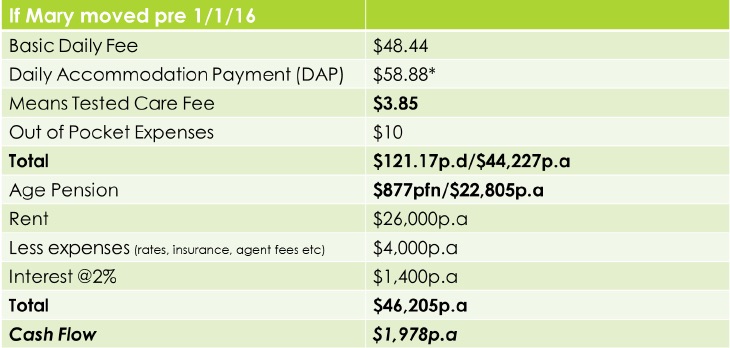
If Mary’s date of entry was prior to 1 January 2016…
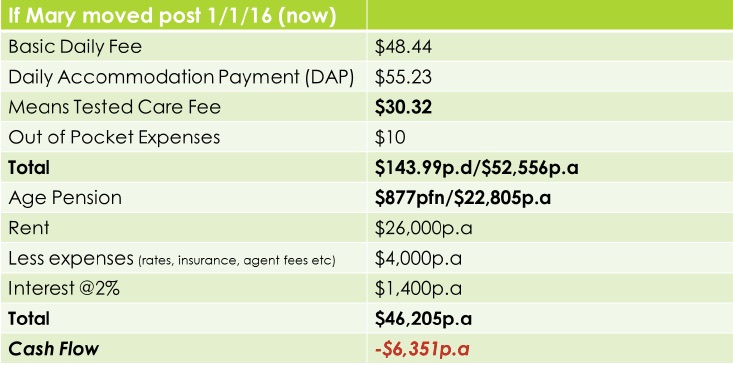
If Mary enters care today…
If Mary enters care after 1 January next year…
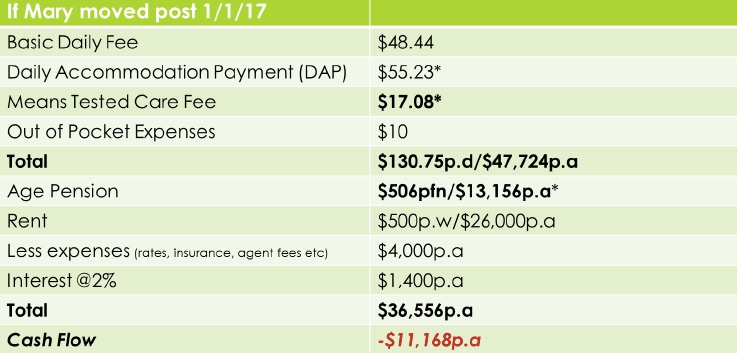
* rates are correct as at 20 September 2016.
As you can see the different assessment criteria create very different outcomes for Mary’s pension, means tested care fee and cash flow.
While the pre 1 January 2016 rules can only apply to existing residents, people currently considering moving into care can still take advantage of the current exemptions.
Keeping up to date with changes and advising residents on how best to fund their cost of care is what we do.
We have recently updated our “Understanding the Cost of Aged Care” booklet to incorporate these changes together with the changes to pension – to order copies you can contact me on 9836 8399 or email richard@advisersure.com.au


