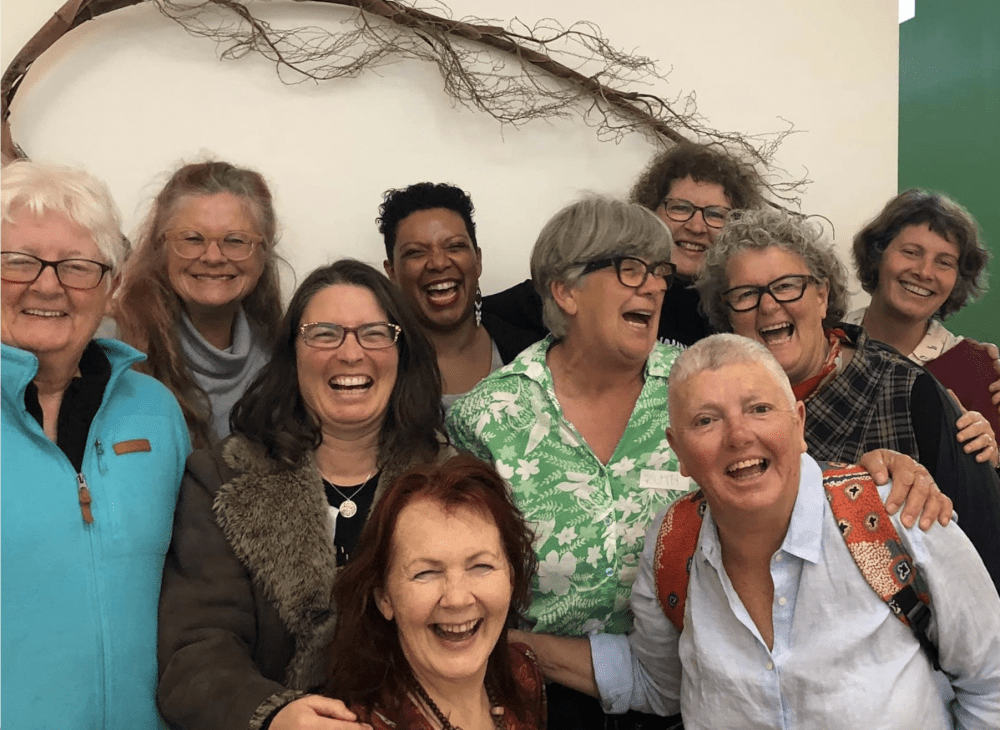
Sound therapy teacher Susie Nelson-Smith was on a retreat in the United States when she first heard the gentle singing of the Threshold Choir.
The choir, whose members sing at the bedsides of those on the threshold between life and death, was started 18 years ago by Kate Munger, a music teacher, after she spontaneously began to sing at the bedside of her friend who was dying of AIDS.
When Ms Nelson-Smith returned to Australia, she decided to bring the concept home, and, with the help of her friend Colleen Kennedy, the two formed the Sydney Threshold Choir. There is now a Threshold Choir in Melbourne, Brisbane, Adelaide, the Central Coast, and Wollongong, and a new one starting in Newcastle.
The choir has a core of 12-18 members, though numbers fluctuate, and it rehearses once a week at the Uniting Marion Nursing Home in the Sydney suburb of Leichhardt.
“We’re singing to people on the threshold of life and death,” Ms Nelson-Smith told HelloCare over the phone recently.
“We may be singing at a palliative bedside, or we might be singing at a bedside where someone’s unable to get out of bed because of ill health. We also sing for people who are struggling with dementia,” she said.
“We sing lullabies, we sing chants, mantras, hymns, predominantly songs that have been written by threshold members,” Ms Nelson-Smith explained.
“There are over 2,000 threshold choir members all over the world. A lot of members are composers or become composers. So we have a very large repertoire,” she said.
“They’re often fairly simple songs. We sing in harmony, we sometimes sing in parts. We sing with a maximum of four people, but generally three people at the bedside. We sing softly, and with a lot of love. We have a softness in our voices which is really suitable for that vulnerable threshold,” she explained.
“The difference we can make is just extraordinary.”
The choir sings to the residents at the Uniting The Marion, where a number of the residents live with dementia. “They respond beautifully,” said Ms Nelson-Smith. “Sometimes they might sing along. We find that it’s very calming because of the style of singing.
“It’s the type of singing. There’s a lot of love that’s coming from us when we sing, and I think that… someone who has dementia… does respond to that in calming them, in relaxing them, in making them feel safe.”
“Families have said to us that they can tell a difference in their family member after we’ve been to sing.”
When they can’t be at the bedside, the choir can sing over the phone.
Recently, they were asked to sing to a woman in Queensland. The woman was in the last days of her life, and her niece organised for her family to be there while a choir of three sang several songs over the phone. Once finished, they ended the call. “We don’t want the family in any way having to say ‘oh that was lovely, thank you’,” Ms Nelson-Smith said.
“We just said ‘we’ll leave you now and let you enjoy those moments with your loved one’.”
The family messaged the singers later that day to let them know how beautiful and meaningful their singing had been.
“It was a treasured moment for them all,” Ms Nelson-Smith said.
The choir is completely voluntary, and at this stage is only open to women, although there are talks underway to have a second choir for men and women.
“If we had enough people we might have an all-women’s choir and a men-and-women’s choir, but we haven’t got enough numbers for that as yet,” explained Ms Nelson-Smith.
“There are so many beautiful men who would love to be doing this work but it’s also something very special for a group of women to do it together,” she said.
The choir chooses songs based on what they know of the person they’re singing to. If they’re singing to a Christian person, they might sing hymns, for example.
“We were asked by a daughter to sing Amazing Grace for her dad who was dying,” Ms Nelson-Smith recalled. “We didn’t know it, so we learnt it. Her dad had been semi-conscious for for days, and when we sang Amazing Grace he rallied. He came out of that unconscious state and it allowed his daughter, with her dad, to have what may have been their very final moments of recognition of each other. It was really, really beautiful.”
The daughter later told the choir ‘Grace’ was her mother’s name, “So it was very, very poignant,” Ms Nelson-Smith said.
There is no audition to join Sydney Threshold Choir, but they do ask members to be able to hold a tune. “Because of the nature of the songs and the training we’ve had with our music director, Trish Watts, and our rehearsals, which we have regularly, people say we sound absolutely beautiful,” said Ms Nelson-Smith.
“We are not professional singers, we’re volunteers, who want to make a difference to those at the end of life through gentle, loving singing.”
Interested in joining the Sydney Threshold Choir? The choir is looking for more singers. To find out more or to book the choir, you can visit their website or the Facebook page.





