The Australian population is getting older, living longer – and for some, getting lonelier. It’s predicted that households of one will rise from 2.1 million in 2011 to a staggering 3.4 million in 2036.
Care services are seeing an increased demand for aged care that works with older people, supporting them to keep independent and socially connected in their own homes.
Lonely and socially isolated older Australians are a widely distributed, often secluded population. As a group, it’s a population far more susceptible to illness and injury.
In fact, isolation and loneliness can be dangerous: “extremely” lonely older people are up to 14% more likely to die prematurely. Feeling lonely can increase blood pressure and cortisol levels, which can disrupt sleep and alter genes. Isolation can trigger depression.
All of these conditions have a significant impact on a person’s wellbeing – and how often they visit the doctors, or call an ambulance.
Older Australians experience a range of age-related illness, and for some the phenomena of a shrinking social circle.
This leaves service providers with a clear design brief: how do we support the independence of older Australians at home, whilst meeting their social needs? Can technology help older people maintain social connection and improve their quality of life?
Turning the internet of things into an internet of actions
Loneliness can be difficult to identify: one person’s isolation is another’s bliss. Moreover, it’s a problem that’s approached reactively, and is difficult to resolve in a timely manner.
Instead of relying on self-reporting methods or invasive monitoring, a collaboration between Bolton Clarke and RMIT took things back to basics.
Together, the team looked at the value of a chat.
The importance of word count is well-documented in children when measuring language acquisition and IQ. Yet daily word count has been seldom explored as a proxy measure for loneliness in older populations.
Using a social and human-centred design approach, the team from Bolton Clarke and RMIT developed an ambient wearable that older people would actually want to wear.
The aim was to develop something that could monitor social contact, without the user needing to interact with any confusing interfaces.
The goal was to address social isolation in older people with a novel yet intuitive intervention.
The CaT pin monitors social interactions without intruding
The design was created as a collaborative with Matiu Bush, Senior Strategist in Business Innovation with Bolton Clarke along with Leah Heiss, Lecturer in RMIT’s School of Design, considered Australia’s pre-eminent designer of wearable technology.
Associate Professor Paul Beckett from the School of Engineering and jewellery designer Emma Luke from the School of Design also formed part of the team.
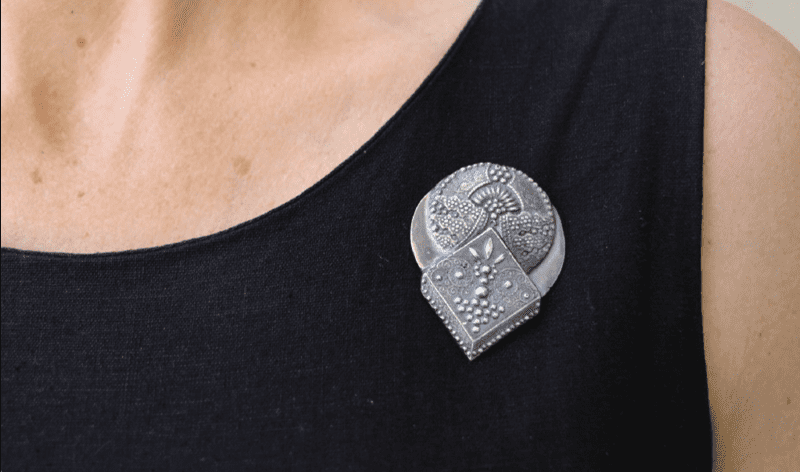
Working at the intersection of design, health and technology, the team came up with the Conversation-as-Therapy (CaT) pin.
The pin looks to be a conventional accessory; a personalized brooch. But inside, it’s enhanced with a digital microphone, embedded microprocessor and Bluetooth Low Energy (BLE) transceiver.
This isn’t a full speech recognition system: the BLE receiver monitors ambient sound to identify potential speech. Rather than recording conversations, the pin counts words over time. This makes the technology easier to build, and avoids privacy issues.
The team is not just monitoring the data: they have designed a service ecosystem response that acts on it too.
They can link the pin to real-time intervention services. If the pin detects that an older person hasn’t spoken in a day, a text message can be sent to the older person’s friends or relatives, or to a volunteer community service.
Care is tailored to the individual and consists of self-actioned and/or external responses. Their preferences can be accounted for, just as the pin itself can be personalised to represent the user’s taste.
The CaT pin can’t hope to solve loneliness overnight. But it has been designed to spark up the conversation.
The team hopes it inspires further research and engagement with the issues of social isolation and loneliness, whilst highlighting the possibility for elegant and desirable IOT solutions that have both style and substance.
The wearable CaT Pin (Conversation as Therapy pin), has won the $10,000 Designing for Ageing Well Challenge, co-sponsored by Telstra and RMIT to reward innovative thinking in design for Australia’s ageing community.
By Matiu Bush and Hannah Ballard.





Interesting idea to map verbal interaction is this available to be used in Aged Care facilities? I have students also working on this subject.
I can see that this is possibly an excellent item, but what about those of us who are used to being alone and frquently talk to objects , TV have conversations to people who are not there. I have always talked to myself, having spent long times with only animals. But I do at times get very lonely, often only people I see for weeks are my support workers and therapist.
My question is , can you tell if the conversation is actually to a person in a social environment?
A great Idea so long as the measuremnet is looked at carefully before loneliness is diagnosed. It certainly is possibly a great safety item