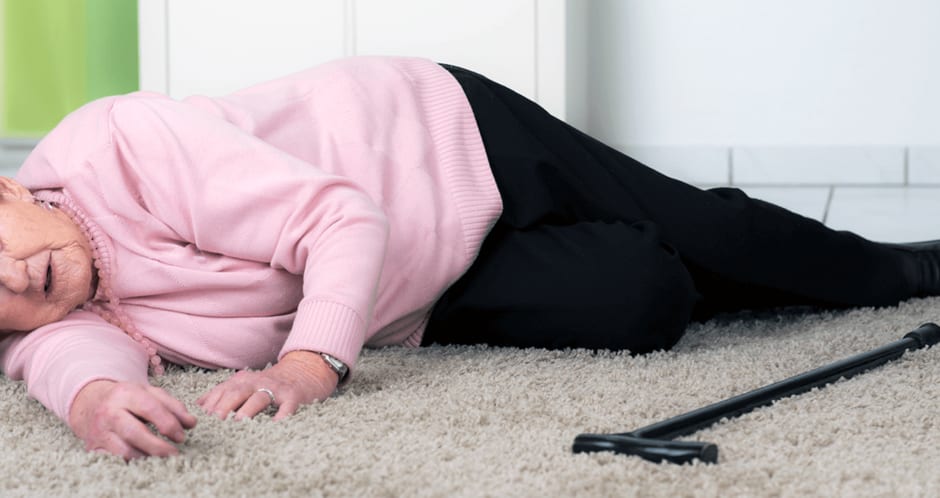
A recent study found that thousands of older people were dying from incidents that could be easily preventable.
Between 2000 and 2013, there were over 21,000 aged care residents who died in care. And of them 15.2% died because of “external causes”.
The number one external cause of these deaths were falls. It was found that 81.5% of these premature deaths, which was 2679 older people over 13 years, were from injuries sustained from falls.
It has been suggested, by not-for-profit aged care provider Benetas, that there needs to be a better understanding of the context of the dignity of risk.
Benetas CEO, Sandra Hills, has said that while the Medical Journal of Australia published research paper gives an important insight into trends in residential aged care, consideration needs to be given to a person’s right to self-determination.
“While we need to ensure our residential aged care environments are as safe as possible for residents, we need to consider how a black and white focus on falls prevention might compromise an older person’s quality of life,” said Ms Hills.
“We often work with residents, their families and their medical and allied health teams to identify how we can best support them to have a happy life; for some this might mean walking unassisted or not wearing devices intended to prevent harm.”
Falls are commonly associated with the elderly, but it is not a natural part of getting older. Falls can be prevented if the right precautions are taken.
There’s a fine balance that needs to be found between honouring the older person’s right to choose and maintaining their safety as best as possible. Managing the risk of choice, particularly in the current landscape of consumer directed care, is a very complex issue for providers.
Ms Hills said that Benetas has developed a range of research and quality initiatives to address the risk of premature death in residential aged care.
In 2015, Benetas partnered with the National Ageing Research Institute (NARI) to better understand the circumstances around falls and what could potentially be done to decrease the risk.
“We know that it only takes a relatively low impact fall for an older person’s health to be compromised and for this reason we want the likelihood of a fall to be reduced as much as practicable,” said Ms Hills.
“Our work with NARI has helped us develop a comprehensive falls prevention pathway for our clinical teams to follow”.
Such research aims to support staff in recognising the potential for a fall and to identify individualised strategies, in addition to the standard assessment cycle, for each resident to ensure the risk is minimised.
Another aspect on the organisation’s focus on quality also means a greater analysis and reporting of trends, “our clinical incident data helps us to capture and monitor trends to ensure we’re delivering the most response care possible to our residents,” said Ms Hills.
“We have had an ongoing focus on falls prevention for some time and we still want to improve in this area.”
Decreasing the risks, as well as the number of preventable deaths, in aged care has become the focus of many in the industry. However, in doing so, organisations also need to strike a balance so that their residents have a sense of dignity and quality of life.



5
I know from personal experience that an “accidental fall” is not always what it appears to be. If Management can get away with blaming the resident for having lost their balance, tripped or fallen out of bed they’ll conceal from the family that they were actually assaulted….. pushed, shoved, mishandled or dropped by a staff member or attacked by another resident. To this day the families of these residents with varying degrees of cognitive impairment are completely unaware of the circumstances that ultimately lead to their loved one’s demise. I can even recall the names of several of the victims…….we were told that under NO circumstances must we ever disclose to the relatives the truth of what really happened. So terribly sad for those residents who were unable to speak for themselves, but extremely fortunate for the facility that they had no memory of the incidents!!
Unfortunately families sometimes never see this delema for what it is. No one wants to see someone fall but it is also not right to take away peoples right to independence. This is not only in aged care facilities but also a problem with independent residential villages where we can encourage family and residents to seek assistance but can’t enforce consequences are sometime nasty falls but because in effectively there own home families accept parents cause more often than in aged care. Same same!!
Certainly not the case where I work it is a shame that a few bad operators give the industry a bad name, we always disclose what has happened for all residents especially those with a cognitive impairment.
People may fall because they have an underlying illness which has caused the fall. All falls should be an alert to investigate cause. Not just an X-ray to rule out fractures.