F
The Albanese government has quietly made changes to the way errors in aged care funding assessments can be corrected. It is being framed as progress. In many respects, it is not enough.
For months, the Integrated Assessment Tool, the algorithm-driven system that determines how much home care support older Australians receive, has been generating outcomes that families, clinicians and even the tool’s own designers have described as wrong. People in their 90s told they can wait a year for care. A 91-year-old Melbourne man who died waiting the ten months the algorithm decided was acceptable. Assessors quitting rather than rubber-stamp decisions they believed were harmful. More than 100 federal parliamentarians signing a joint letter calling for change.
The government’s response, announced last week, is narrower than most had hoped.
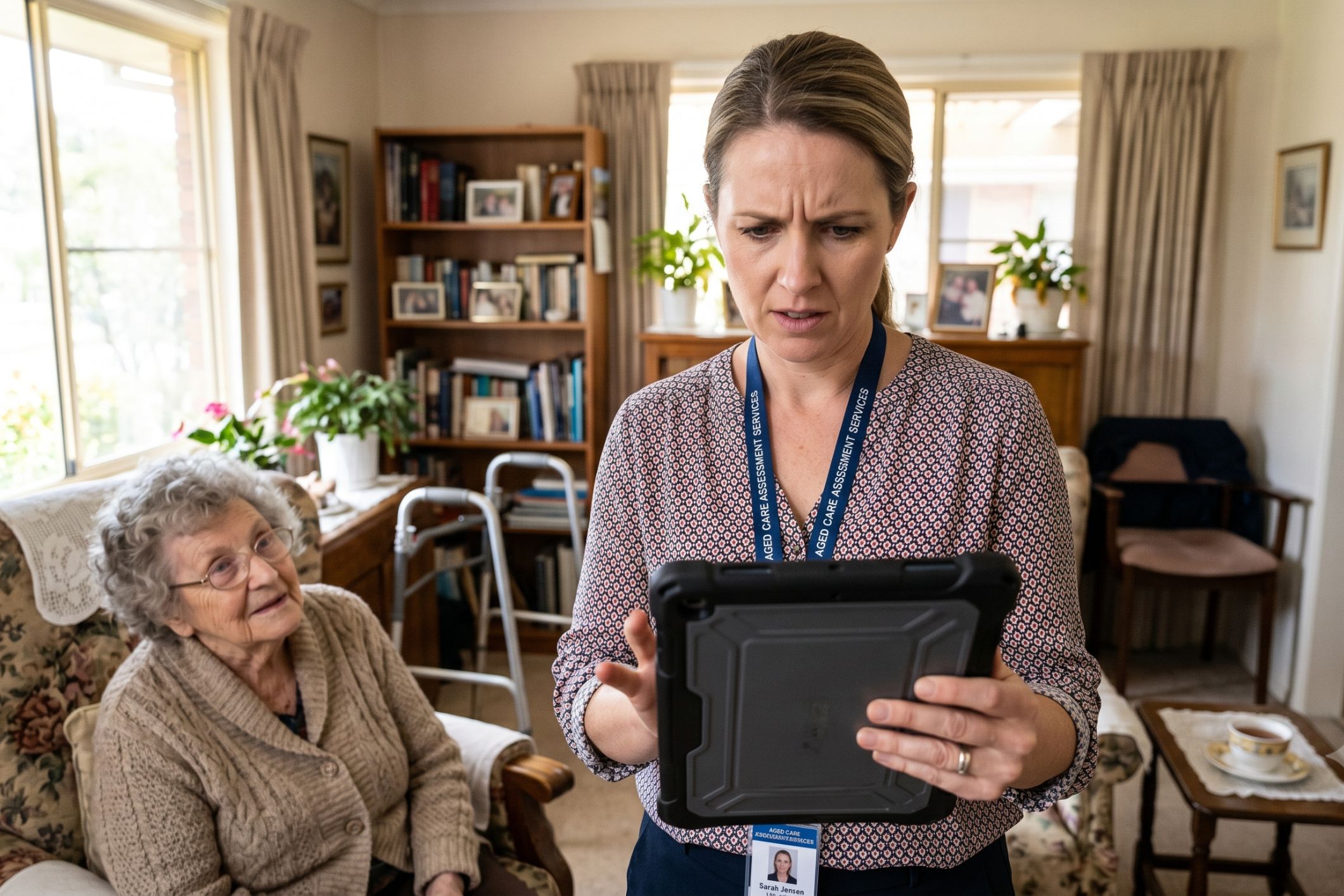
Previously, if a finalised assessment contained an error, a wrong answer entered, a piece of information missed, there was no mechanism to simply correct it. The older person’s only option was to request a formal review, a process that takes up to 90 days. For someone who needs care now, that is not a solution. It is a waiting room.
Under the new arrangement, assessors will be able to go back and fix genuine errors in a completed assessment. If a second assessment then produces a different funding result, the assessor’s manager will decide which outcome is more appropriate.
That is a real improvement in a narrow sense. Clerical errors should be correctable. A 90-day appeals process for what amounts to a data-entry mistake was always absurd.
But here is what has not changed: assessors still cannot override the algorithm’s funding decision itself. They can only change what goes into the system. The algorithm retains the final say over how much support an older person receives. The human beings doing the assessments, trained clinicians who sit with older people, observe their circumstances, and form professional judgements, remain unable to act on those judgements when the algorithm disagrees.
That distinction matters. A lot.
The joint letter. The ombudsman investigation. The assessors walking off the job. The Australian and New Zealand Society for Geriatric Medicine labelling the tool “unsafe”. The expert who helped design it describing her reaction as “fury”. None of this was about clerical errors.
The concern, consistently and clearly articulated across months, is that the algorithm itself produces funding classifications that do not reflect people’s actual needs. Not because someone entered the wrong date of birth, but because the underlying tool, a system that combines 11 separate validated instruments, each with its own error rate, produces results that qualified humans can identify as wrong and are currently powerless to correct.
The government has addressed one problem while leaving the central one intact.
A government source described the change as a “layer of protection”. That framing is telling. It positions a modest administrative fix as a safeguard, when what advocates, clinicians and families have been calling for is something more fundamental: the restoration of human judgement in a system that was designed, against expert advice, to exclude it.
It is worth remembering how the override function disappeared in the first place. Assessors had been told they would have the ability to exercise clinical judgement over the algorithm’s outputs. Then, in November 2025, when the Support at Home program launched, that ability was quietly removed. No public consultation. No announcement. It was simply gone.
Lynda Henderson, an aged care consultant who served on the working group that helped design the Integrated Assessment Tool, has been vocal about her reaction. She described the implemented system as a fundamental betrayal of what the working group had intended to build, a tool that incorporated assessor notes and adjustments, not one that locked clinicians out of the final decision. She is herself now a recipient of home care and says her costs have risen while her support has effectively been cut.
The point is not simply that the system has flaws. Flaws can be refined over time. The point is that the removal of human oversight was a deliberate policy decision made without the input of the people who built the tool or the people who use it, and that decision has caused measurable harm.
Aged Care Minister Sam Rae’s handling of this issue has been, to put it plainly, evasive. Asked directly in a recent ABC Radio National interview whether a human being can override the algorithm’s classification, he spoke at length about assessors collecting data, about equitable rule application, about the appeals process. He did not answer the question. When pressed again, he offered: “An algorithm is just a process.”
That is technically accurate and substantively useless. The people whose care hours have been cut by a process they cannot challenge know what an algorithm is. What they wanted to know was whether anyone in authority could step in and fix it. The answer, even after last week’s announcement, remains largely no.
The minister has since acknowledged he is “not satisfied” with the tool’s prioritisation mechanism and has ordered a departmental review. He has also created a specific priority pathway for people with Motor Neurone Disease, an acknowledgement, however reluctant, that the system was failing an identifiable group of vulnerable people. But he has consistently refused to say plainly that the tool has a problem, even as the evidence has accumulated that it does.
Opposition aged care spokeswoman Senator Anne Ruston has introduced a private member’s bill that would restore assessors’ discretion to vary algorithm outputs where their clinical judgement indicates the tool has produced an inaccurate result. The bill would also require that assessment notices explain how the tool was used, and would give people assessed since November 2025 the right to seek reassessment.
Whether it passes depends on the crossbench. Several independents have already been vocal critics of the assessment tool, and the political pressure is not easing.
The Commonwealth Ombudsman is still investigating. The review of the prioritisation mechanism is underway. The government maintains the system is fundamentally sound and needs only refinement.
It is possible to hold two things at once: that last week’s change is a genuine improvement for people caught in genuinely absurd situations, and that it does not address what most people, including the tool’s own designers, identified as the core problem.
The algorithm still decides. The human assessor still cannot override it. And older Australians navigating a system that was built, in theory, to support them to remain safely at home are still largely at the mercy of a black box whose workings are not publicly explained and whose outputs cannot be professionally contested.
That is not a tweak away from working properly. It is a structural problem that requires a structural fix.



As long as hospital used as waiting rooms for the elderly. At the expense of state gov. Why should fed gov have any benefit of taking the load. Just got back from ballarat hospital having a day procedure done. Code black was anounced . Meaning ther’e full, can’t take anymore. While i had to stay at creswick hospital because of it for the prep & staying 2 nights for that. Who cares about the waiting cost if your not paying.
Lynda Henderson was one of several members of the working group involved in designing the IAT. She had previously owned a consultancy business unrelated to aged care and gave it up to care for her partner, who had early-onset dementia. She participated in the working group as a person with lived caregiving experience, not as an aged care expert or aged care consultant.
Actually Cheryl, I was the OPAN rep on the Assessment Working Group. I happen to have a solid background in psychometrics and assessment.
I was not there as a “caregiver”.
This is an absurd situation. They know it’s wrong and they need to repair it. Now.