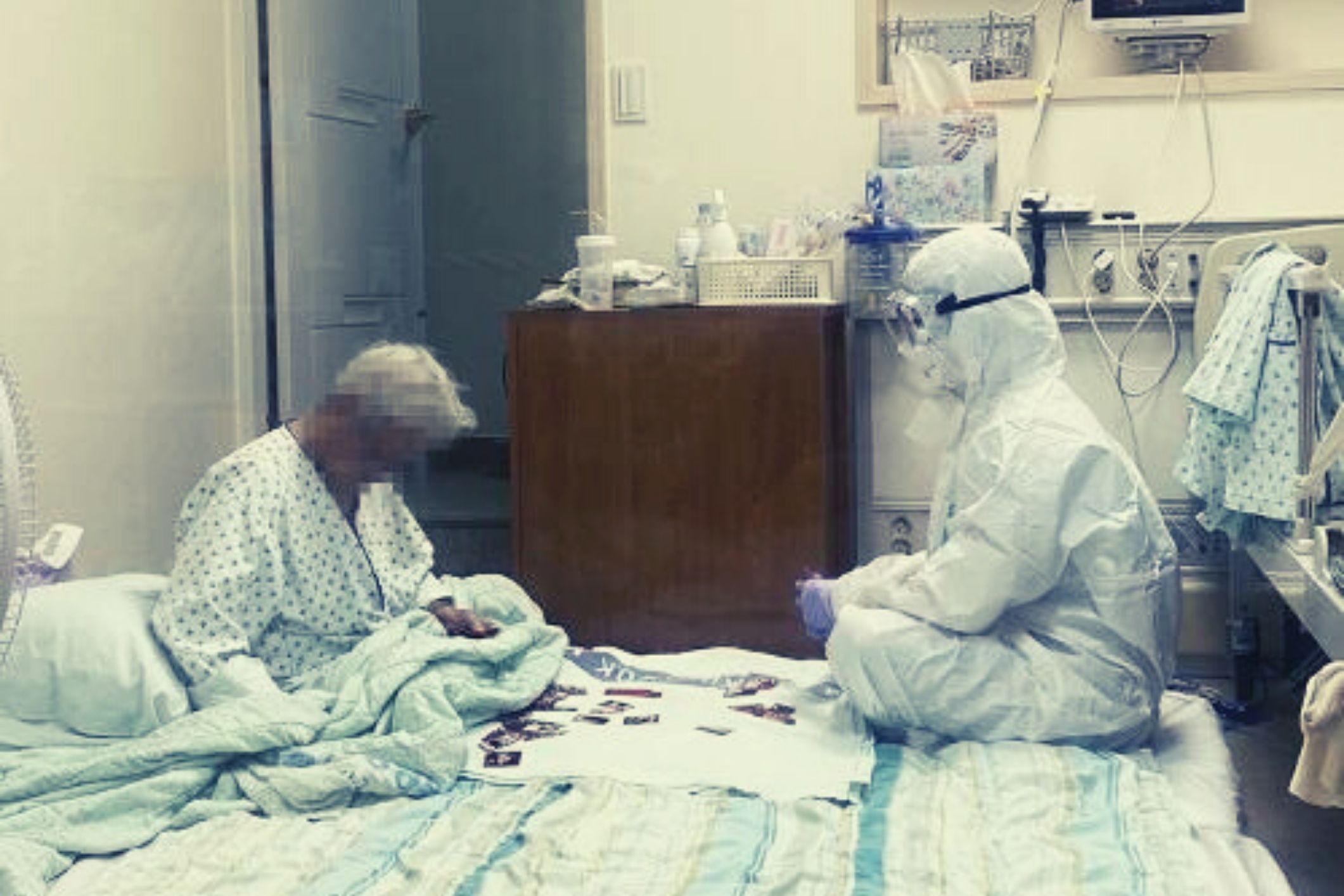
The older woman, whose surname is Park, was quarantined inside a negative pressure module at Sahmyook Medical Center, Seoul, last year while being treated for COVID-19.
In the photo, she is dressed in a simple blue-and-white nightgown, while her opponent º nurse Lee Su-ryan, who is 2 – is wearing a medical-grade hazmat suit, complete with goggles, gloves and face shield.
The two are engaged in the Korean card game, hwatu, which involves matching animals and flowers with the months of the year.
Sitting opposite each other, they are both equally engrossed in the game.
Last year, Park tested positive for COVID-19 at her nursing home and was sent to the negative pressure module for treatment.
Because Park is also living with Alzheimer’s, her stay was complicated, and she suffered severe symptoms, such as high fever and fatigue. She also struggled to cope with her loneliness.
Another nurse at the hospital where Park was being treated, Yang So-yeon, devised a plan to care for patients with Alzheimer’s who were forced to stay in the negative pressure module. She engaged patients with art therapy, including hwatu and painting.
Ten nurses, including Lee, took turns to keep Park company and also arranged video calls with her family to lift her spirits.
Last week, The Korean Nurses Association released the photo of Park and Lee, and since then the image has been retweeted more than 10,000 times and shared widely on social media.
Viral in Korea: Pic of nurse Lee Soo-ryun in hazmat suit caring for 93 y.o. grandma Park who has dementia and was ill with Covid in a negative pressure room.
Nurse Lee used picture/colour therapy using cards and colouring crayons to help with her loneliness and rehabilitation. pic.twitter.com/MOgA6bgmcZ
— Raphael Rashid (@koryodynasty) August 3, 2021
The photo forms part of an exhibition about nurse workplaces, according to Korea.net.
Park remained in the module for 15 days and was only able to leave once she had tested negative for COVID-19.
Lee admitted she did have concerns about being in a confined space with Park.
“I’m afraid of getting infected while caring for COVID-19 patients,” she said.
“But all I can do is to consider patient safety and ensure that they’re treated well to get discharged soon.”
Korean politician Sim Sang-jung, of the opposition Justice Party, shared the photo on her Twitter account, saying, “I feel in awe over seeing a medical worker sitting up straight in her hazmat suit and calmly gazing at the elderly woman.”
In recent months, nurses have been suffering burnout in Korea due to a fourth wave of COVID-19, heatwaves and nurses’ roles in testing, vaccinations and treatment.
Two healthcare workers have died of overwork this year.
Eight in every 10 healthcare workers have complained of worsening mental health, according to a health and medical union survey.
“You cannot change the world with emotion and gratitude alone,” said Sim on Twitter.
“However, I believe that moving hearts and grateful hearts can change the situation of nurses who are guarding the forefront with their whole bodies.”
The photo is a reminder of the enormous role nurses have played during the pandemic and the countless gentle kindnesses they have shown to patients.





