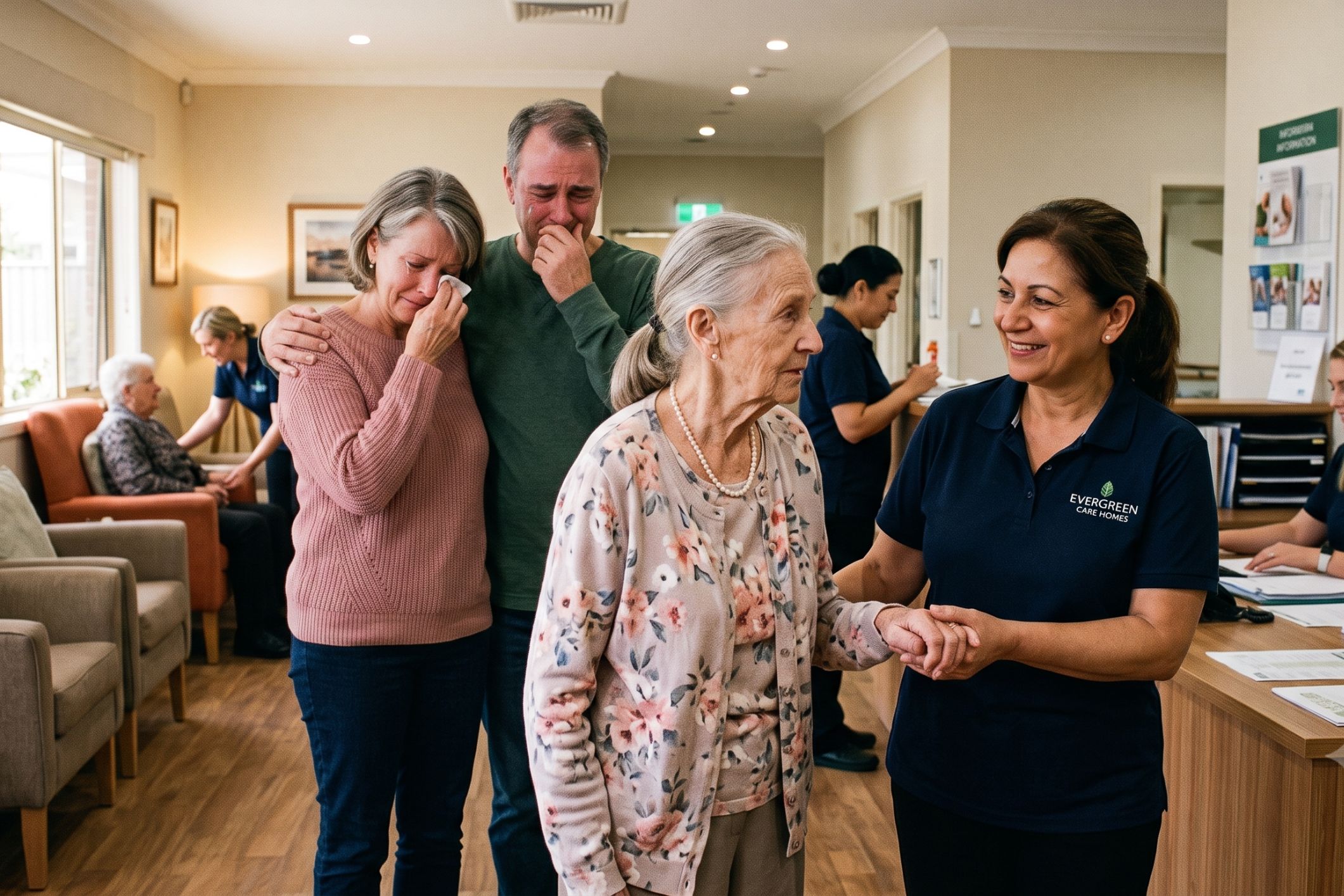
Almost a decade of writing about aged care in Australia has taught me that no two families arrive at the decision to seek residential care the same way, but almost all of them carry the same thing afterwards: guilt.
I used to think I understood that guilt from a professional distance. I didn’t. As bad as it sounds, I have to confess something: I used to be smug and judgmental about families who put their loved ones into residential aged care. I genuinely couldn’t fathom how someone could shirk the responsibility of caring for somebody who once cared for them.
It felt like abandonment, but in reality, I was blind to a harsh reality that no amount of love, sacrifice or good intentions can overcome.
My mum was diagnosed with dementia in 2021. For three years, my brother, my aunty, my uncle, my cousin and I did everything we could to keep her at home. I was sleeping over twice a week, working from home the other days, driving 90 minutes each way while my wife was pregnant with our first child.
And through all of it, every single drive, I felt nothing but guilt. Guilt for being away from mum. Guilt for leaving my wife. Guilt that never actually went away. It simply kept finding new things to attach itself to.
What I didn’t understand back then, when I still held that quiet judgement, is that guilt doesn’t disappear once you make the hard decision. It just changes shape.
For three years, we made it work between us. My brother and uncle lived with mum full-time, and my aunty visited almost every single day along with my cousin. I added two overnight stays a week on top of working from home, which meant a 90-minute drive there and a 90-minute drive back, twice weekly, on top of everything else.
During mum’s final year at home, my wife was pregnant with our first child. So every week, I was effectively leaving her for four days and two nights to go and care for my mother.
My wife never once made me feel bad about it. She was, and is, remarkably understanding. But she didn’t need to say anything for the guilt to set in. I did that all on my own.
Nobody warns you about the guilt. Not the guilt of a single bad moment, but a low, constant hum that starts the second you get in the car and doesn’t let up until you’re home again, and then begins all over again the next time you leave.
Every time I left mum’s place to drive home to my pregnant wife, I was consumed by it. I felt like I was abandoning mum. Then I’d walk through my own front door and feel like I’d abandoned my wife for four days to do it. There was no direction I could drive in that felt like the right one.
It was exhausting in a way that had nothing to do with sleep, though I wasn’t getting much of that either.
By the time our daughter was born, the combination of guilt, sleep deprivation and the demands of my working life had already ground me down. I was already trying to silence the quiet voice in my head telling me that moving mum into aged care might actually be the safer option. I just didn’t have the courage to listen to it yet.
The pebble that started the landslide came a few weeks later.
Mum wandered out of bed one night, silently, avoiding the monitors we’d set up in her room. She mistook a bottle of bleach under the laundry sink for water, and took a sip. She had never once gone near that laundry sink before. None of us even knew the bleach was there. She’d also started trying to wander out the front door at night.
That was the moment safety stopped being a hypothetical. Placing mum in aged care was the hardest decision I have ever made.
The first day, she seemed okay. Settled, even. But when I came back on day two, she had a look on her face, shock, disappointment, that I still see when I close my eyes.
By then, she could no longer tell me in words what she was feeling, but she didn’t need to. When I hugged her, she let out this massive sigh, the kind that only comes from somewhere truly stressed and holding it in. It was heartbreaking. It made me question what kind of person I actually was.
We chose a facility close to the rest of my family rather than close to me, because it meant more people could visit her regularly. It was the right decision for mum. It also meant my own commute became 90 minutes each way, which meant a lot of time alone in a car again, with a lot of guilt to sit in.
On top of it all, we were also adjusting to life with a newborn, which meant the guilt now had a new shape entirely: leaving an exhausted new mother alone with our baby to spend another 90 minutes alone with that guilt, over and over again.
Looking back, I can see that I wasn’t just caring for a parent with dementia. I was also, at the exact same time, becoming a parent myself. Caring “up” for mum and “down” for my own newborn, often on the same day, sometimes within the same hour.
It turns out there’s a name for this, and I’m far from the only one living it. More than 1.5 million Australians are currently part of what’s known as the “sandwich generation”: people caring for both ageing parents and children at the same time. On average, these carers spend around 15 hours a week on unpaid care for an ageing parent and another 15 hours on their kids, leaving less than 10 hours a week for themselves. Caregiving in this position looks different again when dementia is involved, since the needs are less predictable and the emotional toll runs deeper than the physical caregiving tasks alone.
Nine in ten sandwich generation carers report experiencing burnout, and it’s not hard to understand why. You’re needed in two directions at once, and there’s no version of the day where both people get everything they need from you.
If any of this sounds familiar, know that the exhaustion and the guilt you’re feeling isn’t a personal failing. It’s an incredibly common, well-documented experience shared by well over a million other Australian families right now.
Mum is now in the advanced stages of dementia. She’s non-verbal, non-mobile after a fall in care left her with a broken hip, which brought its own fresh wave of guilt, and she needs to be hoisted for every transfer, every shower and every part of daily care.
Strangely, the one thing that’s eased is the specific distress she showed in those first weeks. Her cognitive decline means she can no longer fully understand her surroundings, which means she’s no longer visibly suffering the way she was during that first fortnight.
It’s a strange kind of relief. The guilt of the placement itself has softened, but it’s been replaced by a quieter, more persistent guilt that never fully resolves. Am I visiting enough? Should it be more? Is once a week enough? Is twice enough? Will it ever feel like enough?
I don’t think that particular question has an answer. I think it’s just part of what this is now.
Looking back, I realise I was judging people whose stories I didn’t know. I mistook placement for abandonment, when in many cases it’s the final act of caring someone can give. Love doesn’t always look like keeping someone at home. Sometimes love is recognising when home is no longer the safest place for them.
The best available Australian evidence suggests that around 43% of Australians aged 65 and over who died had used permanent residential aged care at some point in the years before their death, according to data from the Australian Institute of Health and Welfare.
Other studies estimate the lifetime probability of entering permanent aged care is even higher for women, up to around 46% from age 65 onward. That’s not a small, unlucky minority. That’s nearly half of all families in this country, at some point, facing some version of the drive I described above.
If you’re reading this and you’re carrying that same guilt, I don’t have any advice for you. I just wanted you to know you’re not the only person carrying it.
If any part of this article has struck a nerve, please know that support is available, and reaching out for it isn’t a sign of weakness.
If you’re a carer yourself, Carers Australia and Carer Gateway can also connect you with respite care, counselling and financial support in your state. Details at carergateway.gov.au.



No matter how many of us think we know what it is like, have completed various courses and degrees, be a researcher, a Dementia specialist or clinician it is only when you walk in those shoes and travel that journey you fully understand.
The guilt remains with you and you somehow manage to cope however the guilt is always there.
Thank you for sharing this, Jakob. We knew that you were blessedly human beforehand, but this just confirms it.
Guilt is an inevitable and overriding condition in the dementia journey and needs to be addressed in therapy and support services
This is all too familiar. Add to this story the issue that arises when your parents live in another state. My Dad had been my mother’s carer for many years – not so much physical care but very definitely her mental wellbeing as well as cooking etc and making sure she was safe (getting rid of any candles because she would light them in the most unsafe places). I was lucky they had a great general practitioner who would respond to my emails. My Dad was burnt out – he had his own chronic health issues to deal with. With the help and the support from their GP I managed to get my Mum some respite in an aged care facility (Dad was in hospital) – that respite turned into permanent placement. I know my Mums quality of life was way better in the facility that it was at home. Its guilt at every turn with no easy answers.
Thank you for sharing your experience. Caring for a loved one is both complex and emotionally demanding, and I believe your article will help many people better understand what families go through during this journey.
I also think it’s difficult to fully appreciate the emotional impact of moving a loved one from their family home into aged care unless you’ve experienced it yourself. It can be an incredibly painful transition, not only for the person entering aged care but also for their family.
Your reflections help bring greater awareness and compassion to an experience that so many families face.
Thank you Jakob
Your article distilled many of the thoughts and feelings I had (and still have) when my wife went into care with dementia 9 months ago and as you say -you must go through it to understand it
Thanks again – or is it dank u well?
Stewart Mitchell
Jakob, you’ve hit the nail on the head! Everything you expressed in this article is accurate.
Thank you for sharing your personal journey, as the saying goes, ‘ walk a mile in my shoes…..’
This resonated with me and will with many, I’m sure.
I was fortunate that I didn’t suffer guilt. I looked after my mother who had dementia for four years and at the same time cared for 2 grandchildren.
One morning my mother left the house and tried to go “home” to her “mother’s house” I was looking up and down the streets looking for her, then decided to go home and call police, but when I turned into our street mum was in an ambulance. That morning she had made her own ‘breakfast” – 1 cup of raw rice, 1 cup of sugar and 1 cup of water. I threw that away and made her something edible, then went to my room. When I came back a minute or two later she had disappeared. The doctors told me that my mother could not go home but needed to go into care. I had already decided on a place two months before when I started feeling that I would become ill from the lack of rest.
It was a decision that I had to make for her care and safety and for my own health. I felt I had done everything I could for her and that I had made the right decision.
I do feel for those people who feel guilty but when you’ve done your very best, even made huge sacrifices, you need to learn to banish guilt from your emotions. Perhaps through meditation or through counselling etc.
My name is Kitt and I’ve been a registered nurse in the state of New York, USA since 2018. I have a lot of experience taking care of the acutely ill patients in the private hospitals and a veterans hospital (VA). I also have cared for Alzheimer’s dementia patients or residents more times than I can remember. “A long goodbye” accurately describes people in this condition. It’s heartbreaking to think these residents used to be able to communicate and live fulfilling lives. My maternal grandmother went through it when she was in her mid-80s. She passed away when she was 104. Unfortunately, my maternal uncle has been experiencing the same fate since he was in his late 70s.
It is a challenge to take care of these patient populations. We have to make sure they are well cared for and safe. We often have to feed them as they don’t know what to do with the food in their trays. We urge them to take the same medications daily because they no longer know or don’t understand why they have to. We clean them as they’re unaware they’re incontinent. We tuck them in bed because they don’t know it is bedtime. We set bed alarms whenever these residents are in their beds.We make sure each resident has a wander guard bracelet on so they don’t inadvertently wander off the floor. We also monitor them to make sure they do not fall. Once they fall and sustain injuries like fractured hips, their days are numbered.
Enormous amount of work and resources are put in place daily to care for these residents. I DO NOT have any judgement against the families who ask us to care for their spouses, parents, or grandparents. It is both financially and emotionally draining for the families who face this alone. My family had no other option but to admit grandma to a long-term care facility. They just couldn’t do that anymore. We will continue to make sure the residents have the best remaining quality of life and, when the time comes, they pass away with dignity.
Guilt still lives with me. It was the hardest and most soul destroying decision to make Covid did not help. Phone calls and waving at your loved one through the care home windows while on the phone to them doesnt come close to a hug and made harder because they dont understand why you cant come . Until it became impossible to transfer into the car we went out to cafes for lunch and sometimes just a drive. It doesnt matter if you visit every day , you still have to leave so yes abandonment is there every day.
If nothing else it had convinced me to not put that burden onto the next generation. I plan to put myself into aged care so my children dont have to make that decision. I just hope that I do it early enough before cognitive function deteriorates.
There is also the conflict around your comitment to your spouse and family who get sidelined. Add in a job and it becomes exhausting monumental juggling act.
Caring for our parents, and all the while building our own lives is not an easy gig. It is tough, it requires open communication with family members, it requires grit. Dementia is cruel and it impacts everyone in the family. You are not alone in this journey. Thank you for sharing