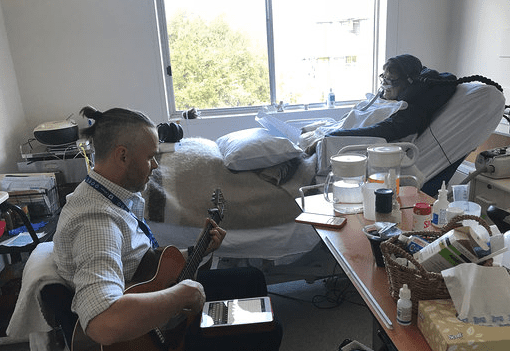
When Eric Ludwick was a boy, his life was intertwined with music; he sang in a choir and played the piano, and he built up a foundation of musical knowledge.
Years later, in 2011, Eric was diagnosed with motor neurone disease. The diagnosis led him to worry he had been living a “wasteful” life up to that point.
Now, at age 53, Eric has turned inwards to his spirituality and has embarked on a musical project with the help of a team of music therapists including Stephan Skov. These two anchors – spirituality and music – have enabled Eric to find meaning, purpose and forgiveness in life, as he faces the challenges of MND.
Stephan and Eric have written a number of songs together, and have also produced a CD.
Eric is now working on a second CD, and a third is in the wings.
Eric and Stephan met at Calvary Health Care Bethlehem hospital, which specialises in palliative care and support for people with degenerative neurological diseases.
Staff at the hospital believe that even those with life-limiting and debilitating illness can continue to contribute and create, even in their final days.
When Stephan met Eric, he quickly realised his musical interest and background, and the two embarked on the project to write and record songs together.
To write the songs, Eric first writes poems and then chooses which ones he likes to add music too.
He then provides Stephan with guidance about what he wants the song to be like. For example, he might say, ‘I would like this song to be a happy song’, ‘I’d like this song to be a country song’, or he might say he wants the song to start in C chord.
Stephan says the two “ping-pong” ideas back and forth until they have a song.
Stephan said, even though it’s a collaboration, the song is Eric’s, and he always keeps that in mind when they are working together.
“He (Eric) has his own song in his heart. He knows that he’s sharing his heart with his family, not me,” Stephan said.
Songs have been recorded in the chapel attached to the hospital, deepening Eric’s connection between his religious faith and music. Eric is wheeled into the chapel, and the songs are recorded during therapy sessions.
Stephan said people diagnosed with MND generally only live up to three years, but Eric has lived longer than anyone expected. He puts it down to Eric’s strong faith and his drive to create music.
Music therapy can help patients in many ways, and can be as effective as medicine in some cases, Stephan told HelloCare, as it can elicit a physical as well as a psychological and spiritual response.
“I do not separate music from medicine,” he said.
“Here at Bethlehem we are working with patients who are going through existential journeys,” he said.
Music can help patients with anxiety, emotions, sleep, and pain. It can calm and soothe them, and can help in other practical ways, such as relaxing patients who are adapting to using breathing apparatuses.
The hospital has undertaken its own studies which have shown that music is effective in reducing anxiety during non-invasive ventilation’s (NIV’s) introduction, Stephan said.
Stephan said working with Eric, and being a music therapist in general, is “an honour”, and it reminds him of the importance of music.
“It’s an honour to console someone who’s going through a process like Eric is going through,” he said.
“What blows my mind constantly is the power of music.”
Eric’s music is what is known as ‘legacy work’, meaning music is written to leave a legacy behind for friends and family, or for a much wider audience if the person wishes.
Along with his strong religious faith, Eric’s music has given him purpose and a means of expression that have helped him to cope with the challenges he has faced living with MND.
The songs will resonate with all audiences. They are powerfully emotional and provide insight into Eric’s journey.
“If you write a poem, that can be beautiful, but if you add the music to it, everyone connects to it immediately,” Stephan said.
Eric’s music is available online. Any proceeds from sales go to the organisations that have supported Eric on his MND journey.





