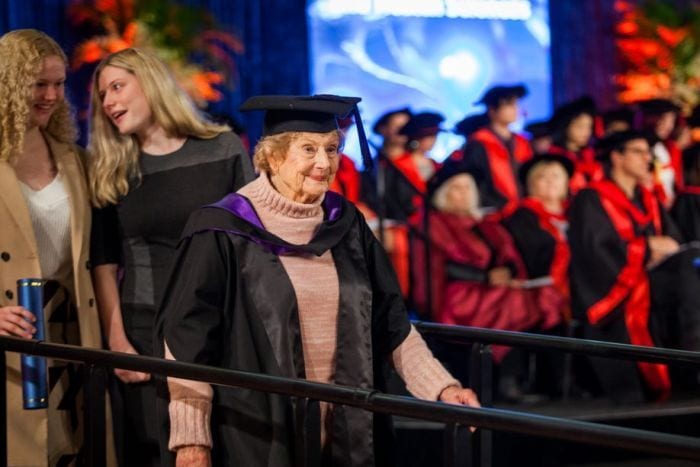
There are very few accomplishments that could be more worthy of celebration than graduating from university, but as the cheers rang out for every newly graduated student from the University of Melbourne, the loudest applause was definitely reserved for 90-year-old Lorna Prendergrast.
Hailing from the country town of Bairnsdale in Victoria, Lorna defied just about every stereotype in the book on her way to receiving a Master of Ageing degree, and this accomplishment is even more significant when you begin to grasp some of the challenges that she faced along the way.
“When my husband, Jim, suffered Parkinson’s disease, our world fell apart as we became involved in the long goodbye,” said Lorna.
“Gradually his condition worsened over the years and then his balance became affected. After about fifteen falls, his doctors decided that it was time for him to be hospitalized which then lead to Jim being placed in a nursing home.”
Unbelievably, the precious time that Lorna spent beside her husband in the nursing home revealed the surprising link between care and music which became Lorna’s inspiration for study and her eventual area of expertise.
“In the nursing home, I kept an iPod beside his bed as it seemed to calm him and help his memory,” said Lorna.”
“During the day I would play DVD’s for the patients in his Wing and saw that they would settle down and listen to the music for hours. When choirs came to sing to the patients, Jim would join in, word perfect, right up to about a fortnight before his death.”
As Lorna grieved the loss of her beloved husband, a chance encounter with a television program proved to be the spark that reignited her burning passion to learn, but it was her first-hand experience using music to help enrich the life of her husband that became the fuel for her new journey.
“After Jim’s death, while I was still picking up the threads of my new life, I turned on the TV and saw an ABC Catalyst program, Music on the Brain, which explicitly explained how music assisted memory recall for people with dementia.”
“Realising that this program confirmed what I had learnt while playing music in the nursing home, I felt I needed to learn more about music helping people with dementia. So, without giving any thought to my age, I applied for an online course at Melbourne University – Master of Ageing, which took three years of part-time study.”
While the prospect of online study can be daunting for anyone who grew up without the internet, Lorna relished the opportunity to learn how to navigate today’s most current platforms and called upon her experiences as a telephonist and a librarian to figure things out.
“I enjoyed joining with other online students on our Discussion Board, appreciating their comments and they seemed to accept mine. Apart from one visit to meet my supervisor, I completed the course online at home,” said Lorna.
“The course was better than I ever dreamed, opening up fields beyond my wildest imagination.”
Lorna’s findings while studying the link between positive care outcomes for elderly people and music, echo a growing trend among experts who have seen startling results that include amazing behavioural change for people living with dementia.
Music registers within multiple sites in the human brain – activating the auditory, motor, and emotional regions, and there have been numerous instances around the globe of elderly people having extraordinary positive reactions from music.
There have been cases where elderly people who were confined to wheelchairs have actually gotten up and started to dance from the sound of a beloved piece of music, and other instances where people who were thought to be incapable of communication have burst into song upon hearing the sound of a familiar piece of operatic singing.
Lorna’s amazing ability to create new dreams and goals despite the death of her husband should serve as an inspiration to the millions of elderly people around the world currently facing the same situation.
And her radiant smile and can-do attitude is the perfect example of the old adage that pressure creates diamonds.
“I can only suggest to Australian Seniors, if you have a passion, don’t sit back and think you are too old,” said Lorna.
“You have acquired so much valuable knowledge and experience over the years, please don’t leave it locked away, get out there and share it with the world.”
“I never had any idea that so many people would be interested in my studies, but I am already getting help to get more music therapy for people with dementia.”
Photo courtesy of Danielle Bonica for ABC





