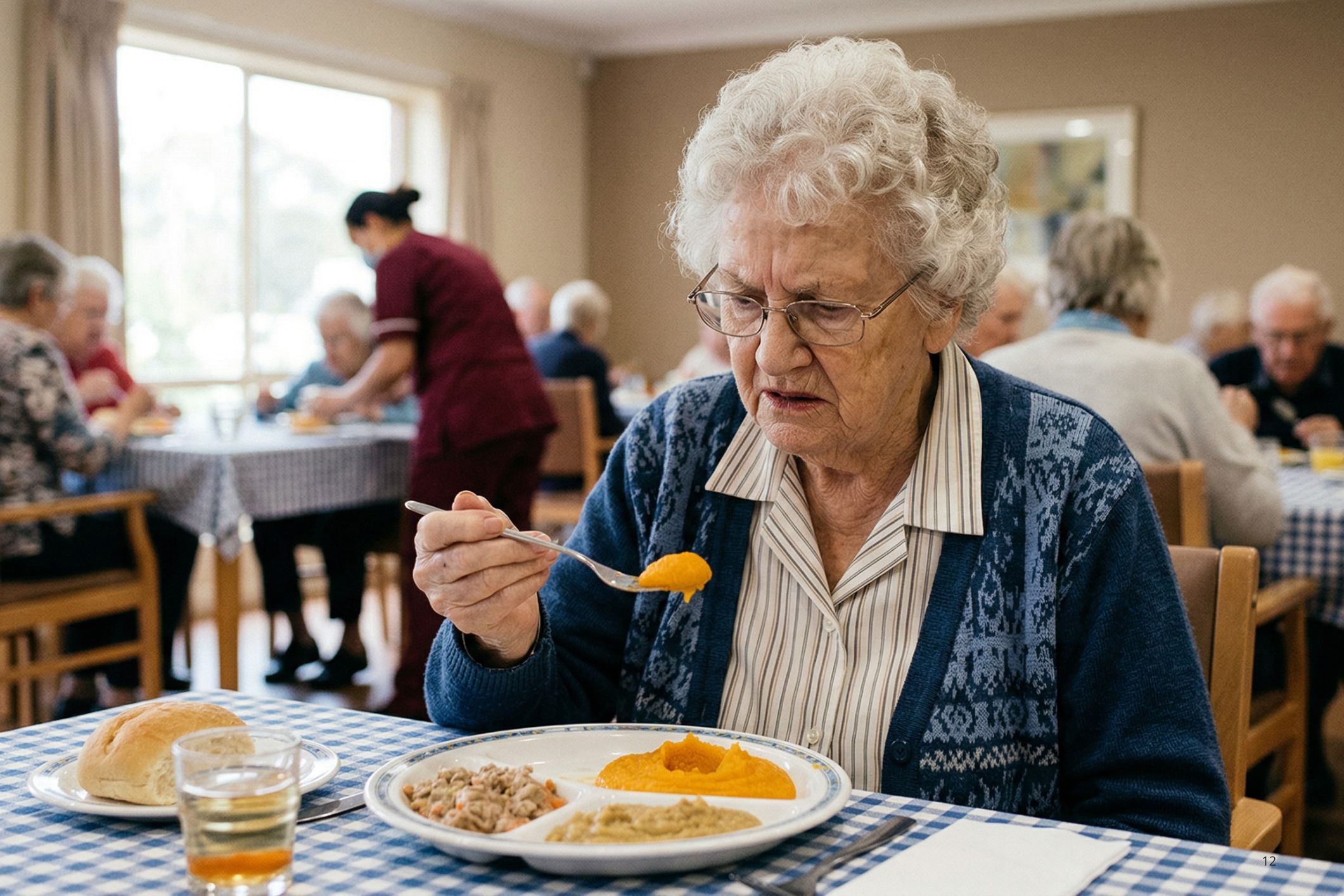
Australia’s aged care sector is grappling with a quiet but deadly crisis. With an ageing population and rising rates of swallowing difficulties, known medically as dysphagia, frontline kitchen and nursing staff face an increasingly complex task at every mealtime.
Up to half of residents in residential aged care experience dysphagia, meaning ordinary foods can easily form a dangerous bolus that blocks the airway. The solution sounds straightforward on paper: texture-modified diets such as ‘minced and moist’ or pureed meals that are soft, moist and safe to swallow.
But in practice, preparing and serving these meals consistently is anything but simple.
Facilities are often under-resourced, with high staff turnover, multicultural workforces, stretched rosters and limited time for training.
Speech pathology recommendations must be translated into daily operations, from precise particle sizes, no lumps larger than 4 mm for adults on minced and moist diets, to correct positioning, upright at 90 degrees, close supervision and real-time checks that each mouthful has been swallowed.
Mealtime plans can run to bulky folders that new staff barely have time to read. Assessments for swallowing risks can take weeks or months, leaving vulnerable residents exposed. When homes try to adapt regular meals themselves, blending, mashing or ‘gelling’ bread, the results vary widely depending on equipment, skills and understanding of national standards.
The consequences are now impossible to ignore. Choking has become the second most common preventable cause of death in residential aged care. In Victoria alone, coronial data showed choking-related deaths more than doubled from 17 in 2023 to 38 in 2024, prompting Safer Care Victoria to issue an urgent alert describing it as an ‘emerging quality and safety risk’.
The alert highlighted common failures: residents given food inconsistent with their care plans, lack of supervision, incorrect positioning and thinly stretched staff unable to follow complex protocols. A federal aged care watchdog issued a similar national warning earlier in 2025. Experts say the same systemic issues repeat year after year.
Professor Bronwyn Hemsley, Head of Speech Pathology at the University of Technology Sydney, has studied dysphagia in care settings for two decades. She points to high staff turnover and poorly accessible care plans as key drivers.
“With each wave, people recommend similar things to resolve it,” she has noted. “Without addressing the systemic issues, these premature deaths continue to rise.”
New staff often struggle with mealtime plans, and delays in speech pathology reviews leave risks unmanaged.
Chris Deed, Australian Director of The Pure Food Co, which supplies texture-modified meals to more than 500 aged care homes nationwide, sees the daily struggle up close. He describes the pressure on kitchens trying to meet clinical standards while also delivering nutritious, appealing food.
“Despite the best of intentions, we see a lot of aged care kitchens really struggle to get texture-modified food right every time,” Deed said.
“Texture-modified food needs to meet very precise standards to be safe, nutritious and appealing for residents, and staff training is key. It is not simply a matter of blending or mashing food.”
The challenges came into sharp focus in a dual coronial inquest examining two preventable deaths at the same Sydney facility.
Dimosthenis ‘Jim’ Gesios, 78, a Greek migrant, former construction worker and devoted family man, died on 7 June 2019 at the Acacia Centre in Marrickville after an assistant in nursing fed him scrambled eggs and bread dipped in Milo. A large food bolus completely occluded his airway.
Maureen McGreevy, 79, a resilient child migrant from England who had survived orphanage life and schizophrenia, choked fatally on 13 March 2020 after receiving an incorrect meal tray containing buttered bread that should never have been given to her under her minced and moist diet. She was found gasping in a corridor. Paramedics removed the bread but could not revive her.
NSW Deputy State Coroner Derek Lee’s findings, delivered on 27 February 2026, exposed widespread confusion at the facility. Staff held conflicting views on whether bread was permitted at all on a minced and moist diet. Some thought ‘wet’ or dipped bread was acceptable, while others knew it was banned outright.
Spare bread sat openly on meal trolleys. Feeding practices often contradicted speech pathology advice. Even the International Dysphagia Diet Standardisation Initiative framework itself came under criticism for poorly defining ‘gelled bread’, leading to dangerous misinterpretations.
Coroner Lee identified systemic gaps in training, competency assessment, policy implementation and communication between kitchen and clinical staff. He made two formal recommendations: the Aged Care Quality and Safety Commission should develop consistent minimum training expectations for all kitchen and nursing staff, particularly assistants in nursing who perform most feeding, including documented competency checks and periodic quality audits aligned with the IDDSI framework.
He also urged the IDDSI board to either remove gelled bread as a permissible food on minced and moist diets or define its preparation far more strictly.
The Acacia Centre has since closed, and its former operator, Columbia Aged Care Services, has introduced mandatory IDDSI training, revised feeding competencies, first aid protocols and external speech pathology referrals. However, the coroner’s findings show the problems were not confined to one site.
They reflect broader pressures across the sector as it implements sweeping reforms under the new Aged Care Act, which from November 2025 includes stricter food and nutrition standards aimed at supporting dignity, health and individual preferences.
Mr Gesios was remembered by family as a man with “a big heart” who loved surprising his grandson with toys and fixing anything with his hands. Ms McGreevy’s life was quieter but marked by quiet strength despite significant health challenges. Their deaths were entirely preventable.
As Australia’s population ages and the demand for texture-modified meals grows, with roughly 20 to 30 per cent of residents now requiring them, the inquest underscores a confronting truth. Good intentions and basic kitchen adaptations are no longer sufficient.
Without standardised national training, clearer guidelines, reduced staff turnover and better real-time support for those on the frontline, more older Australians will remain at risk, even on diets specifically designed to keep them safe.



The IDDSI Framework, particularly EC7 and SB6, continues to be a major source of confusion for both catering and care staff. Bread and toast are common examples, with ongoing uncertainty around whether a resident can or cannot have these items—often depending on information that may or may not be clearly documented in the individual’s care plan.
In my view, the framework and its application need to be reviewed to make it more user-friendly and practical. Given the nature of a changing and transient workforce, this level of complexity is likely to continue causing issues unless it is simplified and better supported with clear, consistent guidance.
Recently in respite in a Regis facility where I was in a wing that 90% of the residents were dementia patients.
Sat one night having dinner beside a resident who was tearing her paper napkin into little pieces and dropping them into her soup and then proceeded to take spoonfuls of it into her mouth.
I called attention to the staff member who walked over took the paper napkin off her scooped out the paper from her soup and walked away. The resident then pulled out a tissue and continued tearing it up into her soup and eating it. The staff member took no notice nor made any effort to assist with feeding her.
As a speech pathologist, I often provide trainings and education sessions for aged care staffs (carers, catering team, managers) to help building the bridge for swallowing safety and the aged cares day to day practice.
Some practical strategies can save lives.
I would love to share my insights further and collaborate with the editorial team.