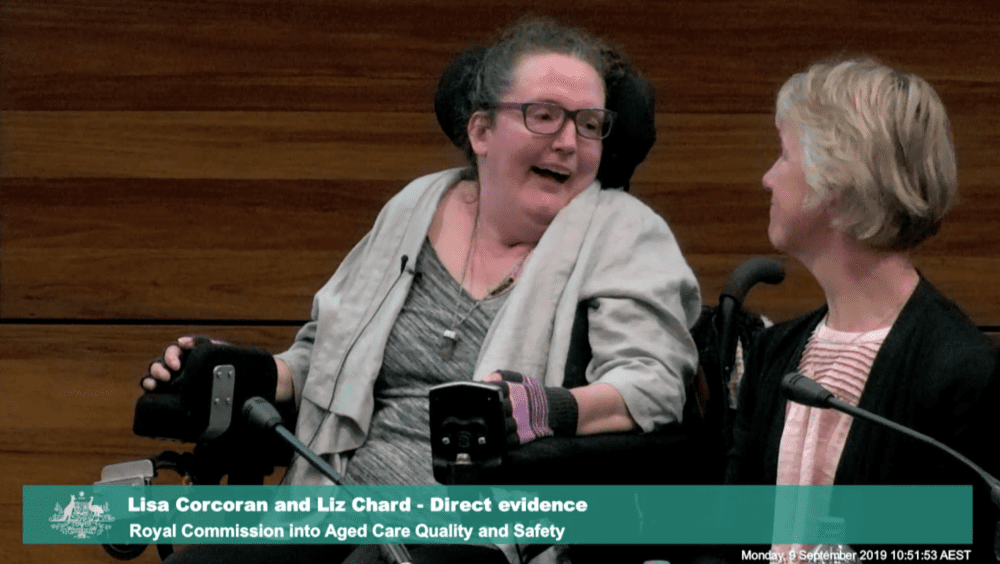
The royal commission is hearing this week from younger Australians living in residential aged care.
Lisa Corcoran, who spoke with the help of a speech pathologist, made her feelings clear.
“My number one goal is to get the fuck out of the nursing home,” she said during the first day of hearings.
Ms Corcoran said her second goal was to hug her children, and her third, to communicate better.
But no one present at the Melbourne hearing could have escaped the message Ms Corcoran, who was 37 when she moved into care, came to deliver.
She said it was a “nightmare”. She told those assembled she had to fight to be showered more than once a week, “the food was crap”, and she had no company.
The one friend she did make, died. The constant presence of death was confronting.
“I just can’t get it out of my head… I saw one body being moved. I saw his head in a red bag. This was at 12 noon when everyone was eating lunch,” she said.
Ms Cororan said she doesn’t feel safe. “I was sexually assaulted. I have been punched. I was pinched by staff.”
She said she often hears screaming or crying, and has asked her daughter to stop bringing her grandchildren because of the uncomfortable atmosphere. “It’s scary for them,” she said.
Ms Corocoran had a powerful message for the Royal Commission into Aged Care Quality and Safety. She wants people to “understand that there are people like me, and we’re all humans, and humans crave respect. And we’re all equal.”
She closed with a telling observation. “I’m not in the witness box because I couldn’t fit in the witness box. And the person before me couldn’t fit on the plane. This (lack of access) is everywhere. We can’t fit into shops and we can’t fit here and there because we’re on wheels. And that kind of sucks.”
The royal commission has now received 6,022 submissions from the public, and 10 per
30 cent raise concerns about the care being delivered to younger people with disabilities.
Senior counsel Assisting the royal commission, Peter Rozen QC, said even though moving a younger person into residential aged care is seen as a “last resort”, it still happens frequently enough to be concerning.
According to a report released this year by the Australian Institute of Health and Welfare, in the 15 years between 1990 and 2014, the number of younger people first entering permanent aged care increased by 22 per cent.
Each year between 2009 and 2014, around 2,000 people under the age of 65 first entered permanent aged care. Around half of this group were between the ages of 60 and 64 but some were considerably younger than that.
Mr Rozen said the policy environment in Australia has “failed to recognise” the “wishes and needs” of younger Australians needing care.
“There’s nothing inevitable about younger people ending up in residential aged care facilities. It happens as a result of deliberate policy decisions that have been made by the Commonwealth, State and Territory governments over many years,” he said.
Mr Rozen said younger people who require care often have profound disabilities, and aged care facilities are not equipped, staffed or funded to meet their needs. Younger people often see their functioning decline significantly when they move into residential aged care, he said.
Mr Rozen said having younger people living in residential aged care flies in the face of the human rights conventions, which say a person with disabilities has the right to live independently in the community.
“Housing younger people with disabilities in residential aged care is not just inappropriate,” he said.



Why is the royal commissioner not acting straight away with every aged care facility in Australia.
This happens in every home,private or public and the fees that are paid into the care is top dollar.
Where my mother is at BUPA POTTSVILLE you can tell who gives the loving care, and she will tell me who she likes, I can always tell when she is having an off time and it all comes down to staff…and that comes down to lack of staff because the funds that we pay are not going to our loved ones.
The government should get off their backsides and get action in every aged care facility