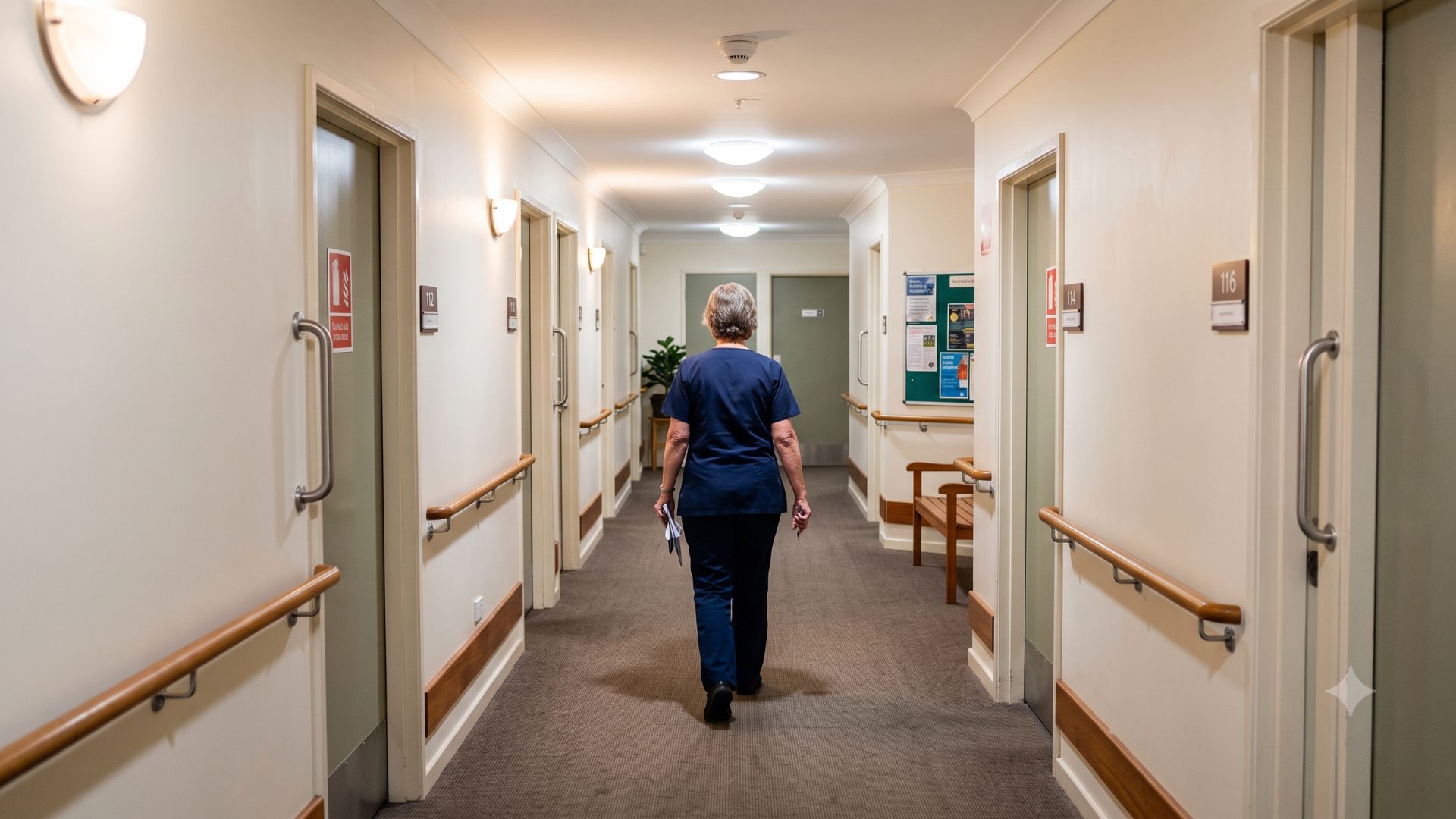
A registered nurse involved in a fatal medication error at a Melbourne aged care home was allowed to continue working without restrictions for months after the death of a 94-year-old resident, despite concerns about serious failures in medication administration.
Rosemary Jacoby died in September 2025 after she was mistakenly given another resident’s medications at Basscare’s Faversham House in Canterbury.
A Victorian coroner has since found that her death was entirely preventable and warned that medication errors remain a broader safety issue across residential aged care.
The nurse at the centre of the case was allowed to continue working as a registered nurse after the incident while an investigation by the Australian Health Practitioner Regulation Agency (AHPRA) continued.
AHPRA did not impose conditions on her registration until March 2026, around six months after Mrs Jacoby’s death.
The nurse was then required to have direct supervision for all medication administration. She chose not to renew her registration in May and can no longer work as a nurse.
The Victorian Coroners Court lists Mrs Jacoby’s death as a finding handed down by Coroner Ingrid Giles on 29 July 2026.
The circumstances surrounding Mrs Jacoby’s death began during an evening medication round on 17 September.
The agency nurse had prepared medications for five residents in separate cups on a medication trolley. The cups were unmarked.
After becoming distracted, the nurse picked up the wrong cup and administered medication intended for another resident to Mrs Jacoby.
The medication included oxycodone and diazepam.
The nurse had also failed to verify Mrs Jacoby’s identity before administering the medication.
The error was identified after a colleague noticed what had happened. However, rather than immediately calling emergency services, the nurse reportedly contacted a friend who was a clinician for advice.
Staff arranged for a locum GP to review Mrs Jacoby and began half-hourly observations.
At 8.56pm, she was found deeply asleep, unresponsive to pain and displaying concerning vital signs.
It was not until 9.12pm that staff called triple-zero, around 75 minutes after the medication error had been reported.
When paramedics arrived, Mrs Jacoby was unconscious and alone in her room. The nurse who had administered the medication had finished her shift and gone home, while paramedics reportedly struggled to obtain clear information from the staff who remained at the facility.
Mrs Jacoby was taken to Box Hill Hospital, where attempts were made to reverse the effects of the medication overdose.
She was placed on palliative care and died three days later.
The timeline and circumstances were detailed in reporting on the coronial findings supplied for this article.
Mrs Jacoby’s daughter, Caroline Jacoby, has questioned why her family was not informed that the nurse remained able to work while the investigation continued.
Ms Jacoby said she repeatedly contacted AHPRA seeking information about the case but was told details could not be provided, including the nurse’s identity, because of privacy requirements.
She said she was eventually told by the media about the conditions placed on the nurse’s registration and her subsequent decision not to renew her registration.
Ms Jacoby described the situation as deeply distressing, particularly given that the coroner had found her mother’s death could have been prevented.
“When someone has been killed, I know there needs to be a process, but I would have thought that needs to be fast tracked,” she said.
“Someone shouldn’t be put in the position where they could do the same thing again.”
She said the medication error was an accident, but one that occurred because of what she described as negligence and incompetence.
The family’s concerns centre not only on the original medication error, but on what happened afterwards and whether sufficient safeguards were put in place quickly enough to protect other patients and residents.
The case highlights a difficult gap between an employer removing a nurse from the workplace and action being taken against a registered health practitioner’s ability to work elsewhere.
The nurse was let go by her employer following Mrs Jacoby’s death.
However, according to AHPRA, conditions were not imposed on her registration until March 2026.
This meant that for at least five months after the fatal incident, she remained able to work as a registered nurse elsewhere, including potentially in aged care, without the medication administration restriction that was eventually imposed.
The March conditions required direct supervision of all medication administration.
The nurse did not renew her registration in May, meaning she can no longer work as a nurse.
AHPRA said its investigation remained ongoing and that it was unable to provide further details while the matter was before the regulator.
The agency also said the case involved coordination with multiple agencies and that it had contacted the Jacoby family to discuss the action taken and address their concerns.
Mrs Jacoby’s death was one of three fatal medication error cases examined by Coroner Ingrid Giles.
The other cases involved Lynette McHarry, 68, and a 78-year-old resident identified as LV.
All three residents were mistakenly given medication intended for someone else, with emergency responses also delayed in two of the cases.
The coroner found the three deaths exposed a wider problem with medication administration in residential aged care.
Since October 2021, medication errors have been linked to at least six deaths of Victorian aged care residents, with another four deaths potentially involving medication mistakes, according to reporting on the coronial findings.
Coroner Giles said medication misadministration in aged care was a broader issue requiring urgent reform.
She also found that Australia did not have national medication standards specifically designed for residential aged care and urged the Federal Government to address the gap.
The Victorian Coroners Court says coronial findings can include recommendations aimed at preventing similar deaths, with the Jacoby, McHarry and LV findings all handed down on 29 July 2026.
Basscare, which operates Faversham House, has accepted responsibility for the care provided to Mrs Jacoby.
Chief executive Craig Bardrick apologised to the family and acknowledged that the organisation should have contacted them sooner and more openly following her death.
The provider subsequently conducted a comprehensive review of its medication management and incident response procedures and introduced changes designed to reduce the risk of another medication error.
The coroner noted that Faversham House had made changes following Mrs Jacoby’s death.
Basscare said it was committed to continuing to improve its systems and preventing a similar incident from happening again.
The case raises questions beyond the actions of one nurse.
Medication administration in residential aged care involves multiple layers of responsibility, from individual clinical practice through to facility procedures, incident escalation, emergency response and professional regulation.
In Mrs Jacoby’s case, the coroner identified failures at several points in that chain.
The medication was prepared incorrectly, resident identification procedures were not followed, the error was not immediately escalated to emergency services and the nurse involved had left the facility by the time paramedics arrived.
For the Jacoby family, the subsequent regulatory process has added another layer to an already devastating loss.
Ms Jacoby said she was speaking publicly because she did not want another family to experience what hers had endured.
Her mother, a former educator who loved gardening, socialising, visiting cafes and chatting, was still in relatively good health despite having experienced health problems throughout her life.
“She was a very lively sort of person,” Ms Jacoby said.
“She’d be up for a chat with anyone.”
The coroner’s findings have now placed the case within a much larger national conversation about medication safety in aged care.
For the sector, the question is no longer simply how an individual medication error occurred. It is whether the systems surrounding aged care residents are strong enough to ensure that one mistake does not become a fatal chain of failures.


