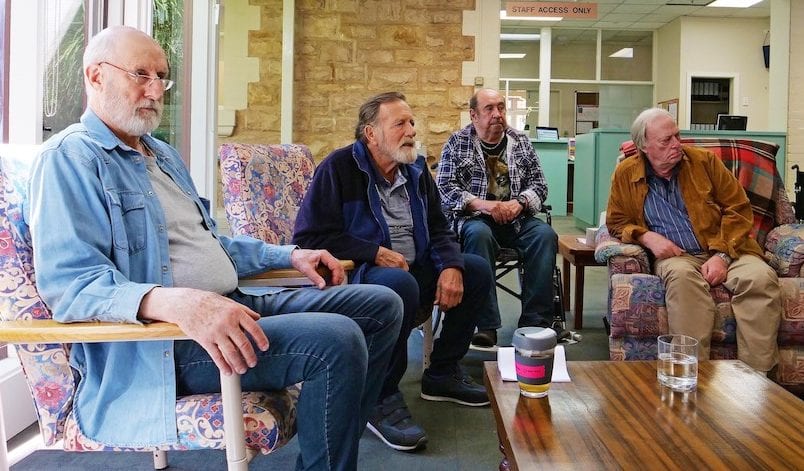
I generally make it a point to see movies featuring older actors and ageing themes, partly out of loyalty to my peers, and partly to see if the films have got it right, or wrong, in some ways. But I almost gave ‘Never Too Late’ a miss, because of the overwhelmingly lacklustre reviews that I’d read of it. And then I changed my mind, just in case – as quite often happens in movies about older people – those reviewers had got it wrong.
As it turned out, while they did get it right, they missed its worst flaw even though it was out there in plain sight. So I guess I didn’t totally waste my time seeing it, as I can reveal the most objectionable aspect of a film that also squanders the talents of its excellent cast: James Cromwell, Jackie Weaver, Jack Thompson, Roy Billing, Dennis Waterman, and Shane Jacobson in the main roles, and several others – such as Max Cullen and Darren Gilshenan – lampooned in more minor parts.
The reviews – which I agreed with completely post hoc – included points such as “its premise is hokey and unbelievable”, the plot “limps along” and meanders to a “predictably schmaltzy finish” while being “a sad waste of talent”.
But none of the critics picked up on the fact that at a time when the Royal Commission into Aged Care has been regaling us for the past two years with horrifying stories of what can happen in some nursing homes, it is utterly irresponsible for a new Australian movie to use as a plot device a totally unrealistic and fictional retirement home for returned veterans as if it was some sort of jail, surrounded by wire fences and locked gates, and guarded by what look like beefy, tattooed bikie club members ready to pounce on would-be escapees and haul them back inside. And with repeated recidivists being clamped onto beds and drugged for indefinite periods.
Not to mention that – as a sample of the film’s comedy – a resident (played by Jack Thompson, as it happens) with Alzheimer’s isn’t helped to put on his pants. Instead, in a scene with a staff member in her office, his bare bottom is revealed as the punch line in a jokey demonstration of the failing memory that he’s denying. Words fail!
In reality, too, if the James Cromwell character had wanted to get together with his old love, now in a nursing home, he could just walk in the front door and visit her, rather than having to fake a stroke in order to be admitted, only to find himself in a ‘One Flew Over the Cuckoo’s Nest’ situation with its own Nurse Ratched. Sure, it would have been a different film, perhaps one where he signs her out for an excursion, and then – instead of going back at the end of that day – they start on one of those loving and humour-laden end-of-life road trips together, meeting up with the other main Chain Breaker comrades at various points along the way (while showcasing some of the wonders of the Australian landscape now that we are going to be landlocked for quite some time), and giving them a helping hand with their various challenges (which would be more realistic and complex than the lazy devices dreamed up for ‘Never Too Late’).
Now there’s a movie that I would like to see. Anyone?
Anne Ring ©2020



Couldnt agree more with you Anne. I must confess I didnt do my homework by reviewing the film before committing to see it. I was hopeful that the cast would carry it in a way that would work. But I came away very disappointed, particularly at the portrayal of the aged care facility and those that work in it. thanks for highlighting those issues.