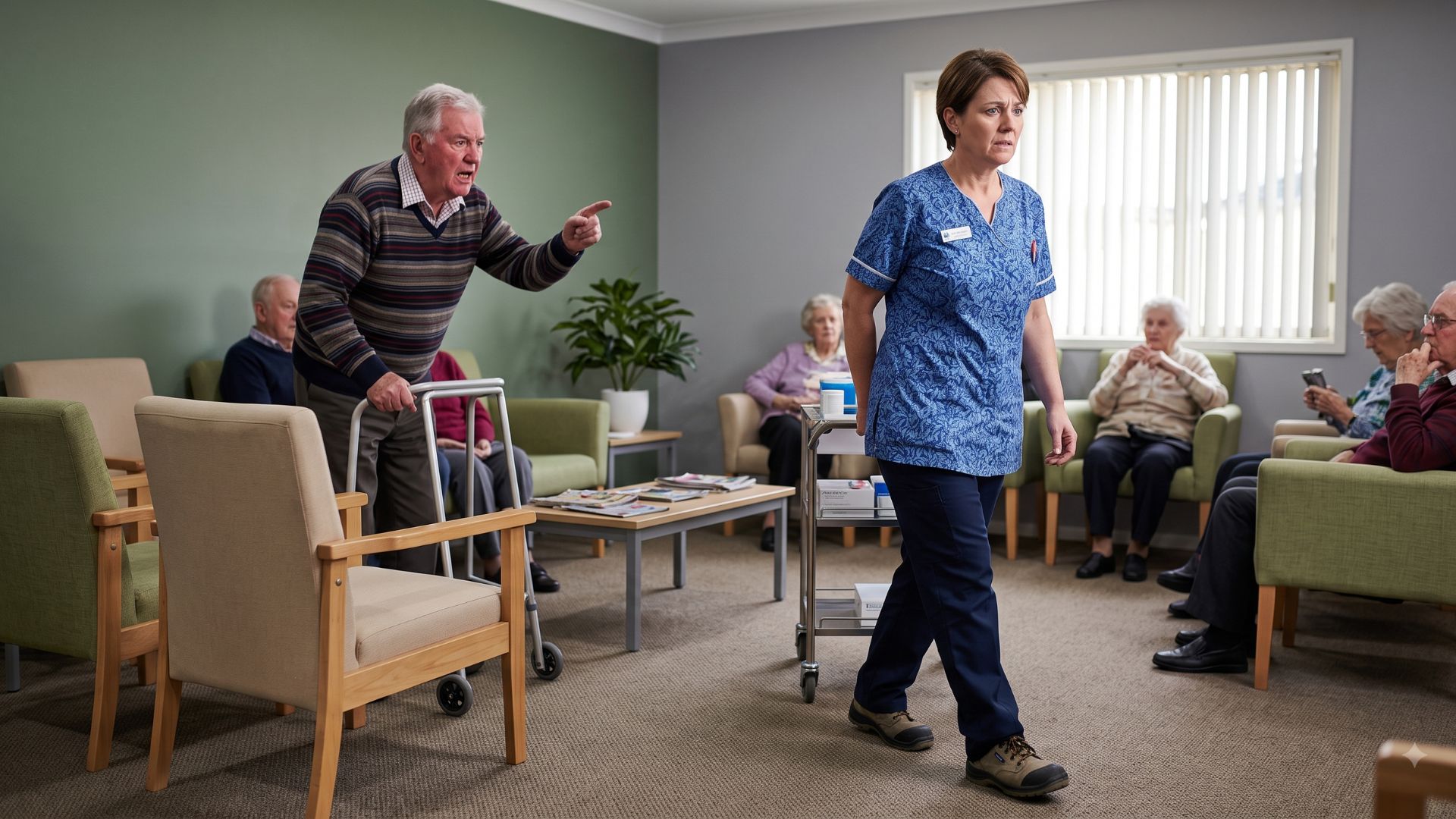
Almost no one in Australian aged care is escaping workplace violence and aggression. According to the Australian Nursing and Midwifery Federation’s new national Pulse Check survey of more than 3,550 frontline workers, 96.43% reported experiencing and/or witnessing violence or aggression at work in the past 12 months.
The raw figures are stark: 76.69% of respondents had experienced verbal abuse, 69.68% physical violence, 49.01% property damage or thrown objects, 36.44% racism, and 35.55% sexual harassment, much of it occurring daily or multiple times a day.
But buried deeper in the data is arguably a more troubling story: when workers do report these incidents, many say management’s response is to question what they did wrong.
Respondents overwhelmingly identified residents as the source of violence: 95-98% of verbal abuse, physical aggression, property damage and sexual harassment was attributed to residents or clients, largely linked to dementia, cognitive decline or unmet care needs. Workers broadly understood this as unintentional.
What frustrated them was the absence of any system to prevent or manage it. Many reported that behaviour support plans were missing, outdated, or simply not followed, and that management treated aggressive incidents as an unavoidable cost of the job rather than something to be actively reduced.
“Management say that’s just what the residents do and there’s nothing you can do about it. You’re made to feel guilty if you refuse care due to threats of violence, refusal of care, or verbal abuse,” one Victorian personal care worker said.
“There are never enough staff to manage all behaviours from residents. They have to be unsupervised to provide appropriate care to all others,” said another, from Queensland.
Perhaps the most striking pattern in the qualitative responses is how often workers described being interrogated, rather than supported, after an incident.
“The ‘what could you have done differently’ is said before giving some understanding,” one Victorian registered nurse said.
Another recounted being injured on the job and having the response turned back on her: “I was injured by a resident and was questioned by manager at the time what did I do to make the resident lash out, then told I should of done it differently,” a NSW personal care worker said.
An educator in NSW summed up the broader sentiment directly: “Violence, aggression, and/or abuse is treated as part of the job, the norm.”
This isn’t just an emotional toll; it’s actively suppressing reporting. Staff told the ANMF they had stopped reporting incidents altogether because they didn’t believe anything would change, or feared being blamed.
“Staff no longer report physical assaults from residents as they see no action being taken or fearing they will be deemed incompetent or unable to manage behaviours,” said one NSW registered nurse. Another respondent was even more direct: “Management do not listen even encourage us not to report it.”
Overall, when asked to rate management support following violent incidents, responses were split: 41.4% rated it “poor” or “very poor,” against 35.5% who rated it “good” or “very good.” Given the survey suggests real under-reporting is occurring, the true picture of dissatisfaction may be worse than these figures capture.
While residents were the most commonly cited perpetrators, the survey also uncovered a less-discussed source of aggression: colleagues and management themselves. Nearly half (48.5%) of respondents who experienced racism attributed it to other aged care staff, almost the same proportion who attributed it to visitors or family members (48.39%). Verbal abuse from other staff was reported by 21.72% of respondents who experienced it.
Some accounts pointed to management conduct directly: “Management are often the abusers,” said one Victorian registered nurse. Another described a workplace where “our team of care manager is yelled/screamed out by General manager in front of other staff members.”
The survey adds statistical weight to something aged care staff have long argued anecdotally: understaffing and workplace violence are directly linked. Among respondents who rated their workplace’s overall staffing as “very poor,” 88.09% reported experiencing verbal abuse, compared with 66.18% of those who rated staffing “very good.” The same pattern held across every category of violence measured, from physical aggression to sexual harassment.
The ANMF argues this isn’t coincidental: inadequate staffing means less capacity to anticipate, de-escalate and safely respond to resident behaviours, and less time for the preventative, relationship-based care that reduces the likelihood of incidents occurring in the first place.
The ANMF’s recommendations go beyond staffing. It’s calling for mandatory, standardised risk assessments and behaviour support planning for every resident; nationally consistent, government-funded training in de-escalation and violence prevention delivered in paid work hours; restrictions ensuring physical and chemical restraint are used only as an absolute last resort; and stronger, more transparent incident reporting systems with real accountability for how providers respond.
Critically, the union is also pushing for a cultural shift at the leadership level: a sector-wide “zero tolerance” approach, backed by the Department of Health, Disability and Ageing, that stops treating violence against aged care workers as an inevitable feature of the job.
As the report’s authors put it, without that shift, “reporting WVA does not lead to improved working conditions”, a perception the data suggests is already deeply entrenched among the workforce delivering the nation’s aged care.



Issues of resident-to-resident abuse and physical interactions are reported under the SIRS. However, resident on staff incidents are not, the government is not interested. And this is not surprising given that the residents Charter of Rights and Responsibilities was amended several iterations ago to remove any responsibility they or their families have towards staff. NSW Police are not interested in, nor do they ever pursue residents for physical acts of aggression towards staff, which in the majority of cases may be reasonable given the relevant diagnoses they may have, but not in all instances. Similarly, incidents of aggression by family members towards staff are not of interest to them either. Referrals of residents for review to geriatricians may result in the prescribing of medication considered “restraints” which then has to be approved and reapproved by their substitute decision maker and treating doctor which creates further issues. Lastly when we report the use of psychotropic medication use quarterly to the ACQSC they question us about why residents are being prescribed these medications. It is little wonder staff feel unsupported and abandoned, because that is the way the “system” is set up to operate.
Another reason Care Staff don’t report is because some Nurses don’t want to have to write up an incident. Too much paperwork so We pretty much have to suck it up. I have been punched, scratched and bruised and still been told not to do an incident report.
If you work in a dementia specific area then eventually, inevitably you will experience some form of aggression. If you are engaged in intimate care routines, bathing, dressing, showering and the like, you will inevitably be the recipient of some form of violence. And yes, it is part of the job. Arguably conflict/aggression is part of being human.
As a retired Home Carer I found verbal abuse daunting as it’s not what you expected from client. Another grabs your hands and didn’t let go when doing personal care. The system needs a wake up call to see how workers are treated by residents and management. I did this job as I enjoyed it but not when management pulled you in for something that was not your doing.