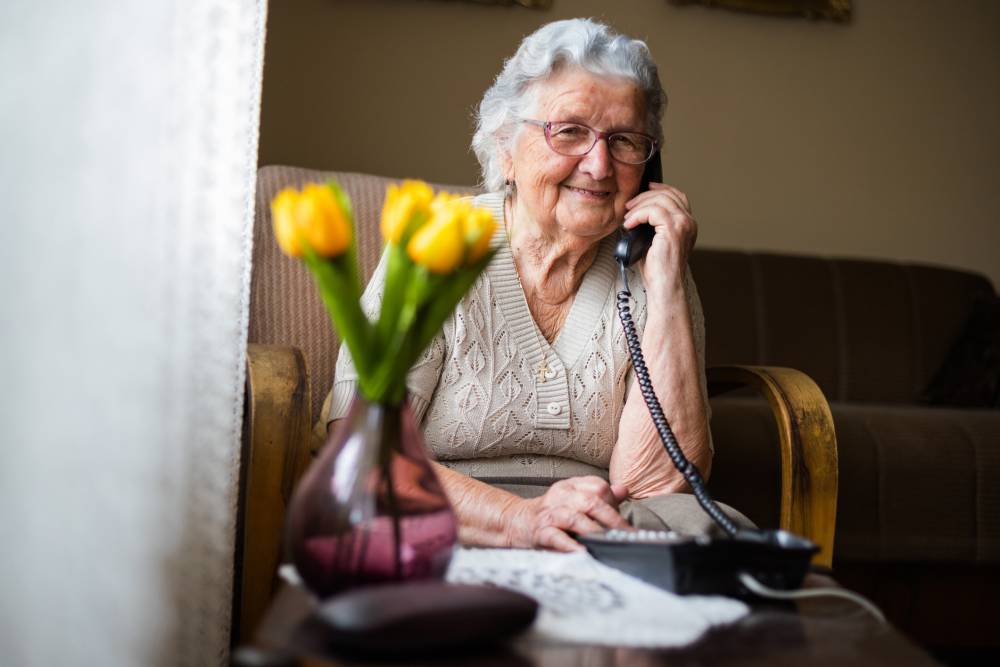
Imagine life without a private phone. Having to make personal phone calls to family and friends, your bank or to report abuse or ill treatment, all in a public space on a public phone.
Imagine having to rely on that public phone during coronavirus lockdowns as the only way to connect with outside family and friends.
That is how it is for many of those living in aged care in Australia.
A recent campaign, initiated by Advocacy Tasmania and supported by Sue Leitch, chief executive of the Council on the Ageing Tasmania has drawn attention to this important issue.
Speaking to The Examiner, Sue Leitch expressed her support.
“It is one of many things that need fixing and is a valid concern, especially during covid where access to friends, family and advocates is so important,” Ms Leitch said.
She suggested that a phone was a necessity and that aged care residents should be able to make calls in the privacy of their own rooms.
This contrasts with the current government policy.
In a recent letter to Advocacy Tasmania, Senator Richard Colbeck re emphasised that a private telephone is not a right for those in aged care.
“Aged care homes are not required to provide a telephone in each individual room” the letter states. However, there was acknowledgement that if a resident is to bring their own phone, a phone socket must be provided. Albeit at the cost to the resident or their families.
Advocacy Tasmania has shared many stories on it’s Facebook page of those impacted by not having access to a private phone in their room.
Grace, in her 90s is deeply depressed and has expressed a desire to seek counselling services, a service not available within her home. A phone counsellor has been provided but with only a communal cordless phone with unreliable reception, and in high demand from other residents. This is not a viable solution. Grace is also sensitive about needing the support and feels she wants to keep her need for counselling sessions private. If she had access to a phone in her room, she could avoid the additional trauma caused by the lack of privacy, retaining her independence and dignity.
Betty is 76 and has recently moved into residential aged care. She has been married for 56 years to her ‘darling husband’ Tom, 82 and says “we’re a team, well…always have been until now, and we’ve lasted this long because we talk about everything.”
Without a phone in her room, Betty needs to ask staff to bring her a phone to call Tom but she stopped asking because she felt it was a huge burden on already busy staff who would tell her they didn’t even have time to do their daily tasks. She and Tom miss each other terribly and are both suffering due to the inability to maintain their communication. Their story is heartbreaking.
Muriel, 81 spent 59 years in the same home, before her daughter moved her to an aged care facility against her wishes. Without access to her own phone she was unable to contact other family members, or advocacy support to assist with her desire to return to her own home. She has now received support from Advocacy Tasmania but mentions that with feelings of despair, she would have liked to access the free COVID-19 support line for senior Australians, but of course, she didn’t have easy access to a telephone.
Minister Colbeck has responded to the call for private phones by saying that the Community Visitor Scheme (CVS) has been provided to coordinate volunteers to visit aged care homes to provide company and support. Ironically, it is a service that is accessed by phone.
The government has invested $800 million in aged care to deal with coronavirus including funding a number of support options for older people who are suffering during this difficult time. Sadly access to those supports requires a phone or internet, something too many Australians in aged care do not have easy access to.
Advocacy Tasmania is encouraging those who would like to support the case for in-room phones to contact Senator Colbeck. For details visit the Advocacy Tasmania Facebook Page.



Maybe you should do your research before making statements saying residents in aged care don’t have access to a private phone. Having worked in aged care for many years I can say that in my experience many residents do have private phones in their rooms or mobile phones and during this lockdown many homes have staff allocated to ensure that residents and their families are communicating by phone on zoom Skype or FaceTime
It doesn’t do anyone any good to make these emotive statements without any understanding of the damage you do to aged care or the reality of the situation.
Thank you for your feedback. We are not suggesting that all aged care residents do not have access to private telephones. However sadly there are still situations where private telephones or mobiles are not available – a problem that I believe you would agree needs to be addressed. It is a situation that has been highlighted by Advocacy Tasmania and you can read more about it on their Facebook page (https://www.facebook.com/AdvocacyTasmania).
We thank you for the good work that you do and applaud your initiatives to facilitate additional communication during this difficult time.