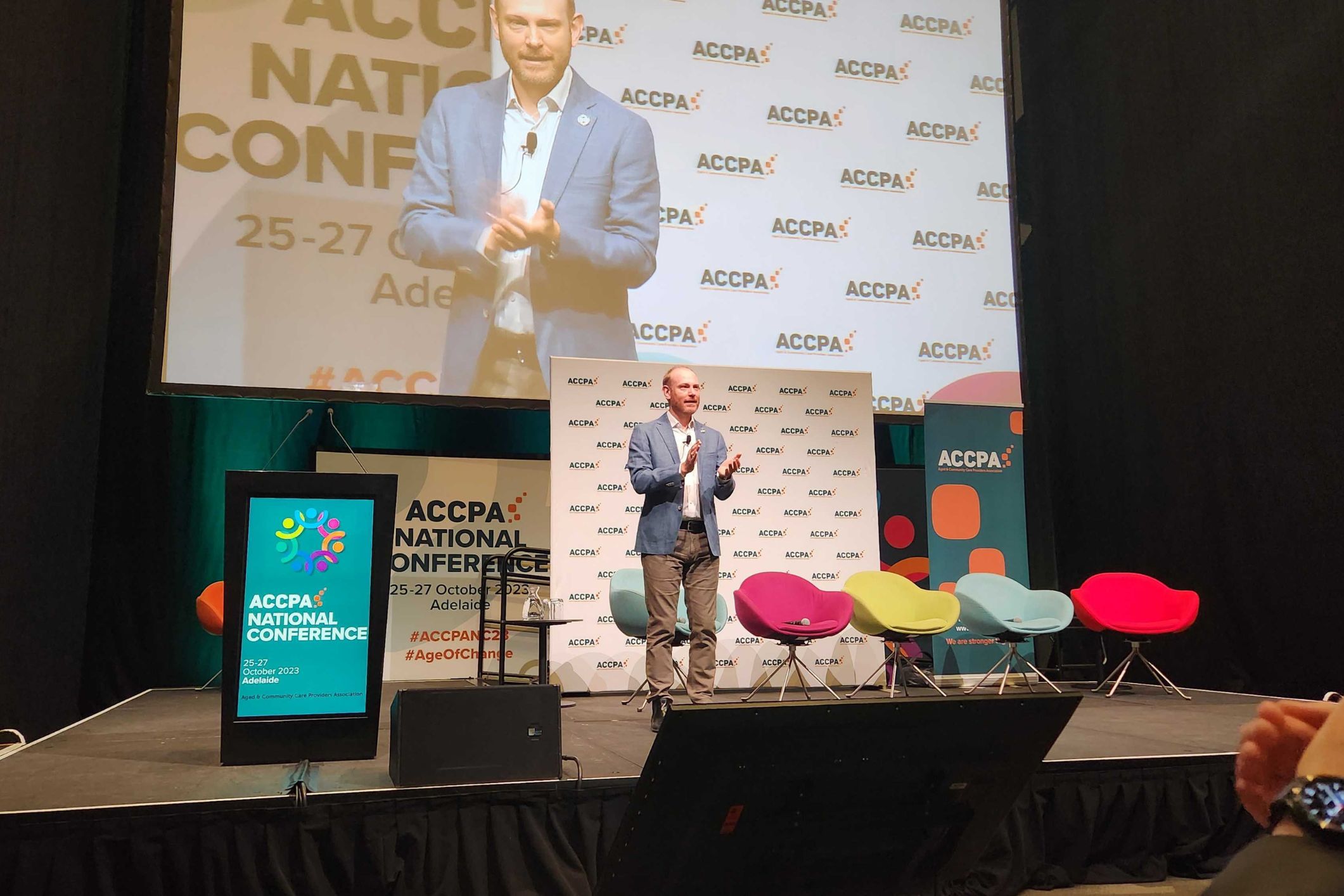
There has been a recurring negative twist to many aged care stories in recent years, and it has been hard to shake due to the challenges of the Royal Commission into Aged Care Quality and Safety and the COVID-19 pandemic.
Now, finally, there is room for the sector to breathe with growing self-confidence, as expressed by ACCPA (Aged & Community Care Providers Association) Chief Executive Officer, Tom Symondson, on day two of the ACCPA National Conference.
Mr Symondson started the day with an optimistic speech that covered some of the highs and lows of his first year in charge of the sector’s peak body. He claimed the past 12 months, since the last ACCPA National Conference, has been one of the best ever for the industry with growing self-confidence on show.
“[12 months ago] I got a sense that when the euphoria settled down [during his first ACCPA Conference], this was a sector lacking something. It was a lack of self confidence. A response to the feeling of being ground down for years and in fact decades. Your profession being criticised… You’d been worn down by the pandemic,” he explained.
“Fast forward 12 months and I feel something quite different. A sense of self confidence and pride in being part of this sector, this great endeavour of ours to ensure people in Australia have their best lives, that’s something we can talk about again.”
As Mr Symondson also touched on a newfound ability for aged care leaders to look at their services objectively and without bias. He also highlighted the need for innovation, resilience and self-confidence in the sector.
The care economy was also explored as industry leaders gathered for a panel session, including Council on the Ageing (COTA) CEO Pat Sparrow and Centacare CEO Peter Selwood.
One of the biggest issues covered was the juggling act between compliance and care workers remaining engaged with their work. Mr Selwood shared his experiences with home care staff that have struggled to pair passion with unequal pay and paperwork.
“What drives us is caring. Support workers, aged care workers, they don’t love being compliant, they love being carers. We have to find ways to be compliant but it’s not going to appeal as the job’s focus to a volunteer or aged care worker who is truly passionate about care,” Mr Selwood said.
“We talk about passion. When you talk about different pay rates, that’s where we get passion from our workers.”
Ms Sparrow also tackled a growing concern in society, ageism. She said it’s essential for us all, whether working within aged care or not, to look at our assumptions around ageing and what it means to be an older person.
“There’s benevolent ageism where we think we’re doing the right thing. We assume about an older person that we need to do certain things for them without consulting or working with them and it’s important we don’t make assumptions,” Ms Sparrow said.
Other highlights included an insightful session on the potential for robots to reduce workloads and stress levels in staff. Lee Martin, CEO of Tanunda Lutheran Home, spoke passionately about how robots in his independent home reduced staff injuries and the extra 10 hours staff get to spend with residents every day.
“Before the robots arrived we had lots of discussions with staff about what robots can and can’t do. When they arrived we had a ceremony… and then we had a competition to name the robots. We have Axil, Speckle and Robbie,” Mr Martin said.
“They are so well known around the facility, that staff and residents talk to the robots. They know the characters of the robots. Axil’s a bit naughty, he doesn’t always turn up where he needs to be. Robbie is always reliable.”
“We believe staff are enjoying coming to work more because the robots are around. We’re technically advancing and moving forward all the time,” he added.
Elsewhere, the conversation turned to workforce and attraction and retention strategies. While international recruiting was one solution explored by the panel, the importance of connecting with local communities and providing clear opportunities for career progression was undoubtedly a popular move.
“When we start to look at the people working in aged care we don’t have a lot of clarity on career progression. We are really trying to clarify for professional carers that you can have a rewarding career and we will develop you along the journey,” explained Katherine Graham, Marketing & Compliance Manager, Warner Institute.
In an action-packed day, clarity around career progression was just one of thousands of ideas shared. Like all of them, it was important to hear as more providers, big and small, work on strengthening aged care.


