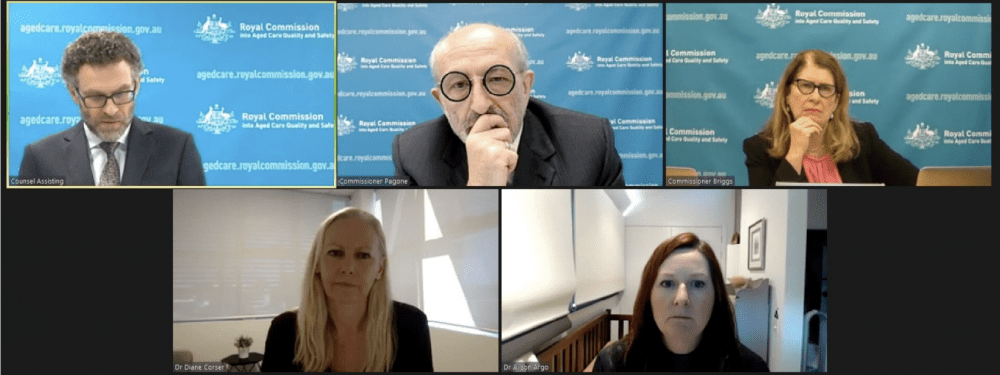
We are following the Royal Commission closely and will be providing regular updates to keep you informed.
The Royal Commission into Aged Care Quality and Safety resumed hearings on Wednesday after breaking due to the pandemic.
The hearings this week are about the availability of mental, oral and dental, and allied health services in aged care facilities.
The focus on Wednesday was on the availability of psychological support, and about proposed future models that could improve services. The commission heard about the difficulties aged care residents have receiving the appropriate support for psychological illnesses.
These services are sometimes referred to as the “missing middle”, the royal commission heard: “too complex for a general practitioner to manage but they do not meet the criteria for access to an Older Persons Mental Health service”, counsel assisting the royal commission, Richard Knowles SC, said in his opening remarks.
A leading geriatric psychiatrist has told the Royal Commission into Aged Care Quality and Safety that the best way to prevent mental illness among older people is to increase the aged pension.
Associate Professor Stephen Macfarlane, head of clinical services at Dementia Support Australia, said, “The single best thing that we could do to improve mental health in older populations, in both a preventative sense and a treatment sense, (is) simply to increase the aged pension.”
“Older people are subject to greater degrees of economic hardship, social isolation, loneliness, access to transport and public transport, all of which could be addressed by an improvement to the aged care pension.”
“Once you address the risk factors for ill health, in terms of mental health in old age, the burden of disease drops itself,” he said.
The royal commission also heard from the daughter of an aged care resident. She appeared under the pseudonym UX and was not visible to viewers.
She told the royal commission that staff have not responded to the family’s concerns about her mother’s “low moods”. Staff don’t follow the doctor’s advice and they don’t communicate with each other, she said. She also noted that staff change every six months, meaning there is little in the way of continuity of care for her mother.
“I wish that those who care for her would understand and appreciate that mum is driven by purpose and provide social activities that reflect that, not just entertainment and activities to occupy time,” she said.
She also said she wished there was more openness about mental illness so those who need support can get the services they need.
Clinical geropsychologist Dr Alison Argo told the royal commission she was “shocked” to discover there is no requirement of a mental health assessment when a person moves into an aged care facility.
She said a resident’s mental health should be assessed as a part of their standard care.
“It’s such an important element of people’s quality of life and how they adjust and how they manage in their later years, that it should be just standard care,” she said.
She said residents only receive support at the “pointy end” of presentations. “We have a saying, unless they’re actively suicidal, or actively psychotic, you’ve got no chance of getting your referral through,” she said.
Clinical geropsychologist Dr Diane Corser said there is little awareness of mental health issues in aged care.
“There’s a bit of hopelessness and helplessness that we can actually improve people’s mental health once they enter the aged care facility,” she said.
“They haven’t had that experience where they’ve seen improvement with mental health because of the engagement with psychologists.”
Associate Professor Macfarlane said funding for aged psychiatric services should be “ring-fenced” for that purpose.
He said providers must be “proactive” in finding out the psychiatric support services available to them in their local communities, and the various parts of the health system need better IT systems to improve communication between the various parts.
Associate Professor Macfarlane said “20 per cent of cases of dementia can be prevented with appropriate early lifestyle interventions.”
We will continue to provide updates as the Royal Commission continues.
Image: Royal Commission.





