
Every day I am asked about the alternatives to replace missing teeth and whilst dentures are a relatively cost effective and easy option, they can present their own issues such as speech difficulties, gum or mouth irritation, inability to eat certain foods and poor stability/retention. I hope that this article can shed some light on the other alternatives for missing teeth.
Options differ depending on how many teeth are missing. If there are one or two teeth in a row missing then bridgework or dental implants may be suitable. However, if three or more teeth in a row are missing then aside from dentures, the only option involves dental implants.
Bridgework is useful for replacing one or two consecutive missing teeth and for many decades this was the ‘go to’ treatment. The advantage of bridgework is that it is relatively straightforward and only requires two appointments, it is moderately priced and is fixed (hence it is not removable). The disadvantage of bridgework is that it requires the adjacent teeth to be prepared by removal of 1.5-2.5mm of enamel all around the tooth so that a porcelain bridge can be glued over the top- modern dentistry emphasizes a conservative approach hence this can be seen as relatively aggressive especially if the adjacent teeth have small/no fillings. Generally these bridges last around 10 years. If these adjacent teeth develop nerve issues or decay down the track then it may compromise the entire bridge. Regardless, for many patients bridgework still remains a viable option and they are routinely placed.
Dental implants have been used for around 50 years now and in the right candidate they have excellent long term results. They involve the placement of a small titanium screw (the same length as a tooth) into the bone in a very atraumatic procedure which often takes less than most other procedures, and a porcelain crown is placed on top. Your dentist will take a detailed medical history and a 3D xray to assess the amount and quality of bone available, to determine whether dental implants are a suitable option for you. The cost of a single implant is often only a fraction more than bridgework and it saves any preparation of the adjacent teeth. Dental implants can be used to replace a single missing tooth, a row of missing teeth or an entire jaw of missing teeth. When implants are used to replace three or more missing teeth we call it an ‘implant bridge’.
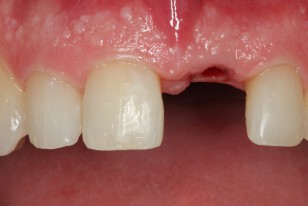
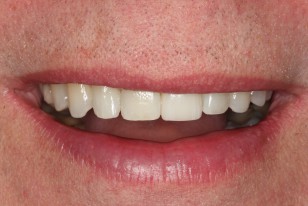
Photo Above: Single Implant Bridge Before and After
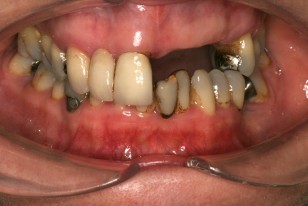
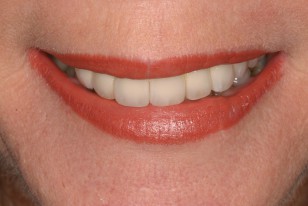
Photo Above: Implant Bridge Before and After
Today’s modern technological advances allow me to restore an entire jaw of missing teeth with an implant bridge, and the patient walks in on the day of the surgery with broken or missing teeth and walks out later that afternoon with ‘teeth in a day’. This procedure is commonly carried out whilst the patient is ‘asleep’ (IV sedation) delivered by our resident anaesthesiologist, within our surgery. This revolution in dentistry allows me to give patients back their smile which is fixed down to the bone and gums below and unlike dentures it is not taken out at night nor does it move around whilst speaking or eating.
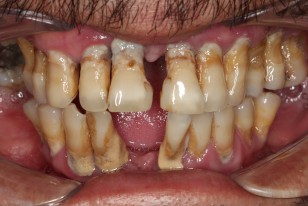

Photo Above: Teeth in a Day – Before and After


