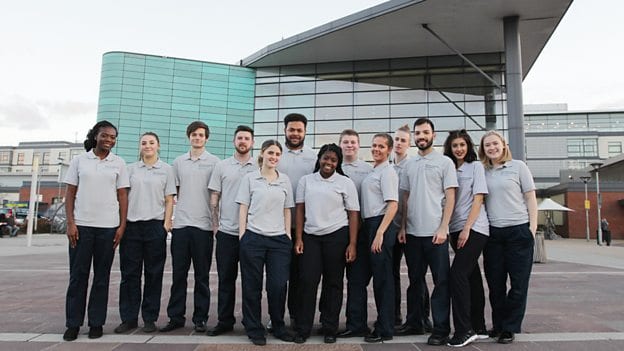
A new documentary television series follows a group of young volunteers with no healthcare experience to see how well they can fill the gaps in an overstretched health system.
This series was inspired by a social care programme in Germany, and sets out to find if the volunteers can make a difference to both patients and staff.
The volunteers help staff and care for patients at Royal Derby Hospital, following nurses through the maternity ward, accidents and emergency, paediatrics, and elderly care.
Before they can work with the patients, the volunteers will be trained by Clinical Educator, Andy, who is cautious about the success of the experiment.
“It’s a big job, I’m very nervous. They could kill somebody,” he observes.
Senior nurses and sisters help the volunteers navigate their way as they face what must be among the most challenging weeks of their lives.
A BBC Two video about the series follows Eric, who is hard of hearing and having trouble eating, and volunteer Deborah, who is trying to help him.
At first, Deborah finds it hard to connect with Eric.
We hear the first time the two met was when Eric’s stoma burst, an experience Deborah found traumatic.
Eventually, another volunteer, Poppy, joins Deborah. They use a whiteboard to ask Eric some questions. Deborah writes, ‘What music do you like?’ Eric replies, “Anything that sounds nice.” He is smiling and laughing, and so are the volunteers.
The volunteers ask Eric about his son, and he tells them he had another son, David, who died when he was 30. “He was marvellous. He’d do anything for you,” he recalled through tears.
The emotion-charged moment brings the volunteers and Eric closer together.
A few days later Eric is feeding himself, the first time he has done so for weeks.
“You’re lovely,” Eric tells the volunteer, his frail hand clutching hers.
Let’s hope this moving series will make it to Australian screens soon.
Image: BBC.


