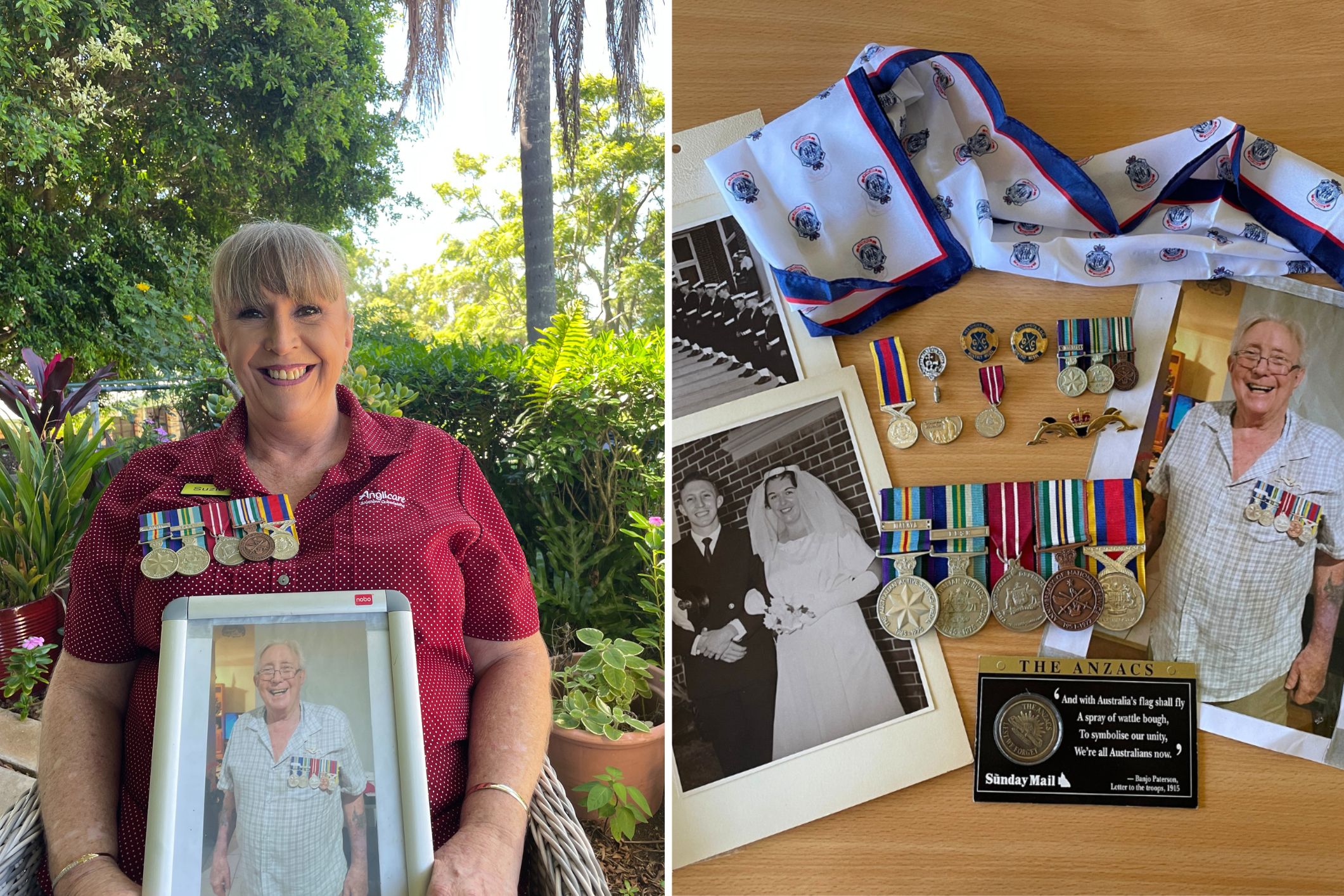
Anzac Day holds profound significance for many Australians, serving as a poignant reminder of the sacrifices made by those who fought bravely to defend the nation’s freedom.
For Susan Macdonald, a dedicated aged care professional at Anglicare Southern Queensland’s E.M. Tooth Memorial Home, Anzac Day is deeply personal, intertwined with her family’s legacy of service and her unwavering commitment to honouring veterans in her care.
Susan’s father, a Chief Petty Officer in the Australian navy, epitomised the spirit of service, spending countless hours in the engine room of the submarine HMS Ottaway during the Korean War.
Reflecting on her father’s service, Susan fondly recalls their shared tradition of attending the dawn service on Anzac Day. Despite his declining health in his later years, her father’s spirit remained resilient, and together they paid homage to fallen comrades, with Susan pushing him in a wheelchair during the solemn march.
“Anzac day is significant to myself and my family because it’s a day we honour the men and women that fought and died to keep our beautiful country a free nation,” Susan reflects, echoing her deep reverence for the day.
“My dad was a Chief Petty Officer (CPO) and spent most of his time in the engine room of the submarine,” Susan recounts. “Dad always wanted to be in submarines. Dad came from a long proud navy family. His dad, his grandfather, all his uncles and eventually his youngest brother were all navy men.”
Today, Susan continues this tradition with her mother, finding solace and pride in honouring her father’s memory and the sacrifices of all veterans. “When my beautiful dad was alive… we would attend the dawn service,” she recalls. “Nowadays my partner and myself take my mum to a service.”
As a leisure and lifestyle assistant at E.M. Tooth Memorial Home, Susan channels her passion for aged care into meaningful interactions with residents, many of whom are veterans themselves.
“It’s always amazing as Anzac day approaches we get to hear more and more stories about those we care for and times they served in the forces,” Susan shares. “It’s a very emotional time.”
With Anzac Day drawing near, Susan finds herself immersed in stories of courage and camaraderie shared by residents who proudly recount their days in the service. “They are so proud of their journey in the forces,” she notes.
While Susan’s father’s footsteps in the navy were not ones she chose to follow, her admiration for his service is unwavering. “Definitely not,” Susan chuckles when asked if she ever wanted to join the Navy. “I couldn’t imagine being stuck on a submarine, underwater for 6 weeks!”
To all the Anzacs, Susan extends her heartfelt gratitude, acknowledging the immeasurable sacrifices they have made for future generations.
“My message to the Anzacs… Thank you for your services,” she says. “I am incredibly proud that I can now give back to veterans, and contribute to their lives in a positive and meaningful way ensuring they get the respect they deserve.”


