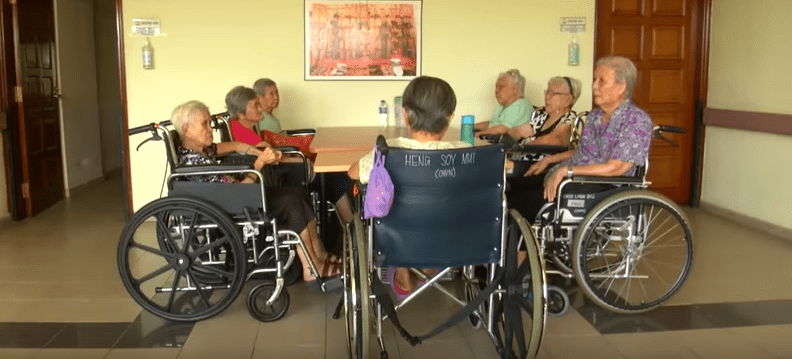
“Turn Back the Clock” is a powerful series of social experiments that were aired on tv in Singapore and Hong Kong every week to bring attention to the little things people can do to improve the well being of the elderly.
How much choice do we as a society give the elderly as they become more frail? Despite best intentions by doing everything for the elderly we are also taking away to extent their choices.
Watch what happens when these seniors are given back the power to make their own decisions.
A social experiment has shown that by giving older people one simple thing, you can improve their emotional and mental wellbeing greatly.
What is that one thing? “Choice”.
In the Singaporean nursing home, a group of elderly women as sitting around a table. They sit in their wheelchairs, looking bored. One is even dozing off.
A group of carers decide to test their cognitive abilities – simple questions like, What is the time? Who is the Prime Minister? And drawing a shape and counting backwards from 20 to 1.
The elderly residents struggle. Some women get the answers wrong, while others refuse to answer, thinking that they do not know the correct response.
Then the group of women are given the fun task of redecorating the communal area. They don’t have to do any heavy lifting or strenuous work themselves, all they have to do is choose what is done.
They direct a team of volunteers with choices of wall colour and flowers to plant around the facility.
They choose red, yellow and purple flowers to be placed in garden beds.
There is a selection of photographs that they can choose to hang on the walls. And they choose a bright orange/red to replace the drab white walls.
Afterwards, they are given a tour of their “new” communal space. They show off their choices – “my beautiful flowers” exclaims one resident – and the women say that the new look makes them “happy”.
Two weeks later, and the residents are tending to the flowers. One waters them with a hose from her wheelchair while another, with some assistance, uses a watering can.
Their mental well-being is tested again. The group of women are asked to complete the same questions and tasks as two weeks earlier.
And in remarkable results, it turns out their test scores have improved. Being empowered had motivated these residents to do better.
What do you have to say? Comment, share and like below.



Some nursing homes used to have trivia days,bingo. People need to be able to make choices. What about meals they should also have an input into everything that’s pertaining to them.
I need to show this to my GM. And this would be wonderfully to set in motion at our care home..
It was mentioned in our leadership meeting,areas need to be made more homely and asked for suggestions…
This is a great initiative…